

AI-directed camera switching scales hybrid event production with skeleton crews
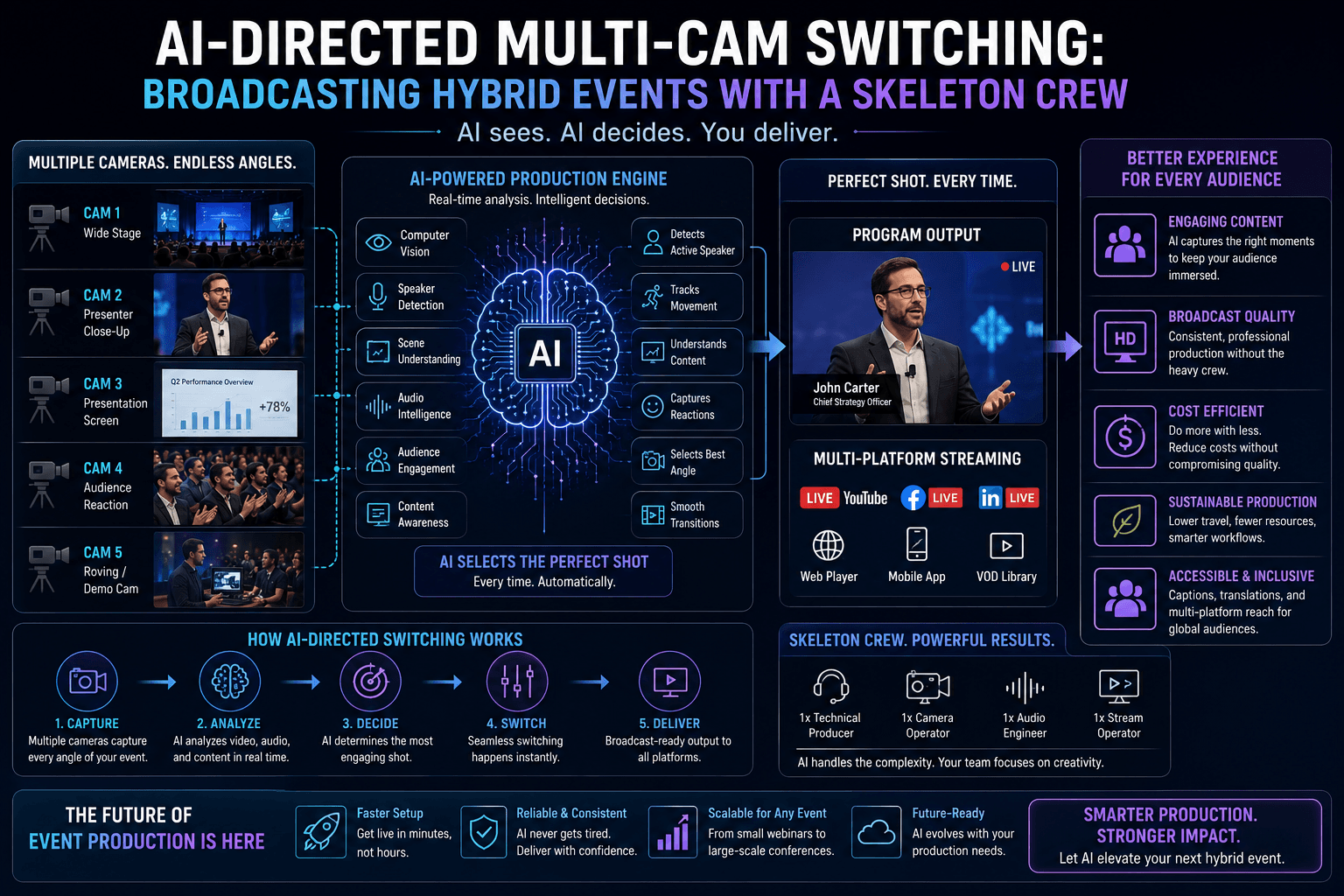
AI-directed multi-camera switching technology is increasingly utilized to automate live production tasks like shot selection and PTZ camera control. This trend allows organizations to produce professional-quality hybrid events with smaller onsite crews by leveraging computer vision and machine learning.
Key Takeaways
- AI-driven computer vision identifies active speakers, facial orientation, and audience engagement to rank and select camera feeds dynamically.
- Automated systems coordinate robotic Pan-Tilt-Zoom (PTZ) cameras to track presenters without dedicated manual operators.
- Integrated audio intelligence uses microphone arrays to improve shot selection accuracy by detecting changes in speaker identity.
- AI production workflows facilitate real-time captioning, multilingual subtitles, and automated metadata tagging for post-event digital asset management.
Why It Matters
This technology directly addresses the mounting pressure on event organizers to maintain high-quality streaming standards while managing labor shortages and rising operational costs. By automating routine directing tasks, AI allows technical directors to focus on creative storytelling rather than technical execution. In a fragmented market where audiences expect parity between in-person and virtual experiences, this shift enables mid-sized organizations to compete with traditional broadcast budgets. Moving forward, the industry should monitor the integration of these AI engines directly into cloud-based production switchers, which will further centralize control and reduce the physical footprint required at venues.
Additional Context
The adoption of AI-directed switching follows a broader hardware-to-software shift in the live production market. Per Blackmagic Design in April 2025, the release of DaVinci Resolve 20 introduced 'AI Multicam SmartSwitch,' a feature that automates timeline assembly by analyzing audio and lip movement across multiple camera angles. This reflects a growing trend of embedding production intelligence directly into editing and switching suites to shorten the loop between capture and distribution.
Simultaneously, major camera manufacturers are integrating these capabilities into the hardware itself. Per Panasonic Connect in October 2024, the company launched an 'Advanced Auto Framing' plug-in for its Media Production Suite, enabling its AW-UE160 PTZ cameras to utilize human body detection for consistent subject framing. Sony followed suit at IBC 2025 by debuting the PXW-Z300 camcorder, which utilizes a dedicated AI unit for real-time skeletal recognition and skeletal movement tracking to ensure presenters remain centered without manual intervention.
Beyond visual tracking, connectivity providers are using AI to ensure these high-bandwidth feeds remain stable. Per LiveU in March 2026, the first large-scale deployment of 'LiveU IQ' (LIQ) occurred during the Winter Games, using AI-driven predictive congestion management to achieve 36% higher average bitrates for 4K and HDR streams. These parallel developments in camera intelligence, automated switching, and intelligent networking indicate that the future of streaming production is moving toward a fully autonomous ecosystem capable of professional delivery under constrained local resources.
Read full article at eventtechnology.org
Enjoy our coverage?
Add StreamingMeme as a preferred source on Google to see more of our streaming news at the top of your Search results.
Add as preferred source