

Advantech launches industrial edge platforms with 100 TOPS AI performance
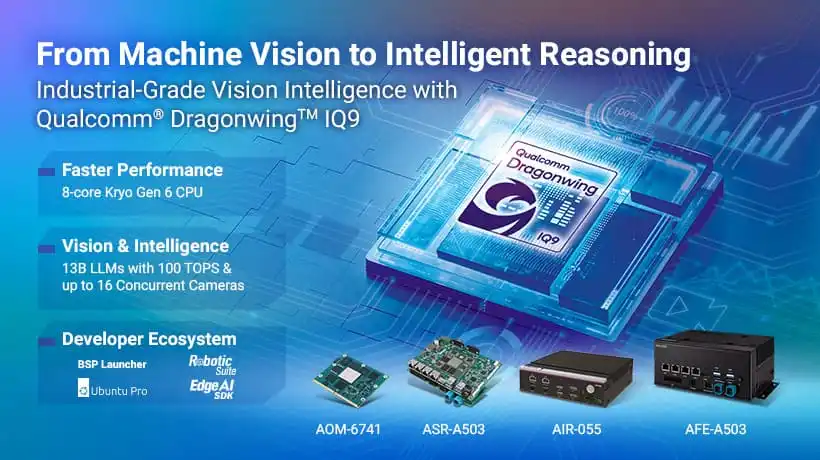
Advantech has launched new industrial edge computing platforms powered by the Qualcomm Dragonwing IQ-9075 processor, aimed at real-time computer vision and high-bandwidth video processing. These systems support up to 100 TOPS of AI performance and can manage concurrent data streams from 16 cameras for applications like intelligent surveillance and automation.
Key Takeaways
- New hardware lineup features the AOM-6741 SMARC module, AIR-055 edge AI system, and ASR-A503/AFE-A503 robotic controllers.
- The Qualcomm Dragonwing IQ-9075 processor delivers 100 TOPS of dense AI performance, or 200 TOPS for sparse workloads.
- Integrated Image Signal Processor (ISP) and Vision Processing Unit (VPU) support high-speed MIPI-CSI, USB 3.0, and Gigabit Ethernet interfaces.
- Heterogeneous architecture combines an eight-core Kryo Gen6 CPU with a real-time microcontroller for deterministic, safety-critical tasks.
- Software ecosystem includes the Advantech Edge AI SDK, Robotics Suite with ROS2 support, and a centralized BSP Launcher for updates.
Why It Matters
This launch signals a shift from passive machine vision toward autonomous, real-time reasoning at the edge. By consolidating multi-camera ingestion and 100 TOPS AI inference into a single industrial-grade unit, Advantech reduces the need for external hardware accelerators in complex video processing stacks. For the broader ecosystem, this increases competition with NVIDIA's Jetson line by offering a high-performance alternative for low-latency surveillance and robotics. As industrial video moves toward local processing to avoid cloud latency and costs, hardware that tightly couples AI acceleration with real-time control will become the baseline for smart factory infrastructure. Watch for adoption rates in autonomous mobile robots (AMRs) as a key indicator of Qualcomm's industrial market share.
Additional Context
The release of Advantech’s Dragonwing-based systems comes as Qualcomm aggressively expands its 'Physical AI' strategy. At CES 2026, Qualcomm unveiled the flagship Dragonwing IQ10 Series, explicitly targeting humanoid robotics and advanced autonomous mobile robots (AMRs), per HotHardware, January 2026. This broader roadmap follows Qualcomm’s strategic $1.4 billion acquisition of chip design startup Nuvia in 2021, which provided the custom Arm-based Oryon CPU cores now scaling across their industrial and PC lineups, per CRN, November 2025.
Advantech is simultaneously maintaining a multi-vendor strategy. In March 2026, the company showcased next-generation platforms at NVIDIA GTC powered by NVIDIA Jetson Thor and IGX Thor, capable of up to 2,070 TFLOPS of FP4 performance for vision-language-action (VLA) models, according to The Robot Report. This highlights a stratified market where manufacturers like Advantech offer Qualcomm-based platforms for high-efficiency multi-camera IoT (100-200 TOPS) while reserving NVIDIA-based systems for high-end generative and humanoid robotics tasks.
Sector-wide competition in 2026 has intensified around these integrated edge-to-cloud frameworks. While NVIDIA leads in raw benchmark performance and the CUDA-X software ecosystem, per TechStoriess, June 2026, Qualcomm is positioning its Dragonwing series as a more power-efficient, connectivity-native alternative for industrial environments. This competitive pressure is forcing suppliers to assemble complete software-hardware stacks—such as Advantech’s inclusion of the Edge AI SDK and ROS2 tools—to lower the barrier for traditional manufacturers transitioning to AI-enabled automated production.
Read full article at embedded.com
Enjoy our coverage?
Add StreamingMeme as a preferred source on Google to see more of our streaming news at the top of your Search results.
Add as preferred source