
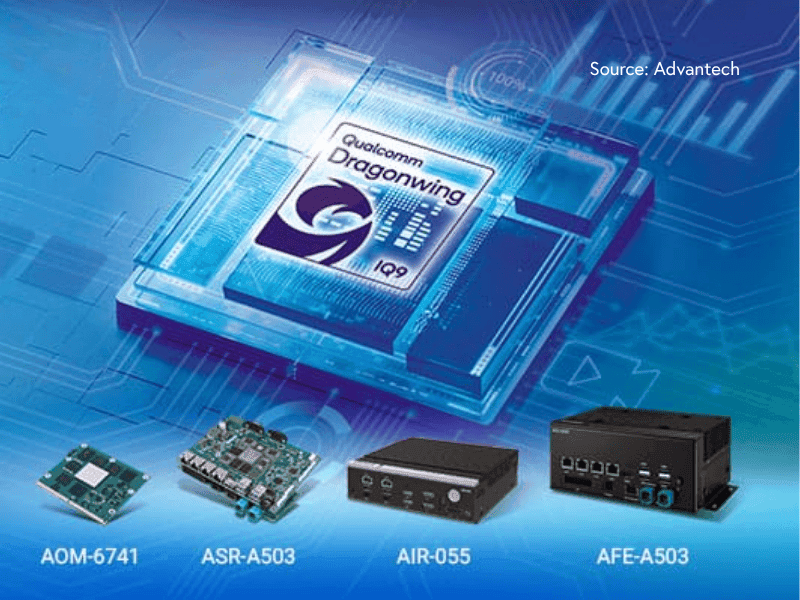
Advantech has launched a line of industrial edge AI platforms powered by the Qualcomm Dragonwing IQ9 processor. The hardware is designed for multi-camera vision reasoning and industrial automation, supporting up to 16 concurrent video streams and offering between 100 and 200 TOPS of AI performance.
The release signals a shift from simple machine vision to real-time vision reasoning at the edge, allowing industrial systems to interpret visual data locally rather than relying on cloud-based processing. By integrating high-density AI performance into ruggedized modules, Advantech and Qualcomm are addressing the increasing demand for ultra-low latency in high-stakes environments like autonomous manufacturing and critical surveillance. This movement creates a more fragmented but responsive streaming infrastructure, moving compute-heavy video analytics away from centralized servers. Watch for the emergence of autonomous vision-as-a-service models as these vision-reasoning platforms reach commercial scale in smart factory deployments.
The launch coincides with a broader expansion of Qualcomm’s industrial presence. Per Qualcomm reports from March 2026, the company recently introduced its flagship Dragonwing IQ10 series, marking its formal entry into advanced robotics and vision-language model (VLM) workloads. This trajectory follows the initial 2024 launch of the IQ series, which aimed to bring high-compute, power-efficient AI to environments with thermal junction requirements between -40°C and 115°C. Advantech has maintained a strategic collaboration with Qualcomm to translate this silicon into ready-for-market industrial PCs and modules, specifically targeting the smart manufacturing and healthcare verticals.
Software support has also matured to meet these hardware capabilities. Per Canonical (December 2025), certified Ubuntu 24.04 LTS images are now available for the Dragonwing IQ-9075 platform, offering 10 to 15 years of long-term security maintenance. This alignment between chipmakers, ODMs like Advantech, and operating system providers is critical for industrial adopters who require lifecycle stability. Advantech itself showcased a 'Physical AI' strategy at Computex 2026 in June, introducing its WEDA (WISE-Edge Developer Architecture) framework to simplify the deployment of digital twins and AI agents alongside this hardware.
Industry analysts at Fortune Business Insights (July 2026) project the global edge AI market will grow from $46.96 billion in 2026 to over $445 billion by 2034. This growth is driven by a massive increase in IoT endpoints—forecasted to exceed 30 billion by 2027—which require local processing to bypass current cloud cost and latency barriers. Advantech’s new lineup competes directly with NVIDIA's Jetson and Intel's Xeon D ecosystem, focusing on high-throughput video pipelines that are essential for the next generation of autonomous mobility and automated quality control.
Add StreamingMeme as a preferred source on Google to see more of our streaming news at the top of your Search results.
Add as preferred source