
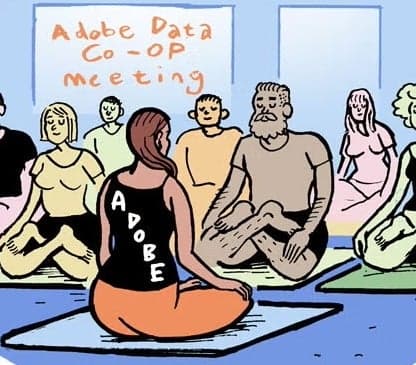
Adobe Advertising has launched a new Custom Algorithms product that allows advertisers to use their own first-party data from Adobe Analytics to train ad-bidding models within the company's DSP. The tool aims to provide a transparent alternative to the proprietary, closed-loop algorithmic models offered by major walled gardens like Google and Meta.
The launch marks Adobe's most aggressive move to unify its marketing cloud and advertising stack since acquiring TubeMogul in 2016. By weaponizing its dominant position in web analytics, Adobe provides a significant counterpoint to the automated 'easy buttons' from walled gardens like Google and Meta, which often lack transparency. For streaming and digital media buyers, this offers a path to optimize for long-term customer value rather than just immediate clicks. Success here will depend on whether Adobe can convince margins-strapped brands that its custom models deliver a higher return on ad spend than the lower-cost, data-poor automation of its larger rivals. Watch for quarterly reports on Adobe’s Digital Media segment to see if DSP adoption accelerates among existing Analytics clients.
The broader ad tech market is undergoing a structural shift toward automation, with Google and Meta leading the trend through Performance Max (PMax) and Advantage+ Shopping Campaigns. Per reports from July 2026, Google’s PMax now accounts for roughly 45% of all Google Ads conversions, illustrating the massive scale Adobe is competing against. While these walled-garden tools offer high efficiency, they have faced criticism for acting as 'black boxes' that prevent advertisers from seeing how their data is used or where their ads actually run. Adobe’s pivot emphasizes 'agentic' AI workflows that prioritize transparency and first-party data ownership to differentiate itself from these incumbents.
Financial analysts remain focused on Adobe's ability to monetize its AI investments across its enterprise suite. In its Q2 2026 earnings report from June 2026, Adobe reported revenue of $6.62 billion, a 12.7% year-over-year increase, beating consensus estimates. However, the company faces pressure to prove that its high-end advertising and creative tools can defend their market share against cheaper, AI-native competitors. Per Reuters in July 2026, while Adobe maintains an impressive 89% gross profit margin, researchers note that its operating margins are facing slight compression due to aggressive spending on generative AI infrastructure.
Simultaneously, the industry is navigating a transition toward identity-independent targeting. Adobe has expanded its 'publisher assist' capabilities to enhance performance across Microsoft and Meta environments using the same first-party conversion data found in its analytics suite. Recent updates from June 2026 show Adobe integrating its DSP more closely with Adobe Customer Journey Analytics, allowing advertisers to track the full organic path of a user—not just the touchpoints attributed to a single ad buy. This push for ‘bi-directional’ data sharing suggests the industry is moving away from siloed ad execution in favor of unified customer experience platforms.
Add StreamingMeme as a preferred source on Google to see more of our streaming news at the top of your Search results.
Add as preferred source