

6G market eyes $31.5B valuation as global standardization efforts accelerate
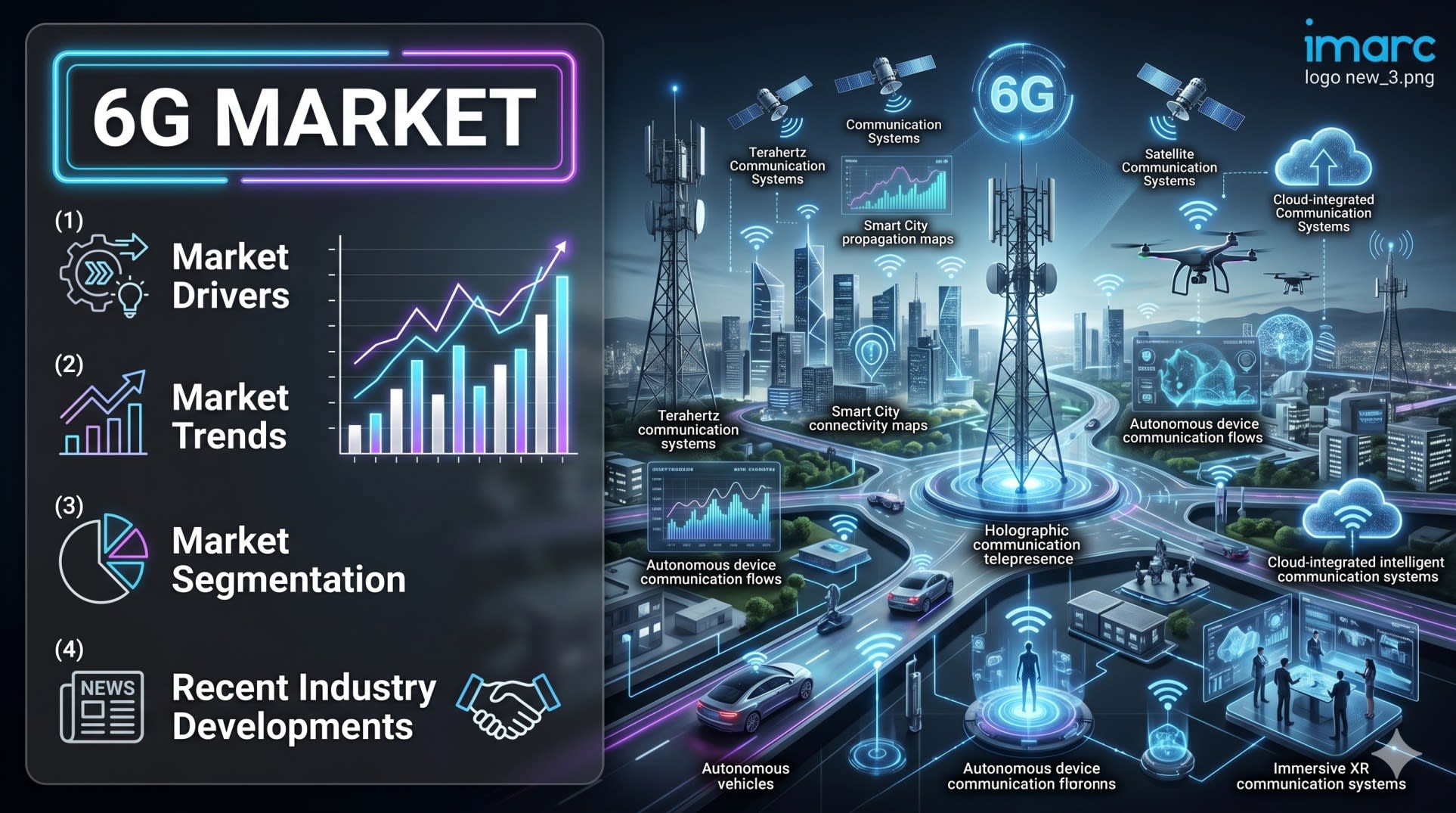
The global 6G market, projected to reach $31.5 billion by 2034, is gaining momentum through government standardization initiatives and multilateral R&D partnerships. This future connectivity infrastructure, driven by AI-native networks and terahertz frequencies, directly impacts future high-bandwidth, low-latency streaming applications. Governments and industry players are investing heavily to shape international standards and architecture ahead of commercial deployment.
Key Takeaways
- IMARC Group forecasts a 58.52% CAGR for the 6G market from 2026 to 2034, growing from $450.4 million to over $31.5 billion.
- Hardware is the dominant expenditure segment due to the requirement for new terahertz transmitters, energy-efficient chips, and advanced antenna systems.
- SK Telecom and Intel reduced core network latency by 70% using AI-native Inline Service Mesh technology on Xeon processors.
- China Mobile launched the world's first 6G satellites in February 2024, signaling a shift toward integrated terrestrial-satellite network testing.
- The 3GPP is scheduled to commence formal 6G standardization in 2025, following the ITU-R's 6G vision framework release.
Why It Matters
The shift to 6G represents a fundamental move toward AI-native infrastructure and ultra-high-frequency bands, offering 100x the throughput of 5G. For the streaming industry, this provides the necessary technical headroom for mass-market 8K immersive video and real-time holographic communication with near-zero latency. While commercial availability remains focused on 2030, current regulatory battles over spectrum and hardware intellectual property will determine which regions lead the next decade's high-bandwidth services. Watch for the 3GPP Release 21 timeline finalization in June 2026, which will define the first normative technical specifications for 6G equipment.
Additional Context
The path to 6G commercialization is increasingly tied to aggressive spectrum management and satellite integration. Per Communications Daily in June 2026, the U.S. National Telecommunications and Information Administration (NTIA) is prioritizing the 7 GHz band for a 6G spectrum pipeline, aiming to identify specific bands for auction by December 2026. This move aligns with the FCC’s 'Build America Agenda,' which is currently auctioning AWS-3 licenses to fund the removal of untrustworthy technology and secure a total of 800 MHz of additional spectrum by 2034. Simultaneously, the FCC recently authorized a $17 billion spectrum transfer from EchoStar to SpaceX, per SatNews in May 2026, to support direct-to-device (D2D) connectivity—a foundational capability for 6G's vision of ubiquitous global coverage. Standardization bodies are meeting critical milestones to ensure interoperability across these diverse infrastructures. Per the ITU in March 2026, mobile experts have drafted 20 technical performance requirements for 'IMT-2030' (6G), including new metrics for AI-native protocol stacks and integrated sensing. The GSMA reported in November 2025 that 6G will require up to three times more mid-band spectrum than current 5G networks to sustain traffic levels projected to reach 4,000 exabytes per month by 2040. These systemic updates aim to bridge the 'connectivity gap' while enabling high-growth scenarios where AI-driven applications become the primary driver of mobile data consumption.
Read full article at vocal.media
Get this in your inbox → Subscribe
Enjoy our coverage?
Add StreamingMeme as a preferred source on Google to see more of our streaming news at the top of your Search results.
Add as preferred source