

CDN77 launches Rust-based edge computing platform with 200 global PoPs
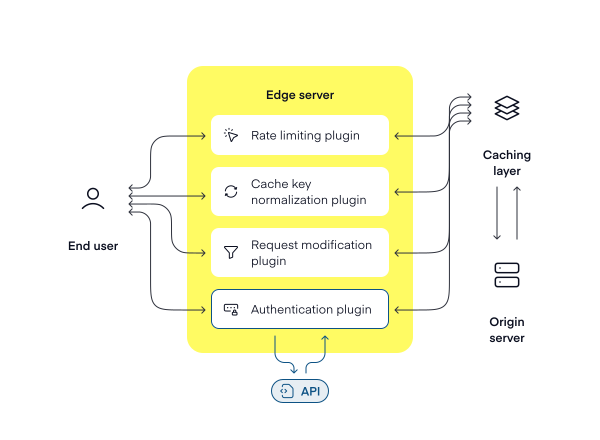
CDN77 has launched its Edge Computing platform to allow customers to run custom request processing logic within its global distribution network of 200 PoPs. The platform uses a Rust-based SDK to compile logic into WebAssembly modules, which run in isolated sandboxes at the CDN edge. The offering also includes integrated key-value storage for local policy enforcement and routing metadata.
Key Takeaways
- Edge logic is compiled into WebAssembly modules using a Rust-based SDK for isolated, high-performance execution.
- Platform includes built-in Key-Value (KV) storage for dynamic local policy enforcement and routing decisions.
- Architecture supports 310 Tbps of global network capacity and 40 Tbps of private backbone capacity.
- Requests are processed inline within the HTTP life cycle at the edge, reducing origin load and backend complexity.
Why It Matters
By shifting logic like authentication and cache normalization to the edge, CDN77 provides sub-millisecond request processing that bypasses traditional origin latencies. This shift allows video delivery networks to manage complex workflows, such as per-user access validation and dynamic API routing, without adding proxy layers. As competitors like Fastly and Cloudflare move toward more automated edge functions, CDN77’s collaboration-heavy engineering model targets enterprise clients requiring precise resource control. Watch for adoption rates among high-bandwidth streaming platforms that currently struggle with origin-shielding costs.
Additional Context
The transition of CDNs into full-fledged edge compute providers has accelerated throughout 2025. Per StreamingMediaBlog (March 2025), CDN77 reported revenue growth to $175 million in 2024, a nearly 21% increase from the previous year, while remaining cash-flow positive and debt-free. By mid-2025, the company further reported hitting an annual revenue rate of $218 million, positioning it among the top five largest CDNs by revenue globally. This growth occurred as the company expanded its physical footprint to 200 PoPs across 130 countries, supported by a backbone that manages daily traffic peaks of 85 Tbps. This platform launch enters a competitive landscape where WebAssembly (Wasm) has become the de facto runtime for edge execution. Per Medium (April 2026), industry leaders Cloudflare and Fastly have both transitioned their core compute layers to Wasm-based isolates to achieve microsecond-level instantiation times. While larger competitors manage thousands of nodes, CDN77 has differentiated itself by maintaining a small, focused engineering team that claims to be three times more revenue-efficient than the industry average. At the StreamTV Show (June 2025), CDN77 leadership noted that their strategy emphasizes dedicated private setups for enterprise clients to avoid "noisy-neighbor" issues common in shared edge environments. The broader market for these services is projected to expand significantly as video traffic continues to dominate the internet. Per TechMarket Experts (September 2025), the global CDN market is expected to reach $79.2 billion by 2034, driven by a 12.3% CAGR as dynamic content now accounts for over 60% of all usage. As streaming providers seek to reduce the environmental and financial impact of data transport, the adoption of edge computing for localized processing—such as real-time sports statistics and token revocation—is becoming a standard requirement for next-generation delivery stacks.
Read full article at cdn77.com