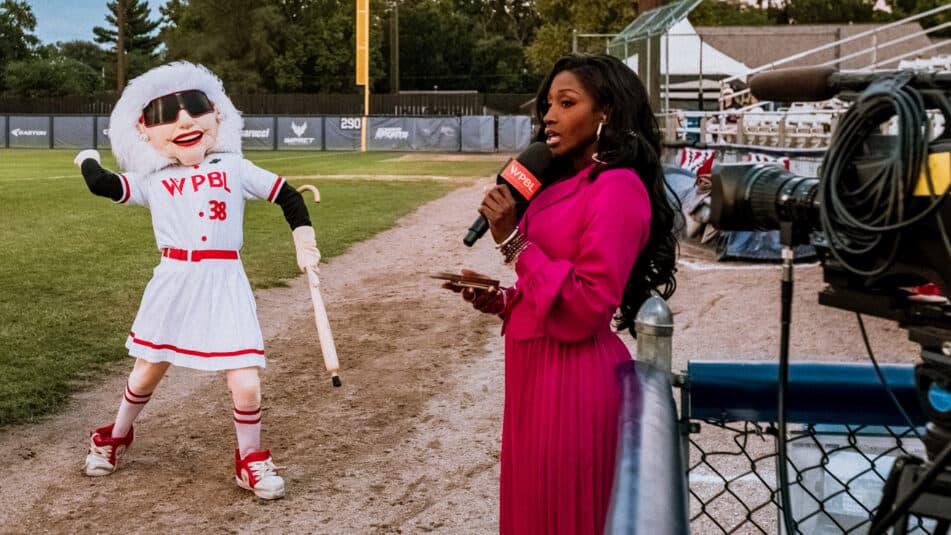
The Women’s Pro Baseball League (WPBL) successfully launched its inaugural season using a seven-camera on-site production model featuring Ross Carbonite switchers and TrackMan data integration. The league produced its own broadcasts for distribution on ESPN and YouTube, demonstrating a rapid six-month development cycle for a professional-grade sports streaming operation.
The successful launch of the WPBL broadcast plan demonstrates that new sports properties can bypass traditional media gatekeepers by building high-quality, in-house production stacks in under a year. By prioritizing on-site personnel and deep player access over remote integration (REMI) models, the league established a distinct storytelling identity that resonates with both casual viewers and data-focused fans. This vertical integration allows the league to control its narrative and data rights from day one, providing a blueprint for other emerging niche sports seeking national distribution. Watch for whether the league shifts to a more cost-effective REMI model or expands its camera count for the 2027 season.
The WPBL's reliance on Ross Video Carbonite switchers places the league within a growing cohort of emerging sports properties that have standardized on Ross production hardware for rapid deployment. Ross Video has positioned its Carbonite line as the default switching platform for mid-tier live sports, and the company's Carbonite Ultra series was highlighted at NAB Show 2026 as a preferred choice for leagues building broadcast operations from zero, with integrated graphics and replay capabilities that reduce the need for separate downstream systems. The WPBL's seven-camera model aligns with what Ross describes as the minimum viable configuration for professional baseball coverage, a threshold that has dropped significantly from the 12-to-16-camera standard common in Major League Baseball productions.
From a business perspective, the WPBL's dual-distribution strategy across ESPN and YouTube reflects a broader trend among new sports leagues seeking to maximize reach while retaining production ownership. TVBEurope reported in September 2026 that Bitmovin's annual Video Developer Report found low latency for live streaming had overtaken cost control as the top challenge for video teams, with 36 percent of respondents citing it as their primary concern. For a league like the WPBL distributing simultaneously to a linear broadcaster and a digital platform, managing latency expectations across both endpoints becomes a core engineering requirement. The league's decision to produce in-house rather than outsource to a third-party production company also mirrors the vertical integration approach that Mux has advocated for sports and live event operators seeking tighter control over their streaming pipelines, where owning the encode and delivery stack reduces dependency on external vendors during rapid scaling.
On the technical side, the WPBL's integration of TrackMan data into its broadcast graphics represents a category of production enhancement that is becoming standard across professional baseball. TrackMan, the Danish radar-tracking company, supplies pitch and batted-ball data to MLB, NPB, and KBO, and its expansion into emerging leagues signals growing demand for data-driven storytelling in sports broadcasts. The 2026 AI Video Streaming Build-and-Buy Playbook noted that managed video platforms have converged on similar feature sets but diverge on pricing models and built-in AI capabilities, with Mux offering Claude-powered auto-chaptering and semantic search, while Bitmovin and Kaltura target enterprise and education workloads with deeper codec control. For the WPBL, the choice between these platforms for its YouTube distribution layer will likely hinge on whether the league prioritizes developer speed or granular encoding control as it scales toward a second season.
The Women’s Pro Baseball League successfully executed a professional broadcast plan for its inaugural season, moving from concept to live production in just six months. By building an in-house production stack, the league secured national distribution on ESPN and YouTube, proving that emerging sports properties can control their own narrative and data.
The Women’s Pro Baseball League moved from the initial concept to live production in six months.
ESPN secured the U.S. media rights for the league-produced content, while YouTube served as the international streaming partner.
The production utilized a Ross Carbonite switcher, XPression graphics, Vizrt 3Play for replays, and integrated TrackMan and Presto data for real-time pitch speed and analytics.
The league used a seven-camera on-site model, which included five foundational baseball positions, a tight center-field unit, and a mobile RF camera for dugout access.
Add StreamingMeme as a preferred source on Google to see more of our streaming news at the top of your Search results.
Add as preferred source
