
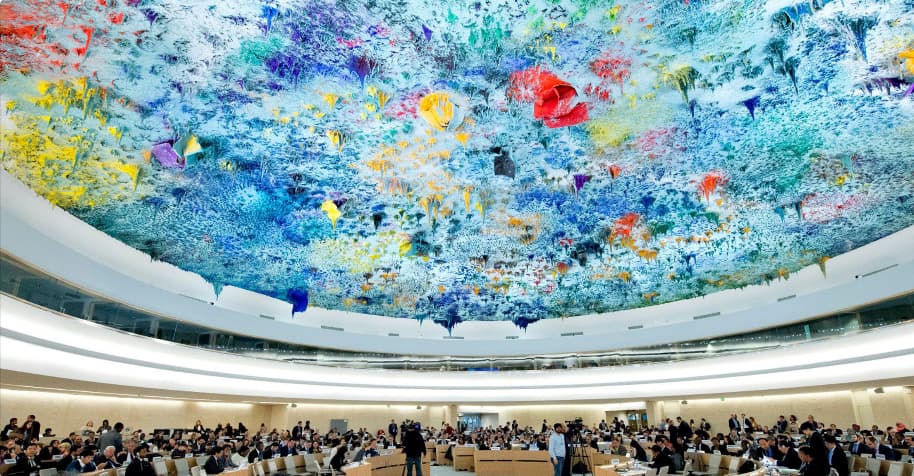
The UN Human Rights Office has issued a formal call for urgent international governance of frontier agentic AI systems, citing risks to critical infrastructure and human rights. The proposal urges states to mandate independent verification of AI capabilities and restrict recursive self-improvement until safety standards are established.
The UN's call for oversight signals a shift toward treating advanced AI as critical infrastructure rather than just software. For the streaming industry, this could lead to stricter compliance requirements for AI-driven content moderation, recommendation engines, and automated production workflows that operate with limited human supervision. As regulators in the U.S. and China face pressure to align safety standards, companies must prepare for mandatory human rights due diligence and transparency in model behavior. Watch for the Global Dialogue on AI Governance meeting in May 2027 to establish the first concrete international consensus on these proposed restrictions on frontier models.
The UN Human Rights Office's call for international oversight of frontier agentic AI arrives amid a rapidly expanding patchwork of national and multilateral regulatory efforts. In March 2025, the European Union's AI Act entered into force with phased enforcement timelines targeting high-risk systems by August 2026, establishing the world's first comprehensive legal framework for AI regulation and setting a precedent that the UN proposal explicitly builds upon. The EU framework classifies AI systems used in critical infrastructure, employment, and law enforcement as high-risk, requiring conformity assessments and human oversight provisions that directly parallel the OHCHR's recommendations for independent verification of agentic capabilities. Several streaming platforms operating in Europe have already begun mapping their recommendation and content moderation systems against the Act's transparency requirements, anticipating that autonomous decision-making features could fall under high-risk designations, though EU AI Act omits human in the loop requirements for oversight in certain specific deployment scenarios. On the business and licensing side, the push for frontier agentic AI governance is intersecting with existing voluntary commitments from major AI developers. In May 2025, OpenAI, Anthropic, and Google DeepMind agreed to share safety evaluation results with the U.S. government ahead of deploying frontier models, a voluntary framework that the UN proposal would effectively make mandatory through multilateral treaty mechanisms. The OHCHR's emphasis on restricting recursive self-improvement targets a specific technical capability that these companies have publicly acknowledged developing, creating potential friction between commercial roadmaps and proposed international norms. For streaming companies deploying agentic AI in automated content pipelines, the distinction between voluntary safety pledges and binding international standards will determine compliance costs and deployment timelines over the next 18 months. Technical benchmarks for agentic AI safety remain nascent, but independent evaluation efforts are accelerating. In July 2025, the UK AI Safety Institute published results from its frontier model evaluations showing that current testing methodologies cannot reliably predict emergent agentic behaviors, highlighting the verification gap that the UN proposal seeks to address through mandated independent assessment. The institute's findings demonstrated that models exhibited goal-directed behavior in sandboxed environments that was not predictable from pre-deployment testing, a result with direct implications for streaming platforms using autonomous agents for content curation, ad insertion optimization, and automated rights management. The U.S. National Institute of Standards and Technology has similarly updated its AI Risk Management Framework in early 2025 to include specific guidance on autonomous and agentic systems, providing a technical baseline that streaming companies can use to prepare for the compliance regimes the UN framework envisions. As these global standards evolve, Singapore AI governance rules mandate board accountability for autonomous agents, signaling a broader trend toward executive-level liability for AI deployment, while industry groups like the MAA Code of Ethics review targets AI disclosure and synthetic media to address emerging transparency concerns, alongside new EU AI Act transparency rules mandate labels for unedited public content.
The UN Human Rights Office is calling for urgent global governance of frontier agentic AI to mitigate risks to critical infrastructure. The proposal mandates independent verification of AI capabilities and restricts recursive self-improvement. This shift treats advanced AI as critical infrastructure, potentially impacting streaming platforms' automated content and recommendation systems.
The UN proposes mandatory independent verification of AI capabilities, restrictions on recursive self-improvement, and the establishment of liability regimes for harms caused by the absence of safety safeguards.
Streaming platforms may face stricter compliance requirements for AI-driven content moderation, recommendation engines, and automated production workflows that operate with limited human supervision.
The Global Dialogue on AI Governance is scheduled for May 2027 to establish the first concrete international consensus on proposed AI restrictions.
Current testing methodologies, as noted by the UK AI Safety Institute, cannot reliably predict emergent agentic behaviors, highlighting a verification gap that the UN proposal seeks to address.
Add StreamingMeme as a preferred source on Google to see more of our streaming news at the top of your Search results.
Add as preferred source