

UK Supreme Court reviews Apple’s $700M patent royalty dispute
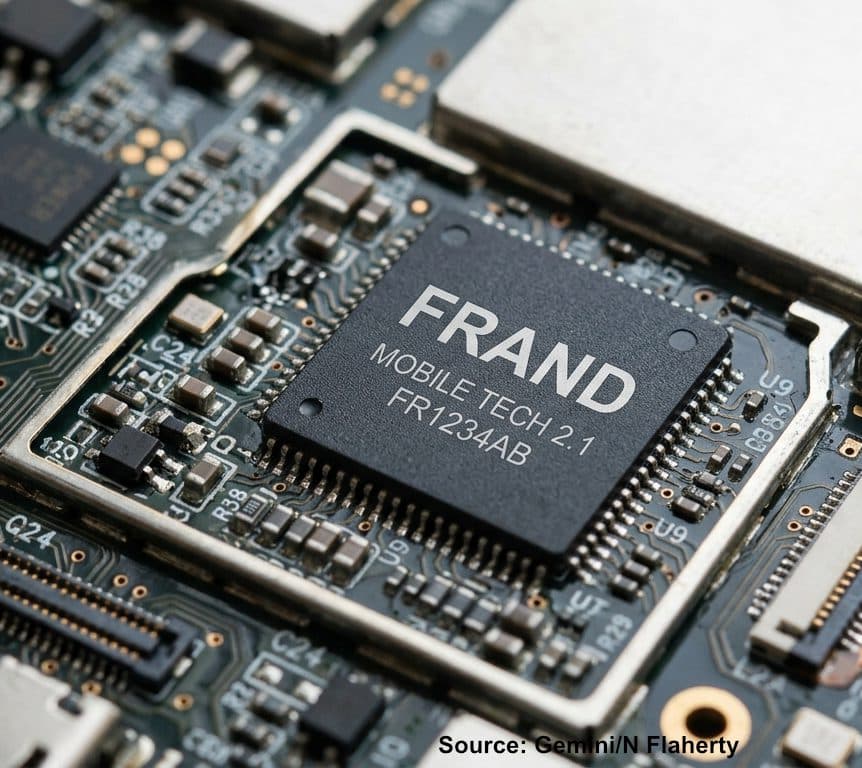
The UK Supreme Court is hearing a case between Apple and Optis Cellular Technology regarding the definition and valuation of fair, reasonable, and non-discriminatory (FRAND) terms for standard-essential patents (SEPs). The court's ruling may reset global benchmarks for how royalty fees are calculated for technologies including video codecs and wireless standards.
Key Takeaways
- Apple is challenging a Court of Appeal ruling that increased its royalty liability from a 2019 baseline of $56 million to over $502 million.
- The 15-cent-per-iPhone licensing fee was determined by the Court of Appeal using a comparable agreement between Optis and Google.
- Intel and Qualcomm have intervened in the case, illustrating the divide between hardware implementers and patent-holding entities over royalty methodologies.
- The decision centers on whether UK courts can set global benchmarks for SEPs across 4G and 5G standards, including emerging 6G sensing technologies.
Why It Matters
A ruling in favor of Optis would solidify the UK’s position as a primary global forum for standard-essential patent (SEP) litigation, potentially subjecting streaming hardware and telecommunications providers to higher, court-mandated royalty rates. If the Supreme Court upholds the current methodology, it validates a 'top-down' valuation approach that critics like Intel claim undermines individual negotiations and discourages innovation by rewarding non-practicing entities. For the streaming ecosystem, this sets a precedent for licensing fees on fundamental codecs and wireless pathways. Industry players should monitor the final judgment for specific guidance on how 'comparable' licenses, like the Google benchmark used here, will be weighted in future FRAND determinations.
Additional Context
The case follows the landmark 2020 Unwired Planet v. Huawei decision, where the UK Supreme Court established that British courts have jurisdiction to set the terms of global patent licenses for UK-designated standard-essential patents. This role as a global arbiter has recently drawn friction from other regions. According to ipfray (February 2026), the Munich I Regional Court and the European Commission have expressed concerns regarding UK jurisdictional overreach, particularly as the Unified Patent Court (UPC) in Europe begins asserting its own authority over patent enforcement. In late 2025, the UPC’s Mannheim division notably ordered Amazon to refrain from enforcing UK-issued interim licenses in UPC proceedings, per law firm reports from January 2026.
Simultaneous litigation in the United States highlights a fragmented legal landscape for Apple. While the UK courts have escalated award figures, a U.S. jury cleared Apple of infringing five related patents in February 2026, according to MacRumors. This verdict followed two previously overturned U.S. awards of $506 million and $300 million. Optis, which is managed by private equity firm Brevet Capital, has acquired vast portfolios originally developed by Ericsson, Samsung, and Panasonic. Its strategy of pursuing global licensing terms in the UK, despite domestic losses in the U.S., underscores the shifting tactical importance of the London High Court for patent management companies seeking to maximize portfolio returns as the industry transitions toward 6G and next-generation connectivity standards.
Read full article at eenewseurope.com
Enjoy our coverage?
Add StreamingMeme as a preferred source on Google to see more of our streaming news at the top of your Search results.
Add as preferred source