

Transatlantic trade war looms as EU-U.S. digital regulation conflict intensifies
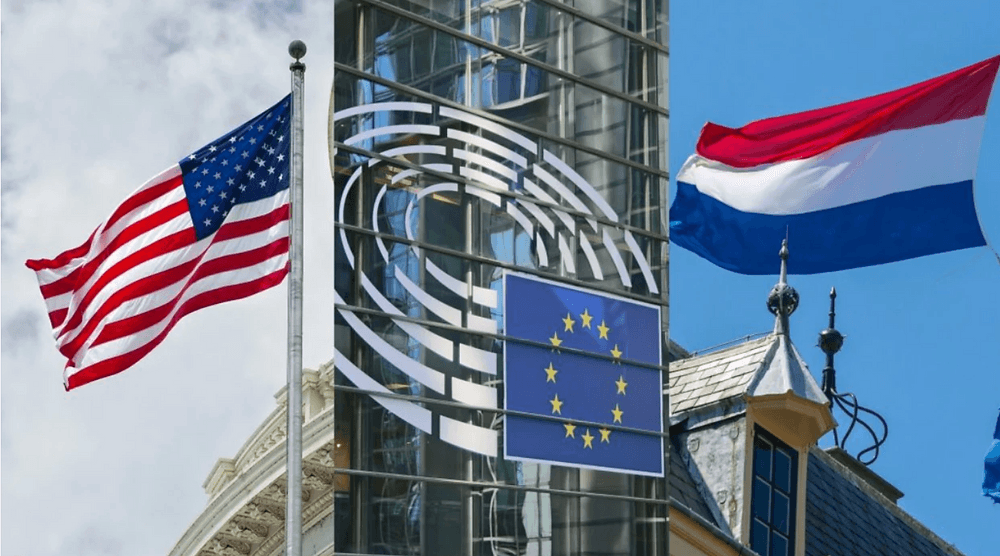
This article examines the intensifying geopolitical friction between the European Union and the United States regarding digital governance, specifically highlighting EU antitrust enforcement against major US tech firms. It contextualizes the US government's retaliatory threats and Big Tech's pushback against the Digital Markets Act and Digital Services Act within the broader struggle for global digital sovereignty.
Key Takeaways
- Apple and Meta were fined €500 million and €200 million respectively in 2025 for Digital Markets Act (DMA) non-compliance.
- The Trump administration has threatened substantial tariffs and chip export restrictions against countries with 'discriminatory' digital rules.
- U.S. Vice President J.D. Vance criticized the EU’s AI and digital governance framework as restrictive at the Paris AI Action Summit.
- Google received a €3.45 billion fine in late 2025 related to search and advertising instrument abuse.
- The EU represented the world's largest market for digitally delivered services imports in 2025, accounting for 55% of the global total.
Why It Matters
The escalating friction represents a fundamental clash between Europe’s 'regulatory superpower' ambitions and the U.S. government's 'America First' protectionist stance. For streaming services and digital platforms, this suggests a bifurcated operating environment where compliance costs increase as the EU and U.S. diverge on data privacy and competition enforcement. If Brussels concedes on enforcement to avoid tariffs, it risks undermining its long-term digital sovereignty and the 'Brussels Effect' that has historically set global standards. Watch for a specific signal in the potential revision of DMA enforcement guidelines following the upcoming EU-U.S. trade dialogues.
Additional Context
The tension between Brussels and Washington reached a critical peak in August 2025 when President Trump used Truth Social to warn that countries maintaining 'discriminatory' digital taxes and regulations would face substantial additional tariffs and export restrictions on semiconductors. Per Politico (August 2025), the State Department simultaneously considered visa restrictions against EU officials enforcing the Digital Services Act (DSA). This followed a report by Reuters suggesting internal U.S. government meetings and a lobbying campaign aimed at designating the DSA and DMA as trade irritants.
In response to these threats, EU officials have signaled a willingness to retaliate. European Commission Executive Vice President Teresa Ribera stated in August 2025 that the bloc must be prepared to rethink its trade relationship with the U.S. rather than 'subordinate' its interests to foreign pressure. Per TechPolicy.Press, EU Industry Commissioner Stéphane Séjourné noted that persistent U.S. pressure for deregulation could lead to a full review of existing trade deals. Despite this rhetoric, recent analysis from IAI (June 2026) indicates that while overall document activity regarding the DMA rose 18% post-2025, formal enforcement decisions declined by 37%, suggesting a potential 'modulation' of activity to avoid triggering trade-wide retaliation.
The conflict also extends to emerging technologies. During the February 2025 AI Action Summit in Paris, Vice President J.D. Vance argued that excessive EU regulation would 'kill a transformative industry' and promote ideological bias. CBS News reported at the time that the U.S. and UK eventually declined to sign the summit's final declaration on inclusive AI, citing a lack of clarity on global governance and national security. This divergence highlights a structural gap: the EU views regulation as a sovereign right to protect citizens, while the U.S. views it as a geopolitical tool for managing global competition.
Read full article at theyoungdiplomats.com
Enjoy our coverage?
Add StreamingMeme as a preferred source on Google to see more of our streaming news at the top of your Search results.
Add as preferred source