

Topaz Labs details AI enhancement controls for professional production workflows
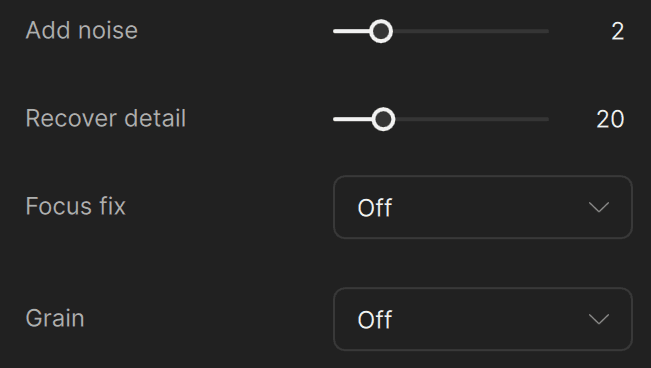
Topaz Labs published documentation detailing the functionality of its video enhancement toolset, specifically focusing on its Add Noise, Recover Detail, Focus Fix, and Grain control features. The guide explains how these AI-driven settings work to mitigate artifacts in HD and UHD footage for professional production workflows.
Key Takeaways
- Focus Fix uses a downscaling-then-upscaling AI cycle to sharpen slightly out-of-focus subjects in HD and UHD footage.
- The Recover Detail threshold prevents AI from misinterpreting compression artifacts as valid texture at higher intensity levels.
- Three distinct grain profiles—Gaussian, Grey, and Silver Rich—provide stylistic alternatives to simple digital noise.
- Astra and Premiere Panel integrations allow for cloud-based rendering that offloads heavy AI processing from local workstations.
Why It Matters
The release of these specific technical guidelines marks a shift toward giving editors surgical control over AI outputs rather than relying on one-click black boxes. By addressing common complaints like 'plastic' skin textures and banding through controlled noise injection, Topaz is making its tools more viable for high-end finishing environments where visual fidelity is paramount. This move supports a broader industry trend where specialized AI utility layers are being integrated directly into NLEs like Adobe Premiere. Executives should monitor the adoption of cloud-render credits as a secondary revenue stream for software vendors moving away from perpetual licenses.
Additional Context
The emphasis on manual oversight comes as part of a significant strategic pivot for Topaz Labs. In September 2025, the company officially transitioned from a perpetual license model to a subscription-only structure priced at approximately $299 per year, according to industry reviews from June 2026. This move aligns with a broader industry shift toward recurring revenue, even as competitors like UniFab highlight limited-time lifetime licenses to capture price-sensitive segments of the creative market.
Technologically, Topaz is addressing hardware bottlenecks through its 'Expansion Update' released in May 2026. Per Topaz Labs and related technical reports, the company introduced NeuroStream technology in collaboration with NVIDIA, which reportedly reduces VRAM usage for high-end AI models by up to 95%. This enables advanced processing, including the new Hyperion SDR-to-HDR upscaling model, to run on mainstream consumer laptops that previously lacked the 30GB+ of VRAM required for similar tasks.
This democratization of processing power reflects the explosive growth in the AI video sector, which is projected to reach $1.81 billion globally by the end of 2026, according to analysis by Research and Markets and Intel Market Research from March 2026. While text-to-video tools from OpenAI and Google dominate mainstream headlines, a Pictory report from June 2026 indicates that professional users leverage URL-to-video and enhancement workflows at nine times the rate of personal users, further solidifying the demand for the precise restoration tools Topaz is documenting.
Read full article at topazlabs.com
Enjoy our coverage?
Add StreamingMeme as a preferred source on Google to see more of our streaming news at the top of your Search results.
Add as preferred source