

Thundercomm TurboX C7790 launches with 24 TOPS for Edge AI video
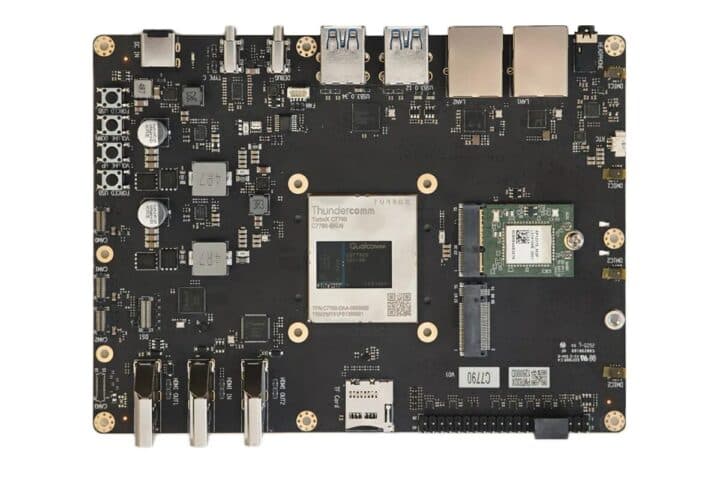
Thundercomm has launched the TurboX C7790 development kit, an edge AI platform powered by Qualcomm's Dragonwing Q-7790 processor. This kit provides 24 TOPS of AI performance, supports Android and Linux, and targets applications like AI cameras and edge AI gateways. The SoC includes video decode capabilities for 4K120 H.264/H.265/AV1 and video encode for 4K60 H.264/H.265.
Key Takeaways
- Dragonwing Q-7790 SoC features an octa-core Kryo CPU and Adreno 722 GPU optimized for 4nm efficiency.
- Video processing capabilities include 4K120 decode for H.264/H.265/AV1 and 4K60 encode for H.264/H.265.
- Hardware kit priced at $1,499 includes 12GB LPDDR5X RAM, 128GB flash, and a Sony IMX577 camera module.
- Interface support includes dual Gigabit Ethernet, HDMI input, and triple 4-lane D-PHY camera connectors.
Why It Matters
The release of the C7790 kit provides a high-performance bridge for developers integrating complex AI models into edge video hardware without relying on cloud compute. By supporting AV1 decoding and 24 TOPS at the edge, Qualcomm and Thundercomm are addressing the increasing demand for real-time video analytics and high-frame-rate processing in professional AV and security sectors. This shift toward localized processing reduces latency and bandwidth costs for enterprise streaming deployments. Watch for the adoption rate of the Sony IMX577 module pairing as a benchmark for next-generation AI-integrated camera hardware performance.
Additional Context
The C7790 launch follows a broader push by Qualcomm to dominate the 'AIoT' sector. Per CNX Software in January 2026, the Dragonwing Q-7790 and its higher-tier counterpart, the Q-8750, were designed specifically to challenge high-end media hubs and drones by integrating dedicated NPUs. This series represents a departure from standard mobile chips, focusing instead on long-term industrial availability and specific video conferencing needs. At CES 2026, Qualcomm emphasized that its new architecture aims to unify AI processing across heterogeneous compute blocks, using the NSP3 (Neural Signal Processor) to handle INT8 operations more efficiently than general-purpose GPUs.
Simultaneously, the edge AI market is seeing increased competition from MediaTek’s Filogic and Genio series. Per Counterpoint Research in February 2026, the demand for edge AI silicon in video surveillance and retail analytics is expected to grow by 22% annually through 2028. Thundercomm’s move to offer both Android and Linux BSPs (Board Support Packages) is a tactical decision to capture both the consumer-facing media app market and the more rigid industrial gateway market. The requirement for a Qualcomm PKLA agreement for source code access remains a hurdle for open-source development, but it aligns with the industry trend of protecting proprietary NPU drivers as AI silicon becomes a primary hardware differentiator.
Read full article at cnx-software.com
Enjoy our coverage?
Add StreamingMeme as a preferred source on Google to see more of our streaming news at the top of your Search results.
Add as preferred source