

Tencent research finds AI agents struggle with complex multilingual localization workflows
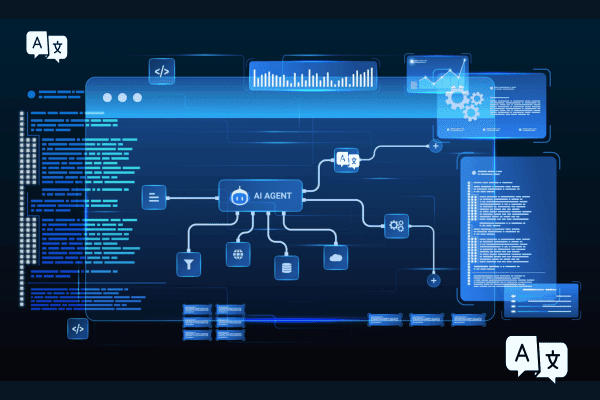
Researchers from Tencent and Beijing Jiaotong University have developed PolyWorkBench, a new benchmark designed to evaluate AI agents on end-to-end multilingual enterprise tasks. The study indicates that even current state-of-the-art models face significant degradation when handling complex localization workflows that require consistency across multiple languages.
Key Takeaways
- PolyWorkBench evaluates 67 enterprise tasks across five domains: commerce, knowledge work, legal, manufacturing, and localization.
- Benchmark results indicate that 88% of tasks involve three or more of the 10 supported languages, including Chinese, Japanese, and Arabic.
- Frontier models showed substantial failure rates due to misunderstanding source information or losing linguistic consistency across multi-step processes.
- Localization tasks specifically rewarded strong multilingual base models over sophisticated long-horizon planning capabilities.
Why It Matters
The findings suggest that current AI agentic frameworks are not yet ready for autonomous, end-to-end globalization without oversight. For the streaming ecosystem, this indicates that while AI can streamline technical dubbing and subtitling, high-stakes marketing and software localization still require robust base models rather than just complex planning layers. Streaming platforms must watch for updates to Tencent Cloud's Agent Development Platform 4.0, which launched in July 2026, as a potential signals for whether these foundational multilingual reasoning gaps are being closed at the infrastructure level.
Additional Context
The introduction of PolyWorkBench comes as Tencent aggressively shifts its corporate strategy toward becoming an 'agent factory.' In July 2026, per industry reports, Tencent launched an extensive portfolio of AI agents including WorkBuddy, a desktop productivity tool, and TDream, a platform focused on AI-native interactive film and game asset creation. This decentralized, agent-first strategy is designed to embed AI capabilities across its entire product mesh, from WeChat to Tencent Docs, positioning these agents as a new operating layer for both consumer and enterprise workflows.
Simultaneously, the broader video industry is racing to integrate agentic AI to solve the 'mathematical unsustainability' of traditional global support. Per reports from June 2026, AI-driven dubbing is already reducing localization costs by up to 90% and shortening production cycles from weeks to hours. Platforms are increasingly prioritizing 'agentic fluency'—the ability of an AI to not only translate but also execute transactions like identity verification or CRM logging across different cultural norms and formal address styles.
However, technical limitations remain a central hurdle for these global deployments. Recent findings from the 2026 World Artificial Intelligence Conference indicate that even high-parameter models experience 'intelligence degradation' when processing long-context multilingual inputs. Research published by Lilt in early 2026 notes that tokenizer inefficiencies and English-centric reasoning account for 70-80% of model failures in non-English tasks. As digital content volumes explode, the competitive gap in streaming B2B services is shifting from simple model parameter counts to specialized internal structures that support cross-lingual consistency within complex systems.
Read full article at slator.com
Enjoy our coverage?
Add StreamingMeme as a preferred source on Google to see more of our streaming news at the top of your Search results.
Add as preferred source