
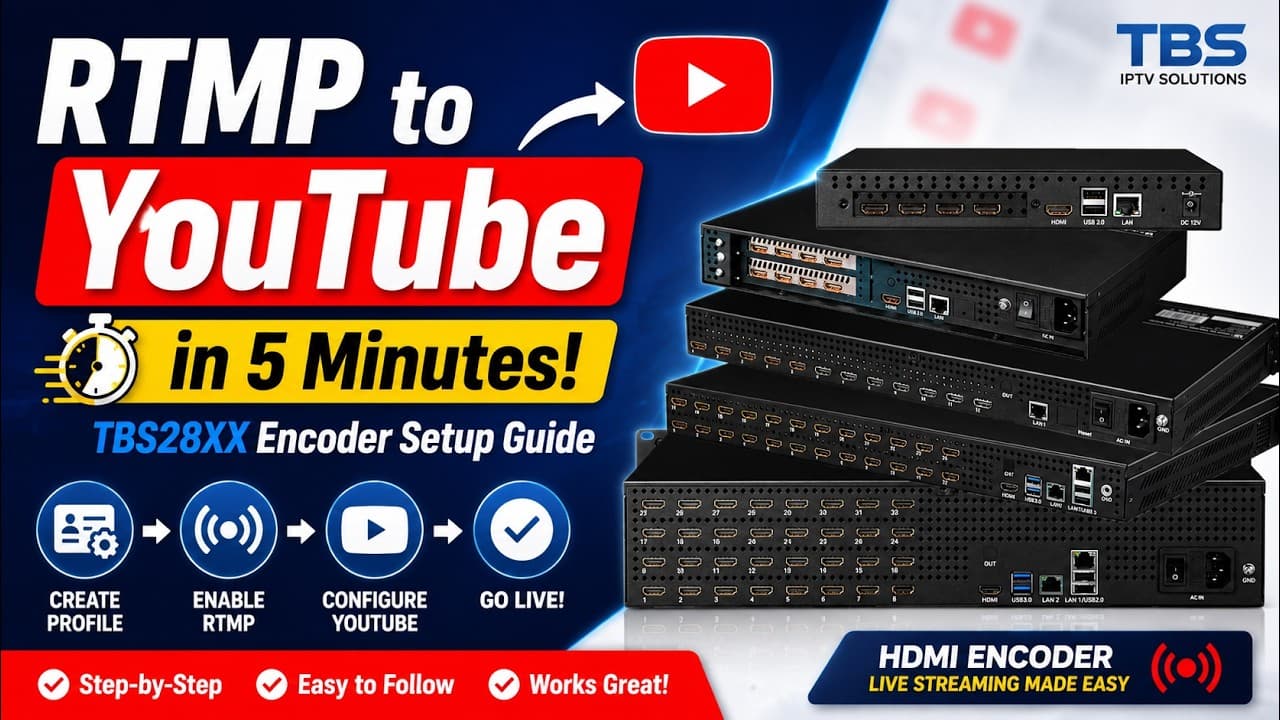
TBS demonstrates how to configure its TBS28XX series HDMI encoders to directly stream live video to YouTube Live using RTMP. The tutorial guides users through creating encoding profiles, enabling RTMP streaming, configuring YouTube stream URLs and keys, and verifying the stream. This process is aimed at IPTV operators, broadcasters, and system integrators for live event streaming.
Direct hardware-to-platform ingest simplifies the contribution chain for professional live streaming by removing the need for intermediary capture software. While RTMP is no longer used for distribution, it remains the industry standard for ingest due to its low complexity and broad hardware compatibility. Streamlining this process underscores a market shift toward ruggedized, 24/7 standalone encoding units that can replace PC-based streaming setups in mission-critical environments like schools or corporate video hubs. Monitor whether TBS adds SRT (Secure Reliable Transport) support to this specific workflow, as it offers better resilience over unpredictable public networks than traditional RTMP.
The professional hardware encoder market is increasingly bifurcated between high-volume, cost-optimized units and multi-channel 4K appliances. Per market data from March 2026, the global IPTV and OTT sector is valued at approximately $340 billion, driven by the expansion of vertical markets such as hospitality, healthcare, and education where standalone encoders are gaining ground. These segments typically prioritize 'set-and-forget' hardware like the TBS28XX series to maintain 24/7 operational stability without the overhead of general-purpose computing resources.
While RTMP remains the primary protocol for ingest to YouTube and Facebook, professional workflows are transitioning toward high-density encoding. Products in this class, such as the TBS2812 12-channel 4K encoder and TBS2804X, now commonly support H.265 (HEVC) at 4K resolution per technical specifications from February 2026. This allows operators to reduce bandwidth consumption by up to 50% compared to legacy H.264 profiles while maintaining video quality. High-density units are also increasingly seen with OLED status displays and unified LAN outputs to simplify system integration in limited rack spaces.
Looking ahead, the industry is moving toward low-latency standards like LL-HLS and LL-DASH to compete with the sub-3-second latency requirements often seen in sports and interactive content. Per industry reporting from January 2026, many operators are migrating from specialized on-premise hardware to hybrid cloud-native platforms. Devices that bridge this gap by supporting multiple protocols—including SRT and HLS alongside RTMP—are becoming the baseline for system integrators aiming to future-proof their video delivery infrastructure against shifting platform requirements.
Add StreamingMeme as a preferred source on Google to see more of our streaming news at the top of your Search results.
Add as preferred source