StreamingMemeStreamingMemeBuyers Guide
AboutLeaderboardsEventsSubmit News
Subscribe

Daily Brief

The streaming industry in your inbox every morning.

Daily Brief

The streaming industry in your inbox every morning.

StreamingMemeStreamingMeme

The independent buyers guide and news aggregator for the streaming technology industry.

Explore

Buyers GuideLeaderboardsEventsSubmit News

Stay updated

Weekly digest of new companies and streaming news.

Categories

Encoding & SoftwareVideo Delivery & CDNStreaming PlatformsAI for VideoProduction HardwareBusiness NewsMonetization & Ad TechRegulatory & Policy

© 2026 StreamingMeme. All rights reserved.

AboutPrivacy PolicyTermsContact
EncodingCDNPlatformsAI & VideoHardwareBusinessAd TechPolicy
← AI for Video
AI & VideoTechnical DevelopmentJune 24, 2026

Splitting Vision-Language Model Inference Cuts GPU Costs 40%
Splitting Vision-Language Model Inference Cuts GPU Costs 40%
sudoall

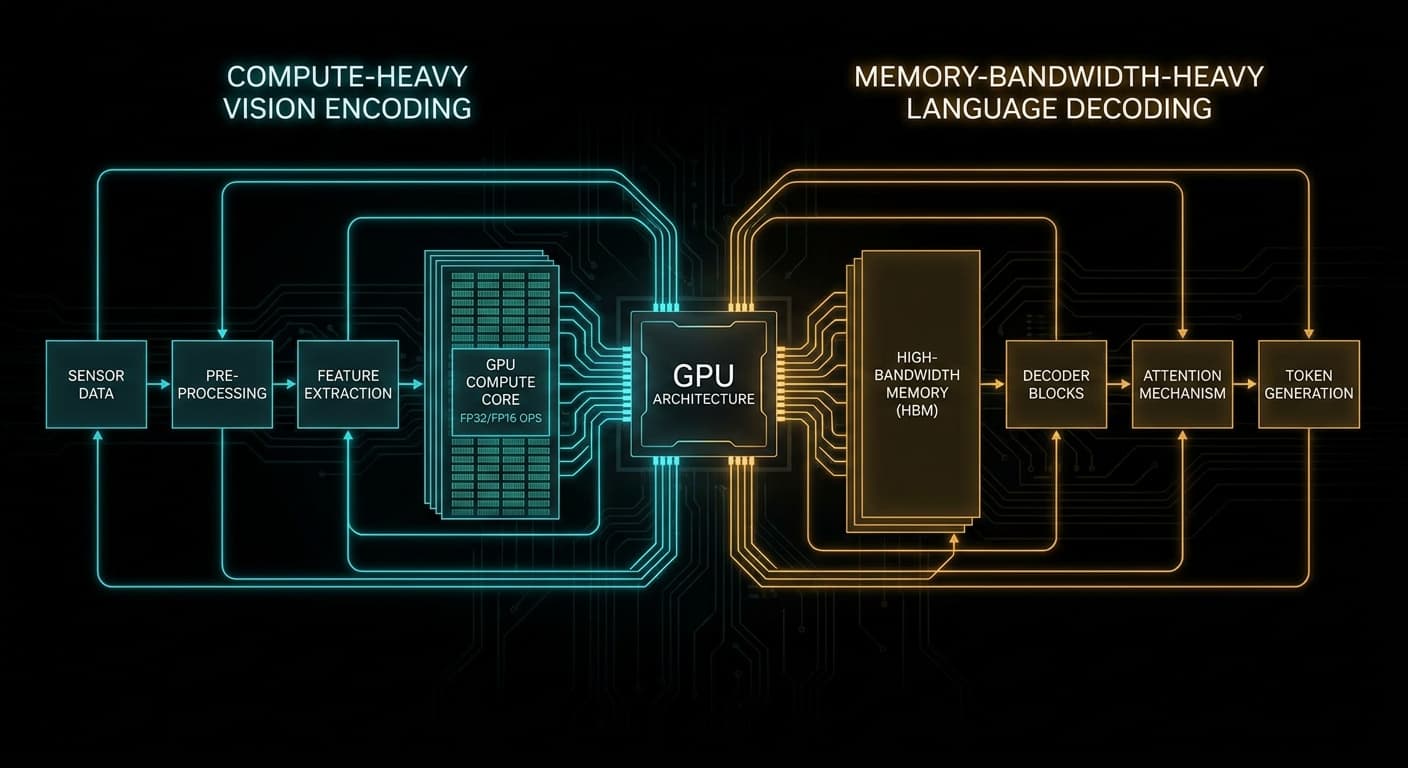
This technical explainer analyzes the hardware mismatch between image encoding and token decoding phases in vision-language model inference. It details how splitting the pipeline between compute-bound encode and memory-bandwidth-bound decode can reduce infrastructure costs by 40%, and provides profiling guidance for deployment.

Key Takeaways

  • Vision encoding is compute-bound (80%+ tensor-core utilization, single-digit HBM bandwidth use) while token decoding is memory-bandwidth-bound — co-locating both on one GPU permanently wastes capacity from each phase
  • Splitting at the encoder/decoder boundary transfers ~4.5 MB embeddings vs ~350 MB KV cache per request for LLaVA-7B, a 78× reduction that works over commodity PCIe without NVLink or InfiniBand
  • Heterogeneous GPU deployments showed approximately 40% cost savings over homogeneous baselines with no measurable latency regression when scheduling is handled correctly
  • A 336×336 image produces ~576 visual tokens, adding ~350 MB to the KV cache for a 7B MHA model at FP16 before generation begins
  • Work-stealing schedulers recover encoder pool utilization during text-only bursts by letting encoder nodes absorb decode jobs, avoiding fragile dynamic role reassignment

Why It Matters

Splitting VLM inference at the modality boundary rather than at the prefill/decode stage makes heterogeneous GPU deployment practical over commodity PCIe, avoiding the NVLink or InfiniBand requirement that has confined prior disaggregation systems to homogeneous datacenter hardware. Multiple serving frameworks are converging on this architecture — SGLang shipped EPD disaggregation in January 2026, vLLM-Omni extends the approach to any-to-any multimodal models, and IBM Research demonstrated llm-d running 3–5× faster across mixed-vendor GPU clusters in June 2026. The signal to track: whether a cross-vendor KV cache transfer library materializes — IBM identified this as the prerequisite for routing prefill and decode to different hardware vendors, and it does not yet exist.

Additional Context

The modality-boundary split described in the SudoAll explainer draws directly from research by Donglin Yu et al. (arXiv:2603.12707), who built HeteroServe — a phase-aware runtime that maps vision encoding to consumer GPUs (RTX 4090, ~$3k) and language generation to datacenter GPUs (A100, ~$16k). Their system achieved 54% higher throughput than vLLM v0.3.0 on identical 4×A100 hardware, and a $38k heterogeneous cluster outperformed a $64k homogeneous baseline by 37% in cost-efficiency, per their evaluation on LLaVA-1.5-7B and Qwen2.5-VL. Multiple serving frameworks have moved toward encoder disaggregation in 2026. SGLang shipped Encoder-Prefill-Decode (EPD) disaggregation in January 2026 (per LMSYS Org blog), reporting 6–8× lower time-to-first-token for image-heavy workloads at 1 QPS by scaling vision encoders horizontally instead of increasing tensor parallelism. vLLM-Omni (arXiv:2602.02204), a 2026 extension of vLLM, generalizes the approach to any-to-any multimodal models handling text, images, video, and audio — reducing job completion time by up to 91.4% for Qwen3-Omni compared to baseline serving. EPD-Serve (arXiv:2601.11590), built for Huawei Ascend NPUs, improved throughput by 57–69% over PD-disaggregated deployment while meeting sub-50ms time-per-output-token SLOs. IBM Research, working with Red Hat and NxtGen Cloud, demonstrated in June 2026 that the llm-d Kubernetes-native control plane ran IBM Granite and Sarvam AI models on mixed-vendor GPU clusters 3–5× faster than traditional Kubernetes round-robin scheduling, serving twice as many users. IBM noted that the next step is routing compute-heavy prefill to one vendor's GPUs and memory-intensive decode to another — but this requires a KV cache transfer library compatible across GPU backends, which does not yet exist. Practical deployment guidance has also emerged: DigitalOcean published a tutorial in June 2026 mapping the heterogeneous split onto GPU Droplets, with L40S or RTX 6000 Ada for the encoder pool and H100 or H200 for the decoder pool, connected over 25 Gbps private networking.


Read full article at sudoall.com

Get this in your inbox → Subscribe

Enjoy our coverage?

Add StreamingMeme as a preferred source on Google to see more of our streaming news at the top of your Search results.

Add as preferred source

Related Articles

MarkTechPost: Induction Labs Photon-1 trains on 18 years of raw video
YouTube: NTT's LLMlet enables distributed LLM inference across browsers via WebRTC
MarkTechPost: Reactor releases 1.6B parameter open-source Dreamer 4 world-model implementation

Newest

1 day ago
Barchart: Cerebras and AMD partner on low-latency AI inference architecture
1 day ago
Light Reading: Charter sidesteps Starlink partnership rumors as Q2 broadband losses widen
1 day ago
GuruFocus: Fastly joins Experian to secure autonomous commerce at the edge
1 day ago
The BIG Newsletter: Nexstar and TEGNA Accused of Violating Judicial Order in $6.2 Billion Merger
1 day ago
AI Rights Brief: Google and Disney integrate AI provenance directly into programmatic ad workflows
1 day ago
Front Office Sports: World Cup afternoon ratings spark shift toward earlier U.S. game windows
1 day ago
Futurism: Meta and TikTok face backlash over deceptive AI-generated health ads
1 day ago
Wccftech: Qualcomm Adreno 850 GPU to debut AI Frame Fusion technology
1 day ago
Beet.TV: Brands must re-describe catalogs for AI agents to maintain discoverability
1 day ago
daily.dev: AVIF achieves universal browser support as Edge and Safari close gaps
1 day ago
Los Angeles Times: Disney, Netflix, and Amazon recruit AI talent to automate production workflows
1 day ago
Callaba: Callaba standardizes remote production workflows via SRT and NDI integration
1 day ago
Lib.rs: New zero-dependency Rust decoder vp9dec achieves bit-exact VP9 conformance
1 day ago
IT Brief UK: Fetch.ai and RedSquid TV launch first agentic AI television platform
1 day ago
Vocal: TeqBlaze challenges Epom with modular full-stack white-label ad tech suite
1 day ago
Euronews: EU Expert Panel Backs Age Restrictions and Addictive Feature Bans
1 day ago
Cord Cutters News: FCC chair signals scrutiny for potential streaming-exclusive 2030 World Cup rights
1 day ago
Audio Chocolate: Merging Technologies debuts Anubis Premium SPS for mission-critical broadcast audio
1 day ago
Cord Cutters News: Linear contraction accelerates as 14 cable networks vanish in five years
1 day ago
IPWatchdog: EC mandates Google share search data and Android features under DMA

Upcoming Events

Jul
29–30
Buffer-Free VideoSeattle
Aug
17–20
SET EXPOSao Paulo
Sep
11–14
IBCAmsterdam
Sep
13
SportsPro Streamtime Sports LiveAmsterdam
Sep
16–18
RTC.ONKrakow
View all events →

Top Sources

  1. 1.Sports Video Group104
  2. 2.SiliconANGLE91
  3. 3.YouTube63
  4. 4.Tech Times60
  5. 5.AdExchanger57
  6. 6.TechCrunch55
  7. 7.arXiv50
  8. 8.PPC Land48
Full leaderboards →

Newest

1 day ago
Barchart: Cerebras and AMD partner on low-latency AI inference architecture
1 day ago
Light Reading: Charter sidesteps Starlink partnership rumors as Q2 broadband losses widen
1 day ago
GuruFocus: Fastly joins Experian to secure autonomous commerce at the edge
1 day ago
The BIG Newsletter: Nexstar and TEGNA Accused of Violating Judicial Order in $6.2 Billion Merger
1 day ago
AI Rights Brief: Google and Disney integrate AI provenance directly into programmatic ad workflows
1 day ago
Front Office Sports: World Cup afternoon ratings spark shift toward earlier U.S. game windows
1 day ago
Futurism: Meta and TikTok face backlash over deceptive AI-generated health ads
1 day ago
Wccftech: Qualcomm Adreno 850 GPU to debut AI Frame Fusion technology
1 day ago
Beet.TV: Brands must re-describe catalogs for AI agents to maintain discoverability
1 day ago
daily.dev: AVIF achieves universal browser support as Edge and Safari close gaps
1 day ago
Los Angeles Times: Disney, Netflix, and Amazon recruit AI talent to automate production workflows
1 day ago
Callaba: Callaba standardizes remote production workflows via SRT and NDI integration
1 day ago
Lib.rs: New zero-dependency Rust decoder vp9dec achieves bit-exact VP9 conformance
1 day ago
IT Brief UK: Fetch.ai and RedSquid TV launch first agentic AI television platform
1 day ago
Vocal: TeqBlaze challenges Epom with modular full-stack white-label ad tech suite
1 day ago
Euronews: EU Expert Panel Backs Age Restrictions and Addictive Feature Bans
1 day ago
Cord Cutters News: FCC chair signals scrutiny for potential streaming-exclusive 2030 World Cup rights
1 day ago
Audio Chocolate: Merging Technologies debuts Anubis Premium SPS for mission-critical broadcast audio
1 day ago
Cord Cutters News: Linear contraction accelerates as 14 cable networks vanish in five years
1 day ago
IPWatchdog: EC mandates Google share search data and Android features under DMA

Upcoming Events

Jul
29–30
Buffer-Free VideoSeattle
Aug
17–20
SET EXPOSao Paulo
Sep
11–14
IBCAmsterdam
Sep
13
SportsPro Streamtime Sports LiveAmsterdam
Sep
16–18
RTC.ONKrakow
View all events →

Top Sources

  1. 1.Sports Video Group104
  2. 2.SiliconANGLE91
  3. 3.YouTube63
  4. 4.Tech Times60
  5. 5.AdExchanger57
  6. 6.TechCrunch55
  7. 7.arXiv50
  8. 8.PPC Land48
Full leaderboards →