

Specialized architecture shift: Balancing CPU, GPU, and TPU for real-time AI
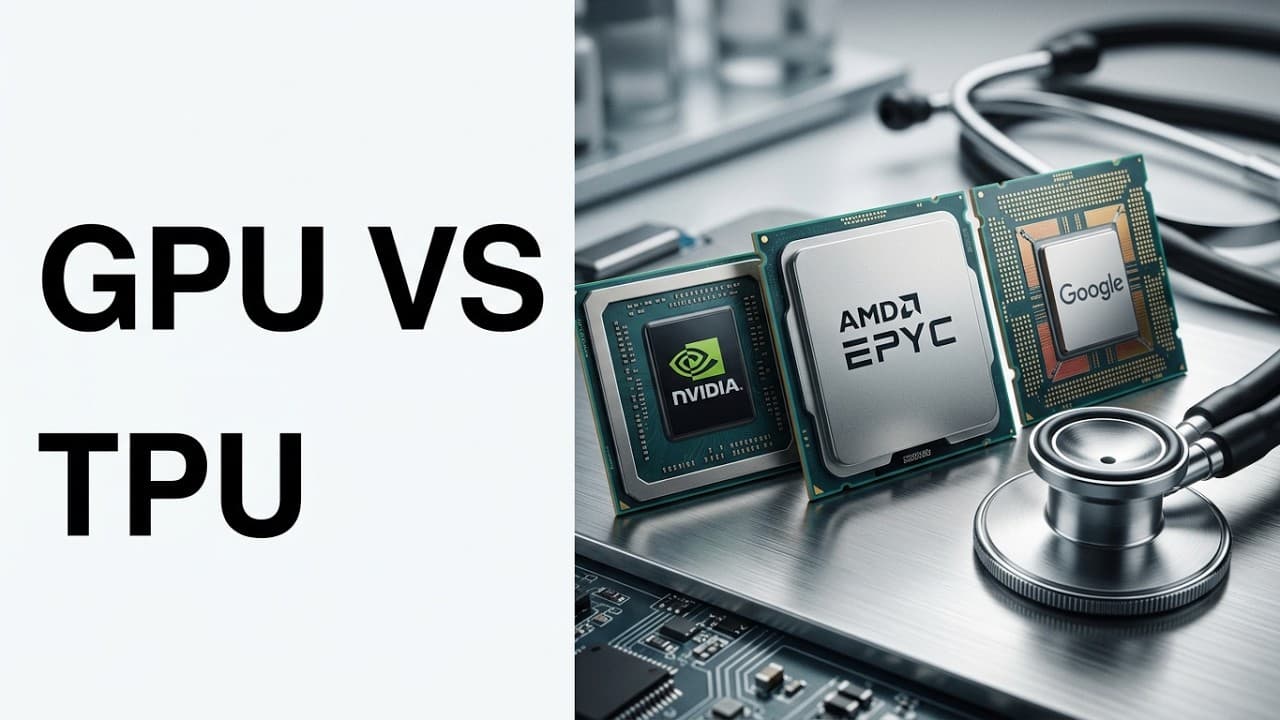
This article explores the architectural differences between CPUs, GPUs, TPUs, and emerging chip technologies like NPUs within the context of healthcare AI. It highlights how selecting specific silicon architectures is essential for optimizing performance, power efficiency, and latency in real-time inference and medical diagnostics.
Key Takeaways
- Google's TPU (Tensor Processing Unit) strips non-essential graphics logic to maximize power efficiency for large-scale machine learning.
- Central Processing Units (CPUs) excel at sequential logic-heavy tasks but create bottlenecks when processing massive neural network queues.
- Graphics Processing Units (GPUs) maintain dominance in AI training due to thousands of cores designed for parallel matrix mathematical operations.
- Neural Processing Units (NPUs) enable real-time 'at the edge' inference, allowing bedside monitors to analyze data without cloud latency.
- Emerging neuromorphic chips mimic brain structures, potentially enabling medical implants to run for years on a single battery.
Why It Matters
The transition from general-purpose hardware to specialized silicon marks the end of one-size-fits-all infrastructure. For streaming video, this implies a shift where CPUs handle metadata and logic while dedicated ASICs manage high-throughput neural tasks like real-time upscale or content moderation. As market fragmentation increases, platforms must adopt heterogeneous stacks to maintain performance without ballooning energy costs. The move Toward 'edge AI' via NPUs will further decentralize processing, shifting heavy inference from costly data centers to consumer devices. Watch for the standardization of NPU performance metrics (TOPS) as a primary benchmark for integrated video applications.
Additional Context
The push for specialized AI silicon is accelerating rapidly as incumbents and newcomers alike move toward inference-specific architectures. Per Analytics India Magazine (July 2025), Google released its seventh-generation TPU, codenamed Ironwood, marking its first chip designed specifically for inference. Ironwood reportedly delivers a tenfold performance improvement over the TPU v5 and is already being deployed at scale by major AI players like Anthropic, which plans to utilize over one million TPUs for its Claude model family. This shift emphasizes efficiency; Google reports that TPU v6 generations already achieve up to 65% better performance-per-dollar than comparable commercial GPUs.
Simultaneously, the GPU market is facing structural supply constraints that are forcing a rethink of infrastructure. According to PCMag (December 2025) and Overclock3D (February 2026), NVIDIA is expected to cut Blackwell gaming GPU production by 30-40% in early 2026 due to global memory shortages in GDDR7 and HBM components. This shortage is driving high-end GPU prices up, with Blackwell lead times extending to seven months, according to Fusion Worldwide (March 2026). Consequently, many B2B providers are seeking relief through custom ASICs or more power-efficient edge solutions.
In the consumer space, the 'AI PC' initiative is standardizing on-device inference via NPUs. Microsoft’s 2026 Copilot+ PC specification now mandates a minimum of 40 TOPS of NPU performance, per Kynix (July 2026). This move toward unified memory architectures, exemplified by NVIDIA’s May 2026 unveiling of the RTX Spark superchip—a 1-petaflop superchip combining Grace CPUs and Blackwell GPUs—aims to break the memory bandwidth bottlenecks that typically cripple discrete hardware during generative video tasks.
Read full article at youtube.com
Enjoy our coverage?
Add StreamingMeme as a preferred source on Google to see more of our streaming news at the top of your Search results.
Add as preferred source