
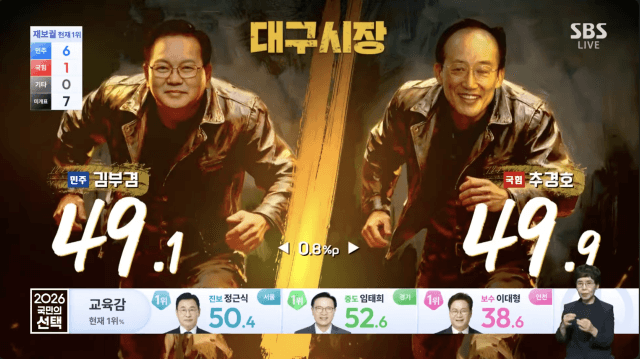
South Korean broadcasters MBC, KBS, and SBS are leveraging advanced technologies, including large LED walls, AI, and metaverse platforms, to transform election night coverage into a prime-time spectacle. This approach combines real-time data and predictive modeling with immersive studio design and entertaining graphics, setting a new standard for live television production. The article highlights specific technological implementations by each network, such as MBC's 33.7-meter LED media wall and AI-generated countdown, KBS's virtual studio via metaverse, and SBS's partnership with OpenAI for an AI situation room and ChatGPT-powered assistant.
The shift from reporting data to producing immersive, AI-driven entertainment reflects a strategic response to linear decline. By integrating generative AI into real-time production, Korean broadcasters are proving that high-stakes live events can remain a collective cultural ritual if packaged with the production value of premium K-content. This elevates the 'second-screen' experience from mere data refreshing to active participation, setting a technical benchmark for global broadcasters. Investors and tech vendors should monitor how these networks monetize archival data via generative AI, as देखा as the potential for these sophisticated graphics systems to be exported to other international markets facing similar audience fragmentation.
The 2026 local elections represent a major escalation in the use of generative AI for live broadcasting. Per Digital Today (May 2026), SBS formalized its partnership with OpenAI Korea specifically to utilize the Codex coding agent for real-time data processing, moving beyond simple visual parodies like its 2012 'VIPON' system. This development follows the 2024 general election where, per the Korea Herald (April 2024), SBS introduced 'Toopyoro,' a generative AI teddy bear commentator, a first in the country's broadcasting history. These efforts aim to bridge the gap between traditional news and the entertainment expectations of younger viewers who are increasingly migrating to social platforms. While Korean networks achieve high engagement—MBC's 2025 presidential coverage peaked at 14.5%—the approach faces scrutiny. Per The Washington Post (June 2025), communication experts have warned that depicting candidates in 'Squid Game' parodies or toilet-plunging races may distract from substantive policy debate. Despite these concerns, the format’s success is driving regional trends; Fuji TV’s adoption of Korean-style ice-skating candidate graphics for Japan’s 2026 House of Representatives election garnered over 12 million views on social media, per Chosun.com (February 2026). This cross-border influence suggests that the 'gamification' of political news is becoming a standardized survival tactic for terrestrial networks globally.
Add StreamingMeme as a preferred source on Google to see more of our streaming news at the top of your Search results.
Add as preferred source