

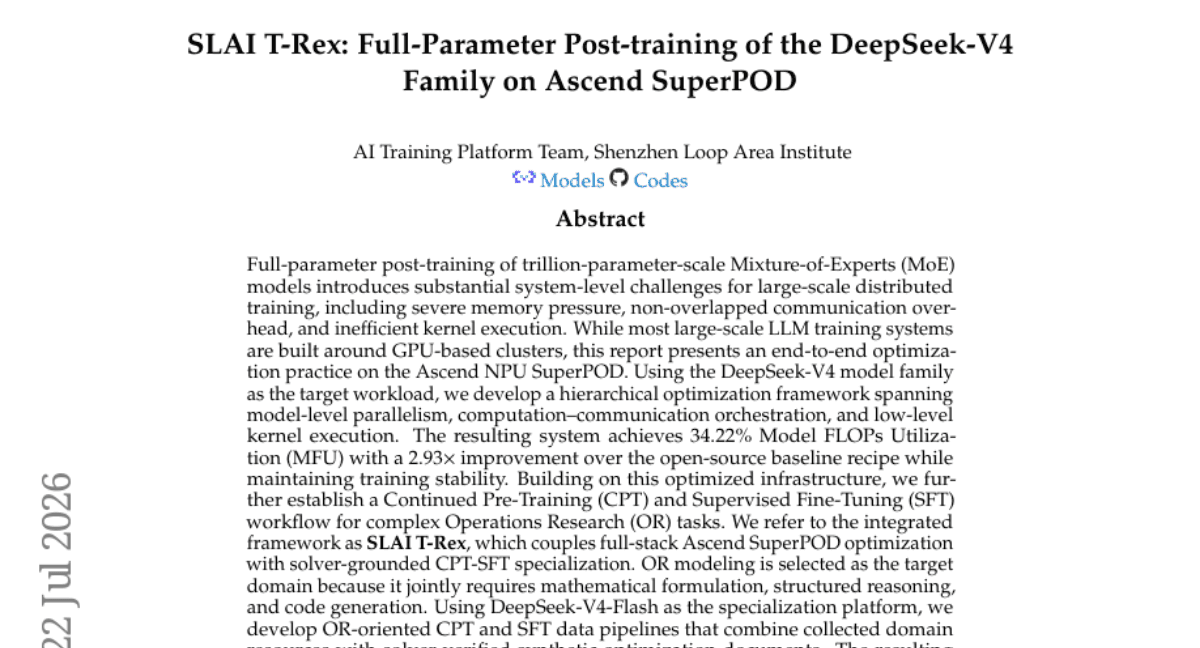
SLAI T-Rex hits 34% MFU and optimizes trillion-parameter MoE training
This digest details various research papers focused on multimodal reasoning, AI systems efficiency, and autonomous agent frameworks. Notable studies include optimizations for trillion-parameter MoE models and the introduction of Self Gradient Forcing to improve stability in long-video extrapolation tasks.
Key Takeaways
- SLAI T-Rex achieved 34.22% Model FLOPs Utilization (MFU), nearly tripling the baseline efficiency for trillion-parameter MoE training.
- DeepSeek-V4-Flash specialized variant reached a 71.81% zero-shot Pass@1 score, surpassing GPT-5.4-Mini by 3.98 points in Operations Research benchmarks.
- Self Gradient Forcing (SGF) enabled minute-scale video extrapolation from only five seconds of training data by addressing the context-gradient gap.
- ActiveVision benchmark results reveal a significant perception gap, with frontier models like Claude Fable 5 scoring just 3.5% versus a 96.1% human average.
- Anchor-Align improved real-world robotic success rates from 37% to 60% by linking vision-language anchoring with language-action alignment.
Why It Matters
The jump in Model FLOPs Utilization on non-Nvidia hardware suggests that the cost floor for training trillion-parameter models is falling, opening the door for regional infrastructure to compete with Western hyperscalers. For the streaming industry, developments like Self Gradient Forcing are particularly critical; they allow for high-fidelity, long-form video generation without the prohibitive compute costs of backpropagating through minutes of video. This technical decoupling of training window from output length could rapidly accelerate the deployment of personalized, generative video environments that maintain temporal and identity stability. Watch for further adoption of Ascend-optimized libraries in open-source MoE projects as teams seek to bypass GPU supply constraints.
Additional Context
The performance gains reported by SLAI T-Rex coincide with a broader shift in frontier model economics. DeepSeek-V4, the 1.6-trillion parameter flagship released in April 2026, has already pressured market pricing. Per Clore.ai in April 2026, the V4-Flash variant is the first sub-15B active parameter model to ship with frontier-class coding and reasoning capabilities, making it runnable on consumer-grade hardware. This follows a trend where Chinese labs have consistently matched proprietary performance at lower inference costs; DeepSeek's V4 Pro tier is currently priced roughly three times cheaper than Gemini 3.1 Pro, per deepseek.ai reports from May 2026.
Simultaneously, the limits of current multimodal reasoning are being tested against more rigorous benchmarks. While older metrics like MMLU have saturated with scores above 90%, new evaluations like ActiveVision (launched July 2026) illustrate that even GPT-5.5 and Claude Fable 5 struggle with 'active observation.' According to arXiv findings from July 2026, these models fail to maintain closed-loop visual perception, solving fewer than 11% of tasks that humans complete with 96% accuracy. This focus on perception-reasoning integration is driving a new wave of research, such as the Anchor-Align framework, which seeks to close the 'action-perception gap' in robotic and autonomous video applications. These foundational shifts suggest that the next competitive frontier for video AI will not just be resolution or length, but the ability of models to 'see' and react to changes with human-level consistency.
Read full article at ainativefoundation.org
Enjoy our coverage?
Add StreamingMeme as a preferred source on Google to see more of our streaming news at the top of your Search results.
Add as preferred source