
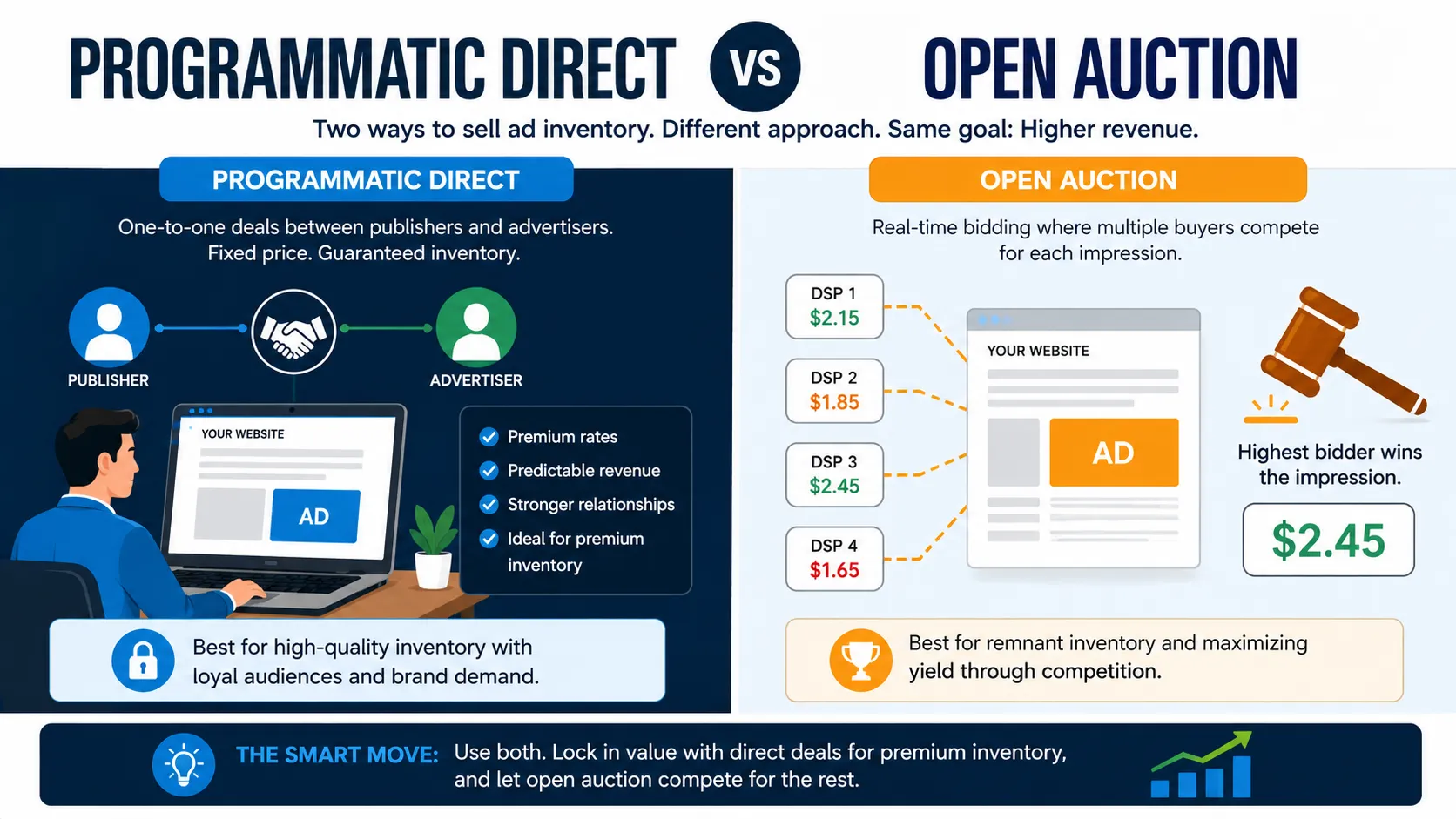
This article explains the mechanical differences between programmatic direct deals and open auctions, highlighting how publishers balance fixed-price guaranteed deals with dynamic real-time bidding for ad yield optimization. It details the strategic use of header bidding to allow both models to compete for inventory simultaneously.
The structural rebalancing toward programmatic direct and private marketplaces marks a strategic pivot toward inventory quality over volume. For streaming platforms, this shift is critical as advertisers demand higher viewability and lower fraud risks that open auctions often fail to guarantee. By utilizing header bidding to force competition between direct and auction channels, publishers can prevent price caps while maintaining revenue floors during demand dips. Industry leaders must now watch the adoption of automated guaranteed workflows in Connected TV (CTV), which is projected to drive premium inventory sales as open-exchange share continues its downward trend.
The shift toward controlled buying environments is accelerating across the digital landscape. Per DigitalApplied (April 2026), open-exchange share of programmatic spend fell from 71% in 2024 to 59% in 2026. This migration is largely driven by brand safety mandates and the premium nature of Connected TV (CTV) inventory, where programmatic guaranteed deals now dominate. While real-time bidding remains the largest single transaction method, accounting for 41.3% of the market in 2025 per Xapads, it faces increasing pressure from sophisticated invalid traffic, which saw a global fraud loss average of 8.7% in 2026.
Major streaming players are leaning heavily into automated direct integrations to capture this demand. Disney expanded its programmatic biddable integrations for live content on Disney+ and Hulu in April 2025, according to Disney Advertising. This move allows advertisers to access live sports and news inventory via biddable workflows, moving away from the manual insertion orders of the past. By early 2026, Disney+ further expanded its interactive ad formats, such as 'Ad Selector' and 'Pause Ads,' illustrating that premium publishers are moving toward high-margin, custom programmatic formats that are typically transacted through preferred deals rather than the open auction.
Global programmatic ad spend is projected to clear $821 billion in 2026, representing roughly 90% of all digital display investment per DigitalApplied. Within this market, PMP and programmatic direct are the fastest-growing segments, with PMPs delivering 92% viewability compared to 71% on open exchanges. As third-party cookies have been fully deprecated in Chrome since mid-2024, the reliance on first-party data within these private and direct environments has become the operating reality for the industry.
Add StreamingMeme as a preferred source on Google to see more of our streaming news at the top of your Search results.
Add as preferred source