

OpenAI launches GPT-Realtime models with 70-language voice input support
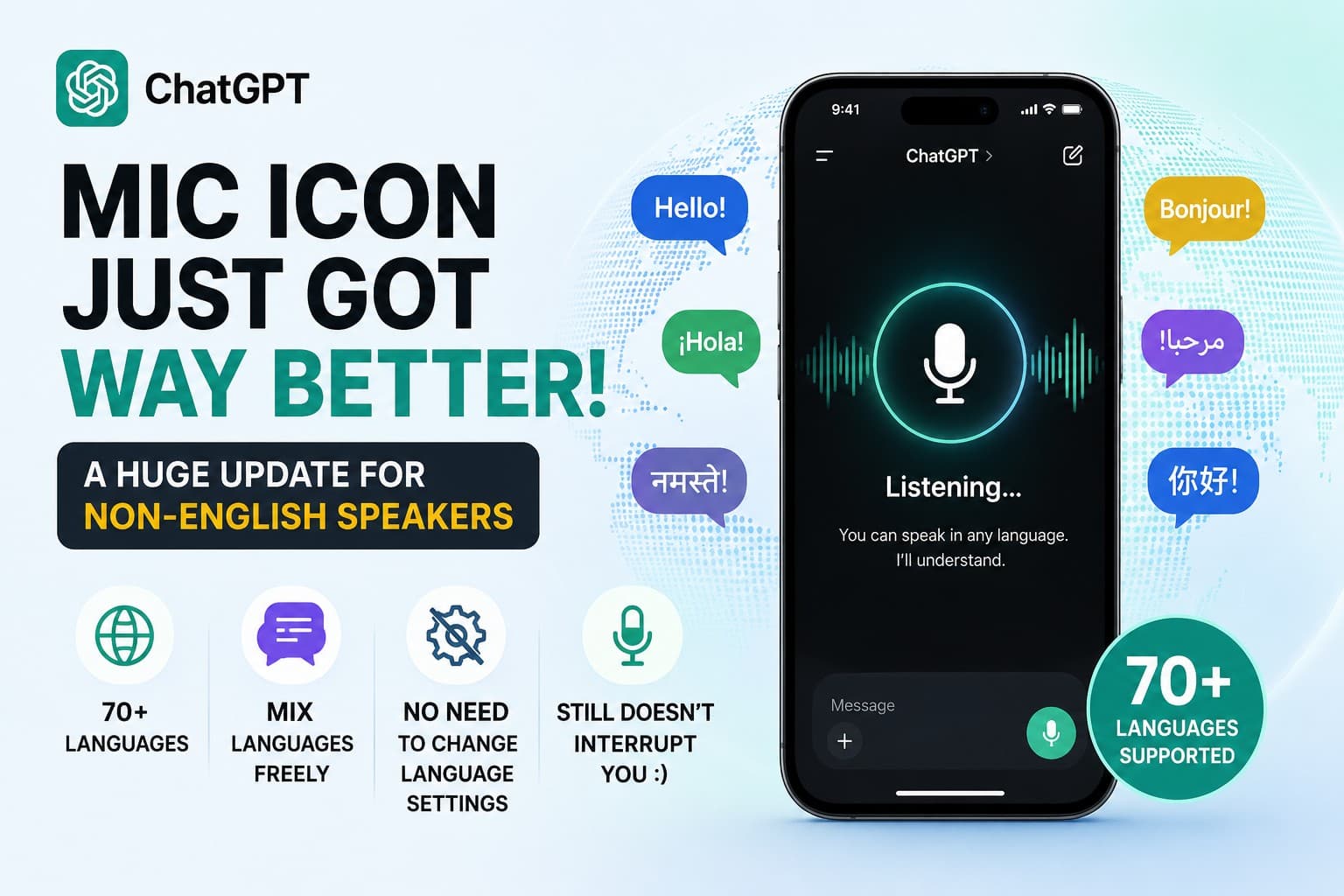
OpenAI has updated its ChatGPT app with 70+ language voice input and launched its developer-focused GPT-Realtime model suite. This suite contains GPT-Realtime-Translate and GPT-Realtime-Whisper, enabling low-latency streaming speech translation and automated live captioning workflows.
Key Takeaways
- ChatGPT app now supports automatic language detection and code-switching across 70+ languages on iOS and Android.
- GPT-Realtime-2 features a 128K token context window and what technical outlets describe as GPT-5-class reasoning.
- GPT-Realtime-Translate converts speech from 70+ input languages into 13 output languages with low-latency streaming.
- Early enterprise testers for the Realtime API suite include Zillow and Priceline for conversational customer support and travel booking.
Why It Matters
This release shifts voice AI from simple call-and-response to continuous streaming agents capable of real-time reasoning and translation. For the streaming industry, these models provide a standardized framework for automated live captioning and multilingual accessibility without the latency of traditional transcription-then-synthesis pipelines. By embedding 70-language support directly into the API, OpenAI is targeting global enterprise services like travel and technical support that require high-concurrency, low-lag verbal interaction. Watch for developer adoption rates in live-streaming apps where instantaneous, accurate translation is the primary barrier to international content distribution.
Additional Context
The expansion of OpenAI’s voice capabilities arrives as competitors move to integrate advanced AI more deeply into consumer hardware. Per CNBC and Substack reporting from June 2024 and June 2026, Apple significantly updated Siri via a partnership with Google, integrating Gemini models to handle conversational reasoning across the iPhone and Vision Pro ecosystems. This move highlights a 'build vs. buy' divide in the industry; while Apple and Meta have focused on product-integrated AI for their billions of monthly users, OpenAI is increasingly pivoting toward a developer-first enterprise model, recently filing confidentially for an initial public offering tied to its traction in B2B sectors.
Concurrent with OpenAI's update, Google has expanded its own voice footprint with the launch of Gemini 3.5 Live Translate, which similarly supports real-time speech-to-speech translation in over 70 languages across its NotebookLM and mobile platforms, per Medium reporting in June 2026. This technical parity in language coverage suggests that the competitive frontier has moved beyond simple availability to performance metrics like reasoning depth and context window size. As of May 2026, OpenAI reports that GPT-Realtime-2 scores approximately 15% higher than previous versions on the Big Bench Audio benchmark, a key signal for developers weighing model selection for complex, multi-step agentic workflows.
Industry pressure is also mounting toward specialized AI hardware. According to Implicator.ai in early 2026, OpenAI has explored developing its own 'audio-first' devices to bypass the friction of mobile operating systems. This strategy mirrors efforts by Meta, which has successfully deployed AI features into its Ray-Ban smart glasses. The shift toward low-latency, real-time voice interaction is viewed by analysts as an effort to move AI away from the screen as the primary interface, potentially transforming how users interact with streaming media and productivity tools in hands-free environments.
Read full article at letsdatascience.com
Enjoy our coverage?
Add StreamingMeme as a preferred source on Google to see more of our streaming news at the top of your Search results.
Add as preferred source