
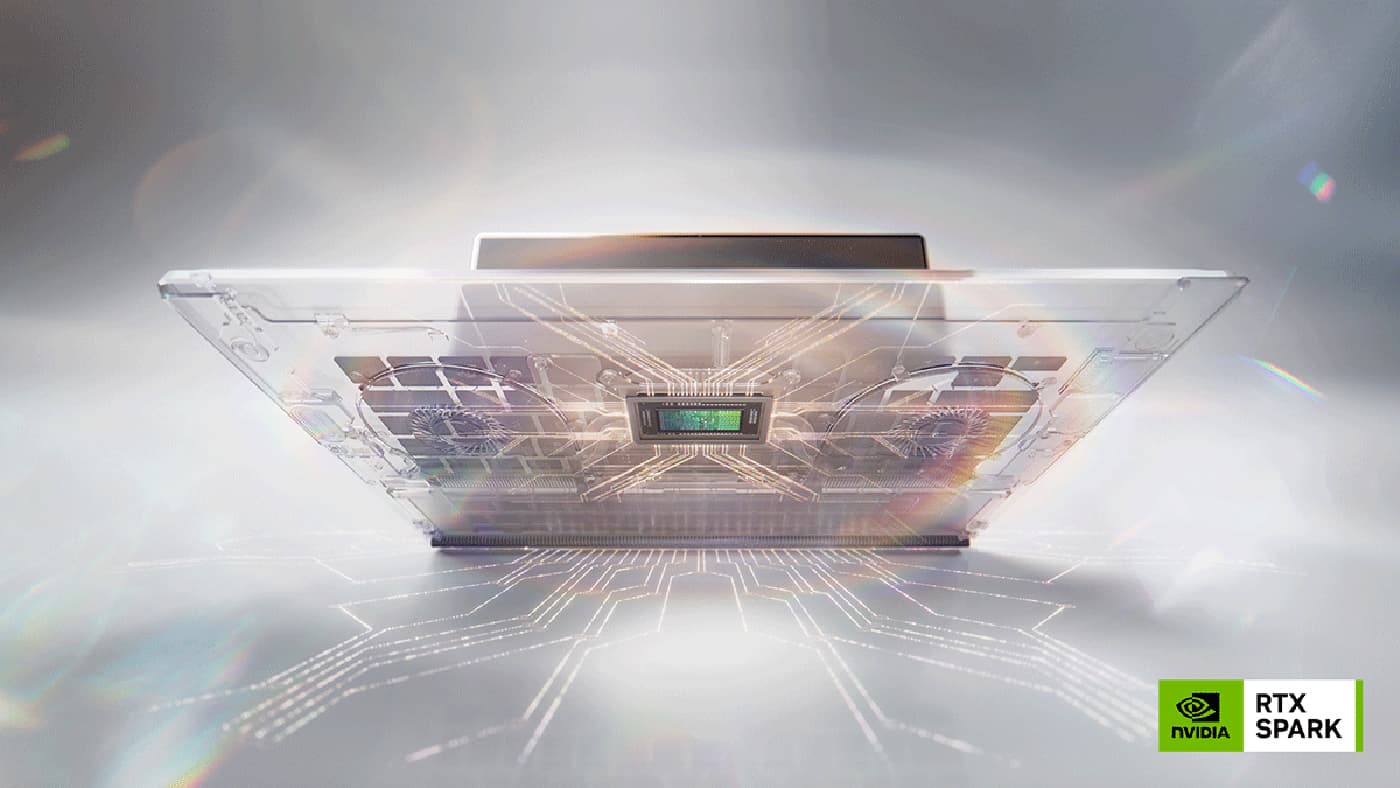
NVIDIA has unveiled RTX Spark, a new superchip designed for Windows laptops and compact desktops, featuring a Blackwell RTX GPU and Grace CPU. This chip promises advanced capabilities for 12K video editing, high-level AI computing, and enhanced gaming, with laptops and desktops expected to launch in Fall 2026. The platform also includes a partnership with Microsoft for personal AI agents and collaborations with software vendors like Adobe and Blackmagic Design for optimized creative workflows.
NVIDIA's entry into the laptop SoC market with RTX Spark directly challenges Apple's M-series chips by offering a unified memory architecture optimized for AI and creative workflows. This move intensifies competition in high-performance portable computing, potentially driving innovation in local AI processing and video editing capabilities on Windows devices. The immediate implication for the streaming video industry is the promise of more powerful, portable workstations capable of handling demanding tasks like 12K video editing and advanced AI-driven post-production. What to watch next is how quickly software vendors beyond Adobe integrate with the RTX Spark platform and the competitive response from Intel and AMD in the unified memory, Arm-based PC market.
NVIDIA's RTX Spark launch at Computex 2026 marks a significant step into the consumer laptop market, expanding beyond its traditional GPU dominance (PCMag, June 2026). The superchip integrates heavy-lifting AI components from NVIDIA's DGX Spark developer desktop into a system-on-a-chip (SoC) design, embracing Windows on Arm and adopting a unified-memory approach similar to Apple's MacBook Pro. This architecture is seen as crucial for Microsoft's ambitions to rewrite Windows for deep, local AI capabilities (PCMag, June 2026).
The introduction of RTX Spark intensifies competition in the laptop processor market, which will now see a four-way battle between Intel, AMD, Qualcomm, and NVIDIA, in addition to Apple's own silicon (PCMag, June 2026). NVIDIA's support for Windows on Arm is expected to boost developer adoption and bring more refinements to the platform, particularly in gaming and heavy-duty AI applications (PCMag, June 2026). The move directly pits NVIDIA against Apple, which has historically dominated creative professionals with its M-series chips, by offering a non-Apple option with competitive developer buy-in and impressive unified memory for AI-enhanced workflows (PCMag, June 2026).
While NVIDIA promises "all-day battery" life, there is speculation that intensive AI or gaming use might lead to shorter durations, a trade-off that will be scrutinized upon release (PCMag, June 2026). Furthermore, the initial top-tier RTX Spark models with 128GB of memory are anticipated to be premium-priced, potentially ranging from $3,000 to $4,000, underscoring NVIDIA's need to also offer more affordable versions to achieve mass-market appeal (PCMag, June 2026).
Add StreamingMeme as a preferred source on Google to see more of our streaming news at the top of your Search results.
Add as preferred source