

NVIDIA releases NeMo Gym 0.3.0 to accelerate verifiable agent training
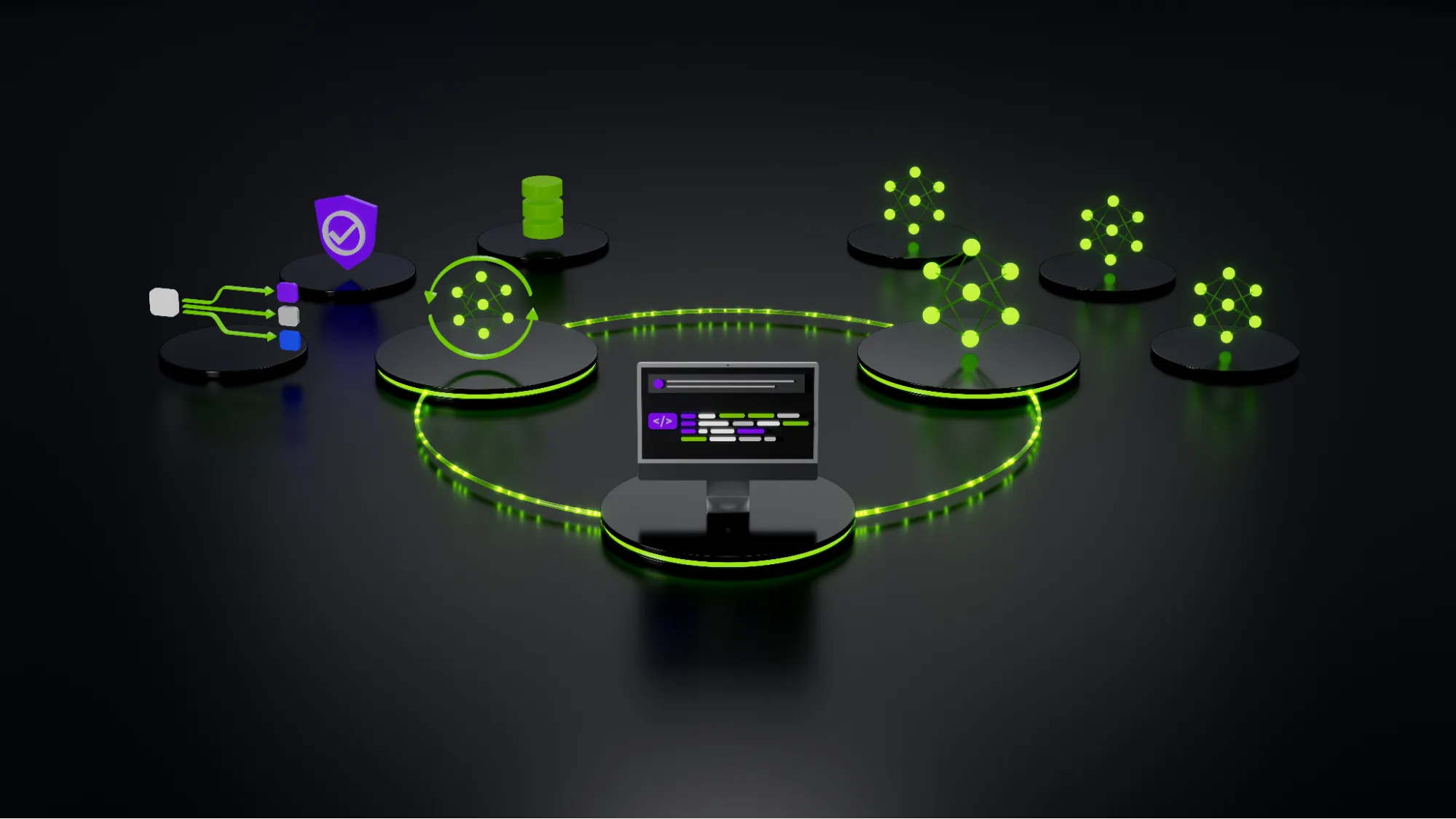
NVIDIA has released a technical guide detailing the use of reinforcement learning with verifiable rewards (RLVR) to improve the reliability and reasoning capabilities of AI agents. The framework utilizes NVIDIA's NeMo Gym and GRPO to support developers in building and optimizing domain-specific, agentic tool-calling workflows.
Key Takeaways
- NeMo Gym v0.3.0 features 70+ new environments and is integrated with Nemotron 3 Ultra training datasets
- NVIDIA Nemotron 3 Super was post-trained using 1.2 million environment rollouts across 37 datasets
- GRPO algorithm reduces memory and compute costs by roughly 50% by eliminating the separate critic model
- NVIDIA NeMo Data Designer provides synthetic data generation to simulate edge cases for training signals
- NVIDIA Nemotron 3 Ultra 550B (55B active) is optimized for frontier reasoning and complex multi-step agents
Why It Matters
The shift toward RLVR and GRPO marks a move from general-purpose assistants to specialized, verifiable agents capable of executing complex B2B video workflows with human-level accuracy. For streaming video, this translates to more reliable automated metadata tagging, ad-insertion logic, and technical triage systems that can pass algorithmic verification. As proprietary labs like OpenAI focus on closed-source reasoning, NVIDIA's open ecosystem provides the infrastructure for enterprises to reclaim control over their IP and deployment costs. Watch for adoption rates of reasoning models in automated video production environments, where verifiable output is critical for professional quality control.
Additional Context
The transition to agentic reinforcement learning comes as the industry moves beyond traditional Reinforcement Learning from Human Feedback (RLHF). Per reports from early 2026, algorithmic methods like GRPO have gained prominence because they provide a 2x increase in reasoning capabilities compared to standard fine-tuning. This efficiency is driven by the elimination of the separate critic model, which historically doubled the memory requirements for large-scale training. NVIDIA's recent releases, including the June 2026 launch of the Nemotron 3 Ultra 550B model, emphasize this efficiency-first philosophy by using sparse Mixture-of-Experts (MoE) architectures and Multi-Token Prediction (MTP) to reduce inference costs.
While NVIDIA builds the software stack, competition in the reasoning sector has intensified following the 2025 release of DeepSeek-R1. Per industry analysis from March 2026, DeepSeek's open-source success forced major cloud providers including AWS, Microsoft, and Google to integrate GRPO-based reasoning models into their primary AI hubs. Research from IDC in June 2026 suggests that roughly 77% of enterprises now have AI agents running in production, a shift from simple chatbots to goal-oriented systems that plan and execute across entire IT stacks. This trend is particularly evident in the life sciences and media sectors, where NVIDIA is increasingly deploying its 'AI Factory' concept for large-scale discovery and production automation.
Concurrent with these software updates, NVIDIA’s hardware strategy at GTC 2026 focused on multi-tenant GPU infrastructure. Per PR Newswire, March 2026, integrations between NeMo Studio and systems like Run:ai are designed to move AI development from isolated sandboxes to governed enterprise clusters. This infrastructure focus allows organizations to run the compute-intensive rollout phases of reinforcement learning across a wider range of GPU profiles, including the newer Blackwell Ultra chips, while maintaining visibility into quota enforcement and ROI for high-value silicon assets.
Read full article at developer.nvidia.com
Enjoy our coverage?
Add StreamingMeme as a preferred source on Google to see more of our streaming news at the top of your Search results.
Add as preferred source