

NVIDIA open-sources NOOA framework to boost agent performance and efficiency
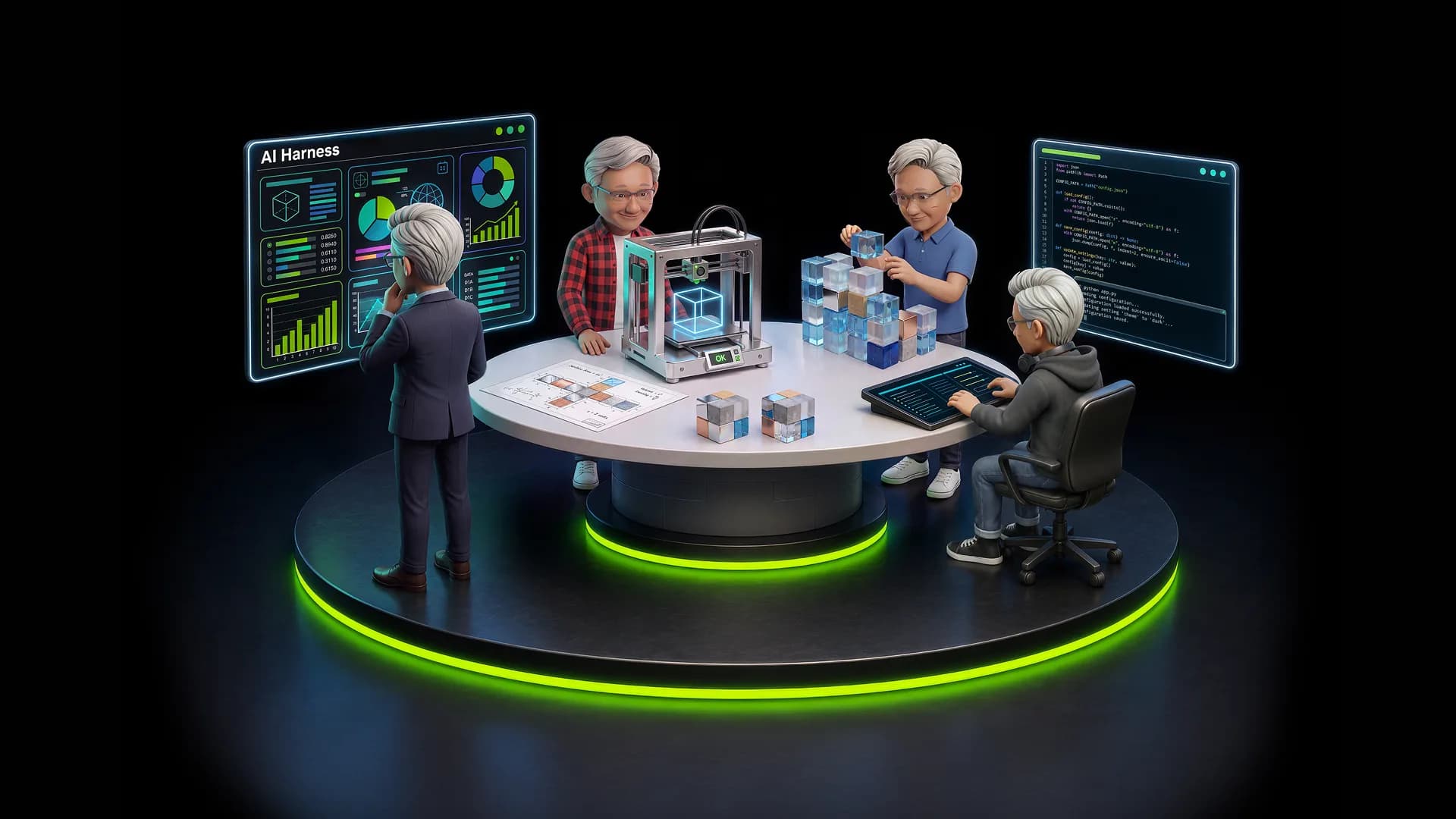
NVIDIA has released NVIDIA Labs Object-Oriented Agents (NOOA), an open-source framework designed to improve AI agent performance through software engineering-inspired architecture. The framework simplifies agent development by using single Python classes and introduces memory management systems that demonstrate efficiency gains on software engineering and cybersecurity benchmarks.
Key Takeaways
- Reaches 82.2% on SWE-bench Verified with GPT-5.5, outperforming the previous state-of-the-art leaderboard score of 79.2%.
- Reduces operational costs to approximately half by utilizing 'pass-by-reference' memory, requiring only 1.1M tokens per task versus 2.2M for traditional harnesses.
- Eliminates background summarization pipelines in favor of an agent-curated SQLite memory store that supports knowledge graphs and cross-session learning.
- Secures 86.8% resolution on the CyberGym L1 benchmark, making it the highest-scoring open-source agent for reasoning-based vulnerability analysis.
Why It Matters
The shift from complex workflow graphs to object-oriented Python classes simplifies the technical stack for building autonomous agents. For streaming engineers and AI strategists, this move indicates that architectural 'harnessing' is becoming as critical as model selection for managing token costs and accuracy. By open-sourcing NOOA, NVIDIA is positioning its framework as a standardized defensive and operational layer within the enterprise AI ecosystem. This approach suggests that the next phase of agent development will focus on deterministic code enforcement and curated memory rather than increasingly large context windows. Watch for potential integrations of NOOA into NVIDIA’s NeMo and Cosmos suites for video search and summarization workflows.
Additional Context
The release of NOOA coincides with the launch of the Open Secure AI Alliance in July 2026, a 44-member coalition including Microsoft, IBM, and CrowdStrike that aims to establish an open-source software stack for AI security. Per Technical Blog reporting in July 2026, the alliance focuses on defensive assets such as Safetensors for secure weight storage and NVIDIA's NOOA for auditable agent harnesses. This movement emerged shortly after a production breach at Hugging Face in late 2024, where closed-source safety layers reportedly hindered forensic analysis, forcing the use of open-weight models to contain the intrusion.
Market data from IDC as of late 2024 projected that global enterprise spending on AI solutions will reach $632 billion by 2028, with agentic AI defined as the primary innovation frontier for 2025. While frontier models like GPT-5 and Claude 4 continue to dominate performance benchmarks, the industry is seeing a shift toward 'inference-specific' architectures. According to Cambrian-AI Research in March 2026, NVIDIA has adapted its hardware roadmap to include LPUs (Language Processing Units) and the Vera Rubin generation of chips to handle the explosive computational demand of agentic frameworks like NOOA.
Competitively, the agent framework landscape remains fragmented. As of June 2026, LangChain and Microsoft’s Agent Framework have maintained dominance in the enterprise sector, while CrewAI and AutoGPT lead in rapid prototyping. NVIDIA’s entry with NOOA targets a specific gap in the market: high-performance engineering tasks that require strict type safety and a human-readable state. This is particularly relevant given Recent SWE-bench Pro results from July 2026, which showed that even top-tier models like GPT-5 drop to approximately 23% resolution on real-world proprietary codebases, underscoring the need for more sophisticated agentic AI workflows.
Read full article at developer.nvidia.com
Enjoy our coverage?
Add StreamingMeme as a preferred source on Google to see more of our streaming news at the top of your Search results.
Add as preferred source