

NVIDIA Nemotron 3.5 ASR beats OpenAI Whisper speed by 14x
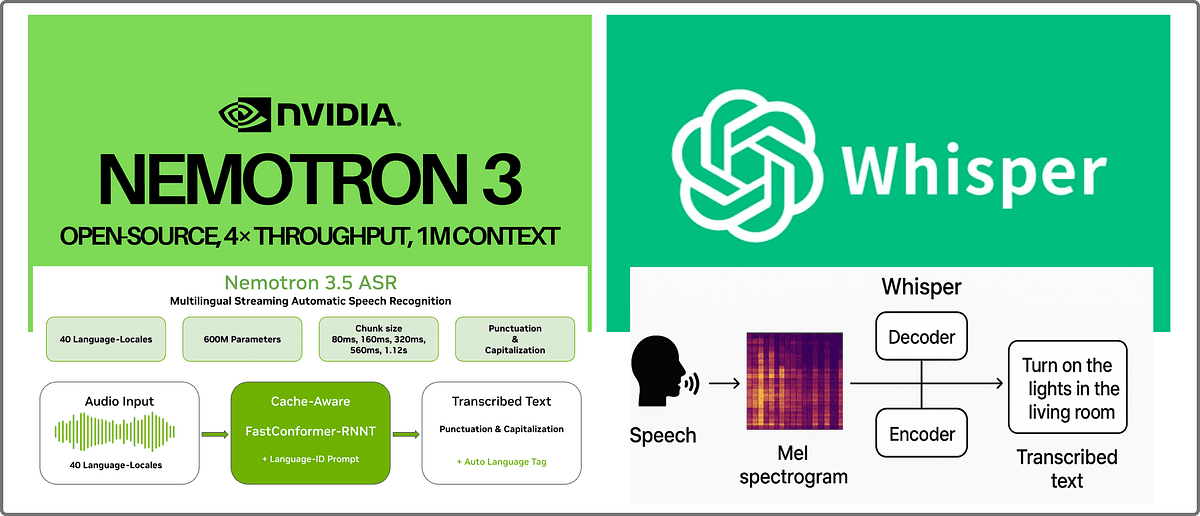
This technical explainer details the configuration and performance benchmarking of the NVIDIA Nemotron 3.5 ASR model using the parakeet.cpp inference engine. The article demonstrates a significant speed improvement over OpenAI's Whisper on CPU-only hardware, offering a viable path for developers building low-latency, offline automated captioning workflows.
Key Takeaways
- Nemotron 3.5 ASR transcribed audio in 32 seconds on CPU, compared to 7 minutes and 34 seconds for Whisper small.
- The parakeet.cpp engine enables local inference without Python or PyTorch, requiring only a single binary and a GGUF model file.
- The 600M model uses FastConformer architecture with 8x depthwise-separable downsampling and a rolling cache to minimize redundant computation.
- Native streaming capability allows frame-by-frame text emission, unlike Whisper’s fixed 30-second window approach.
- Quantization options for the model range from q4_k (718 MB) to near-lossless q8_0 (938 MB) for different RAM constraints.
Why It Matters
This development shifts the balance for developers requiring low-latency, private, and cost-effective speech-to-text without cloud dependencies. The speed delta on consumer-grade CPUs suggests that high-quality automated captioning and real-time transcription are increasingly viable for edge devices and privacy-first SaaS platforms. As NVIDIA’s conformer-based architecture outperforms traditional transformer encoder-decoder models in local throughput, the ecosystem may move toward specialized transducers for real-time applications. Watch for further adoption of GGUF-quantized streaming models in B2B knowledge management tools and live captioning stacks.
Additional Context
The performance gap observed between NVIDIA’s Nemotron family and OpenAI’s Whisper reflects broader architectural trends in automatic speech recognition (ASR). Per NVIDIA technical documentation from June 2026, the Nemotron 3.5 ASR model is designed specifically for high-concurrency streaming, supporting 40 language-locales from a single 600M-parameter checkpoint. Its cache-aware FastConformer-RNNT architecture reports up to 17x the concurrent streams of previous buffered approaches on NVIDIA H100 GPUs by eliminating the need to reprocess overlapping audio frames.
Industry benchmarks from March 2026 by E2E Networks further validate this efficiency, noting that while OpenAI’s release of Whisper large-v3-turbo (October 2024) significantly improved throughput via distillation, it remains architecturally bound to non-streaming fixed windows. Testing on NVIDIA L4 GPUs showed that Nemotron-based models consistently maintain word error rate (WER) across varying configurations, whereas Whisper models frequently suffer a 3.5% WER regression when chunked into 10-second windows for reduced latency, according to the same report.
The rise of local inference engines like parakeet.cpp and the broader LocalAI ecosystem, which mirrors the success of llama.cpp for language models, indicates a maturing market for self-hosted AI. As reported by ArXiv in April 2026, research into ONNX Runtime re-implementations and k-quant quantization strategies has brought sub-1GB ASR models to production-ready status on commodity hardware. This shift allows enterprise users to bypass per-minute API fees from providers like Deepgram or AssemblyAI, focusing instead on capital efficient, private-by-design infrastructure for internal call recording and meeting transcription services.
Read full article at medium.com
Enjoy our coverage?
Add StreamingMeme as a preferred source on Google to see more of our streaming news at the top of your Search results.
Add as preferred source