

NVIDIA BlueField-4 launches to offload infrastructure for agentic AI factories
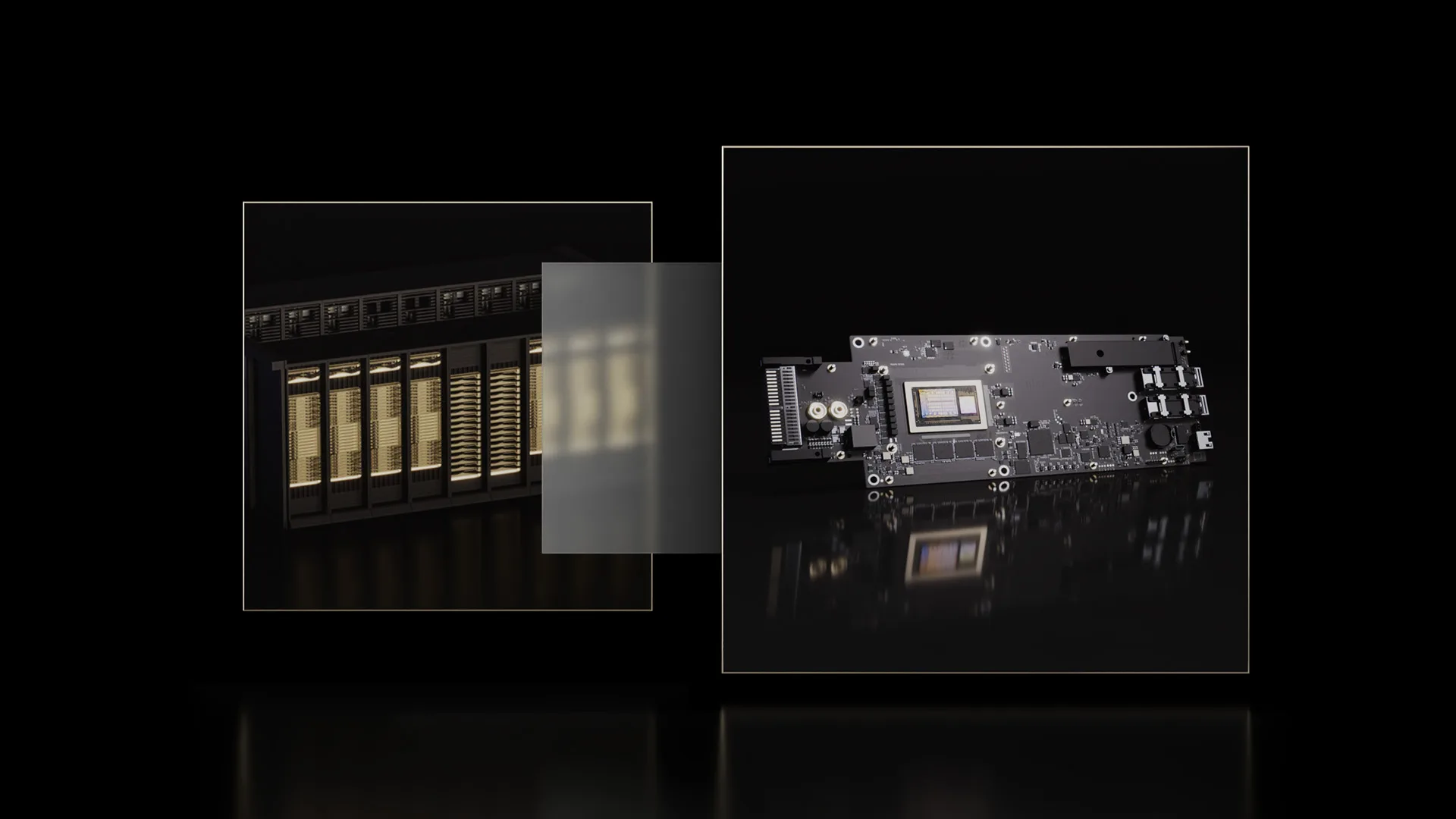
NVIDIA has announced the BlueField-4 platform, including a new DPU and the Vera STX storage processor, to offload infrastructure tasks such as telemetry, storage access, and security from CPUs in agentic AI environments. These technologies are designed to improve GPU utilization and reduce latency in high-performance AI data centers.
Key Takeaways
- BlueField-4 DPU supports up to 800 Gb/s connectivity and features a 64-core Grace CPU with 6x more compute performance than BlueField-3.
- The Vera STX storage processor enables 1.6 Tb/s Ethernet connectivity for high-performance context memory and AI-native storage.
- NVIDIA DOCA software now provides a unified programmable model for networking, security, and KV-cache reuse throughout the data center.
- Platform increases memory capacity by 4x and memory bandwidth by 3x compared to the previous generation.
Why It Matters
As agentic AI shifts inference from a single call to a multi-stage distributed workflow, infrastructure is becoming a primary bottleneck in the inference pipeline. These processors concretely address the high overhead of moving large KV caches and managing context memory, which otherwise forces expensive GPU recomputation or latency spikes. For the streaming and video industry, this architecture is essential for scaling complex generative video agents and real-time AI-driven content orchestration. Watch for the first production rollouts in the H2 2026 Vera Rubin platform launch to see if projected token-per-watt efficiencies translate to lower operational costs for high-scale video providers.
Additional Context
The rollout of BlueField-4 coincides with NVIDIA’s broader push into the 'Vera Rubin' architecture, which entered full production in June 2026 per NVIDIA's GTC Taipei announcements. This next-generation platform, scheduled for partner availability in the second half of 2026, centers on a unified data center rack that combines Rubin GPUs and Vera CPUs. Industry reporting from Wccftech in June 2026 indicates that NVIDIA has already secured the top spot in the data center Ethernet market, largely due to the integration of Spectrum-X and BlueField technologies that bridge the gap between traditional networking and AI-specific cluster demands.
Security is a major pillar of the 2026 roadmap, with NVIDIA introducing DOCA Vault and Argus libraries to provide in-silicon threat detection. Per Global Newswire, May 2026, these tools enable runtime detection up to 1,000x faster than software-only solutions by inspecting data directly at the DPU level. This 'zero-trust' approach is aimed at agentic AI systems that must autonomously access proprietary enterprise data without constant human oversight. Partners like Palo Alto Networks have already confirmed integration with the DOCA Argus framework to monitor kernel-level threats across AI factories.
Hardware manufacturers are moving rapidly to adopt the new reference architectures. Supermicro unveiled some of the first Context Memory (CMX) storage servers based on BlueField-4 STX in March 2026, targeting million-token workloads and generative video applications. These systems are designed to minimize the 'power wall' associated with massive data movement; per NVIDIA technical briefings, the STX architecture delivers up to 4x higher energy efficiency than traditional x86 storage for high-performance AI tasks. Cloud providers such as AWS, Google Cloud, and Oracle have also signaled plans to deploy these systems by late 2026 to support long-context reasoning for enterprise-grade autonomous agents.
Read full article at developer.nvidia.com
Enjoy our coverage?
Add StreamingMeme as a preferred source on Google to see more of our streaming news at the top of your Search results.
Add as preferred source