

NVIDIA automates VLM optimization with agentic reinforcement learning workflows
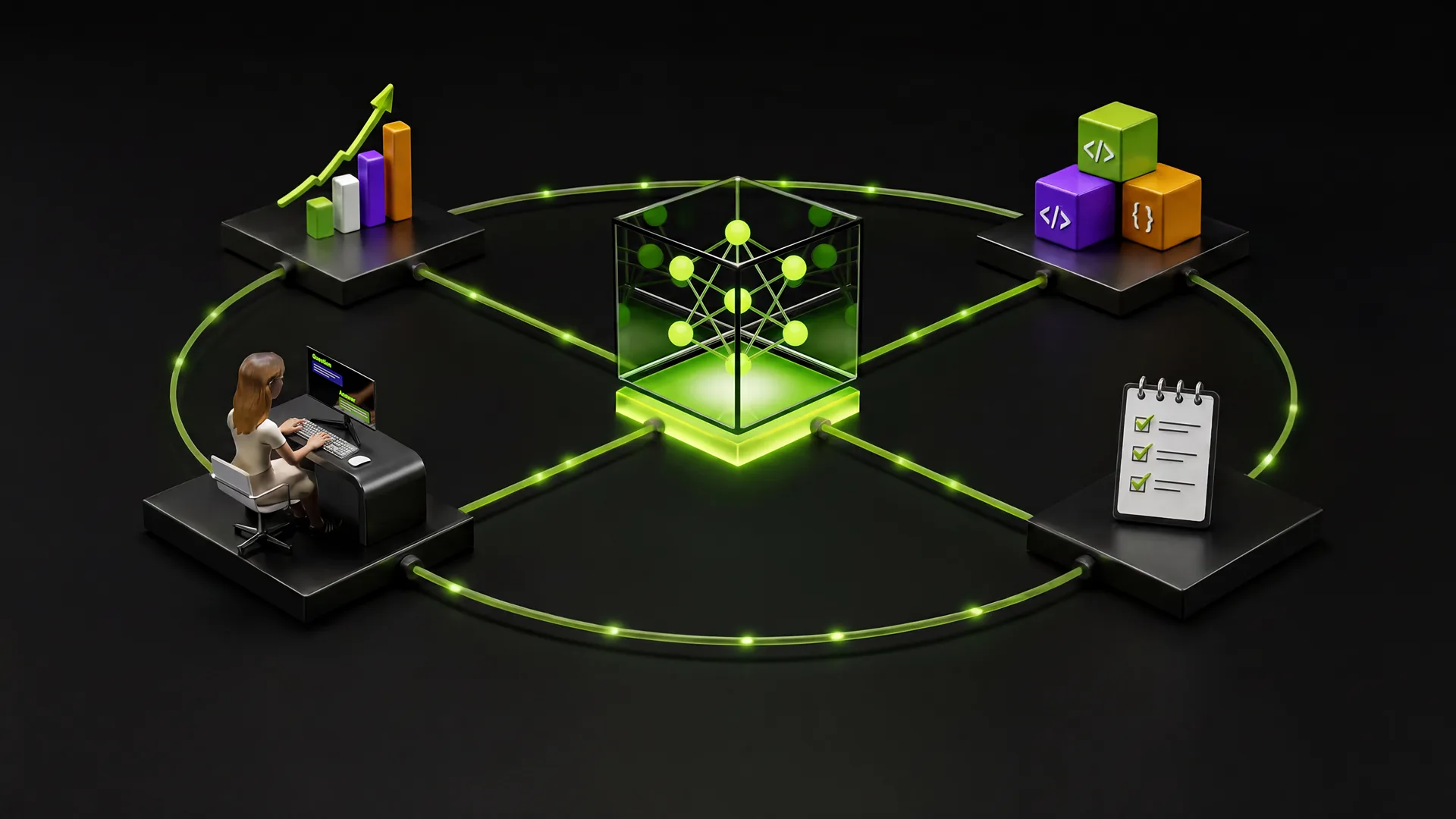
NVIDIA released a technical guide detailing an autonomous research workflow using AI agents, NVIDIA NeMo RL, and NeMo Gym. The workflow demonstrates how developers can use agentic AI to automate experiment setup, metric analysis, and model optimization for vision language models.
Key Takeaways
- Autonomous agents used Codex with GPT 5.5 to manage full-stack tasks including repository inspection, dependency resolution, and GPU memory management.
- Integrated three specialized skills—Brev-etiquette, Session-memory, and Autoresearch—to ensure system hygiene and durable tracking during long-running training campaigns.
- Demonstrated a 10-hour validation campaign that translated an off-policy RL algorithm from a research paper directly into functioning code.
- Utilized the NeMo RL framework, which supports GRPO, DPO, and SFT workflows orchestrated via Ray for distributed scaling.
Why It Matters
The transition from human-led fine-tuning to autonomous RL loops reduces the operational bottleneck of experiment infrastructure. By automating the repetitive 'hypothesize-test-verify' cycle, developers can rapidly adapt open-weight models like Nemotron to domain-specific vision tasks that were previously too labor-intensive to optimize. For the streaming and computer vision ecosystem, this accelerates the deployment of high-accuracy VLMs for automated content tagging and visual search. As these agentic workflows stabilize, the industry focus will shift from prompt engineering to the curation of verifiable RL environments. Watch for NVIDIA to integrate these autonomous skills into its broader Blackwell-generation software stack to lower entry barriers for enterprise-scale post-training.
Additional Context
The NVIDIA release follows a significant surge in interest for 'autoresearch' frameworks. Per Verdent.ai and VentureBeat in April 2026, Andrej Karpathy's open-source Autoresearch project gained over 66,000 GitHub stars within weeks of its launch. The project, often referred to as 'The Karpathy Loop,' demonstrated that AI agents could autonomously stack additive improvements to drop training benchmarks—such as Time to GPT-2—by as much as 11% overnight. These findings suggested that agents are becoming more effective at identifying hyperparameter optimizations that seasoned human researchers often overlook.
Related developments in the enterprise sector indicate a strategic shift toward verifiable reinforcement learning. In June 2026, industry reports from Firecrawl and EY noted that 'vertical AI agents' are beginning to outperform general-purpose models by training against domain-specific, verifiable tasks. NVIDIA has concurrently expanded its NeMo framework to support these trends; following the March 2026 release of Nemotron-3-Super, the company introduced NeMo-RL v0.6.0 in April 2026. This version added support for the Muon Optimizer and long-context training, specifically designed to handle the multi-step rollouts required for agentic reasoning.
Furthermore, the broader AI ecosystem is moving toward 'verifiable rewards' to stabilize agent behavior. According to llm-stats.com (March 2026), techniques like Group Relative Policy Optimization (GRPO) and Reinforcement Learning with Verifiable Rewards (RLVR) are replacing traditional RLHF for complex tasks. These methods allow models to learn from automated code execution results or mathematical correctness rather than subjective human feedback. Gartner projections from early 2026 suggest that by the end of the year, 40% of enterprise applications will embed similar agentic capabilities, reflecting a rapid transition from experimental prototypes to production-ready autonomous systems.
Read full article at developer.nvidia.com
Enjoy our coverage?
Add StreamingMeme as a preferred source on Google to see more of our streaming news at the top of your Search results.
Add as preferred source