
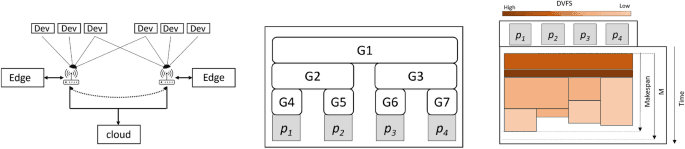
Researchers have proposed the SEOMDEC and DEOMDEC frameworks, which use Integer Linear Programming and heuristics to optimize energy consumption for streaming tasks across edge-cloud continuums. The model enables efficient orchestration of moldable streaming task graphs by managing core allocation, DVFS levels, and communication overhead in distributed systems.
This research provides a concrete roadmap for reducing the carbon footprint and operational expense of distributed streaming pipelines. By treating streaming tasks as 'moldable' rather than static, the SEOMDEC framework allows infrastructure providers to balance latency and power consumption dynamically. This is particularly relevant for high-throughput, low-latency applications like autonomous vehicle swarms or real-time 3D modeling. For the broader industry, it signifies a shift toward energy-aware orchestration that can scale across increasingly fragmented hardware layers. Watch for the integration of these ILP-based heuristics into commercial edge distribution platforms as costs-per-streamed-minute become a primary KPI.
The push for more efficient streaming orchestration arrives as the industry refocuses on margins over raw subscriber growth. Per Broadpeak in February 2026, streaming platforms have increasingly tracked 'cost per streamed minute' as a critical metric, driving workloads back toward private or hybrid infrastructures to avoid unpredictable cloud egress fees. This environment has prioritized 'utility over novelty,' where the ability to handle peak traffic events predictably and cost-effectively determines platform sustainability.
Technological advancement in hardware has further enabled this shift. According to research from IEEE Access in March 2026, the convergence of Neural Processing Units (NPUs) and smarter DVFS mechanisms has reduced energy consumption for demanding computational tasks by up to 75%. These gains are particularly vital in the context of 6G development, where the 'three-tier edge-cloud continuum' is becoming the standard for high-bandwidth IoT services.
Industry leaders are already operationalizing similar distributed strategies. Per Akamai in July 2026, the rise of edge distribution platforms (EDPs) has allowed enterprises to move complex application logic closer to end-users. These platforms integrate security, compute, and AI inference at the network perimeter, reflecting a broader ecosystem move toward the decentralized orchestration models outlined in the SEOMDEC research.
Add StreamingMeme as a preferred source on Google to see more of our streaming news at the top of your Search results.
Add as preferred source