

MIT research and Yann LeCun challenge language-based AI with video world models
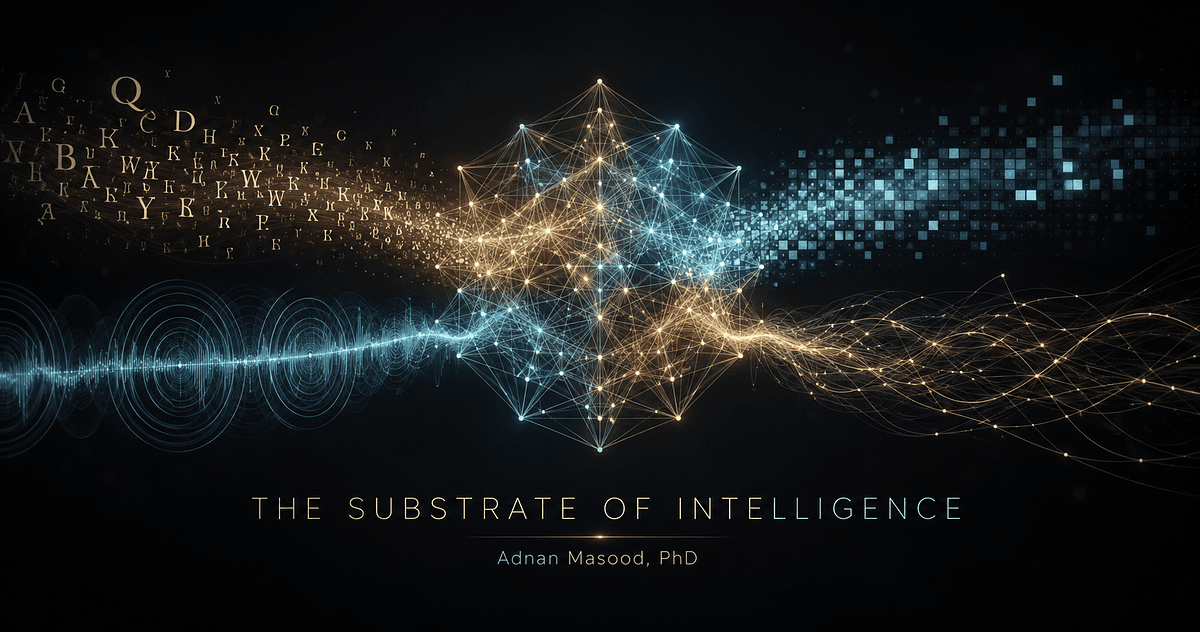
This article discusses the ongoing shift in machine intelligence paradigms, highlighting a divide between AI models trained primarily on massive text datasets versus those leveraging video, simulation, and action-oriented world models. The piece cites research from MIT and perspectives from Yann LeCun to argue that intelligence is not strictly dependent on natural language.
Key Takeaways
- MIT's McGovern Institute published evidence in PNAS (July 2026) showing the human brain uses distinct neural networks for logical reasoning and language.
- Aphasia patients with severe speech impairments successfully identified geometric and mathematical rules, proving abstract logic does not require linguistic ability.
- Billion-dollar investments are now divided between text-scaling models and those trained on video, action, and simulation data to build predictive world models.
- Yann LeCun argues that animal intelligence (corvids, octopuses) proves that reasoning runs on a compositional structure rather than a language-specific substrate.
Why It Matters
This shift validates a move away from LLM-centric architectures toward video-based 'world models' that could redefine streaming content generation and environmental simulation. For the industry, this confirms that the next leap in AI utility—specifically for predictive video and autonomous robotics—likely depends on video data rather than text tokens. If vision-based reasoning scales more efficiently than language, we may see a realignment of compute resources toward spatiotemporal transformers like those used in Sora or V-JEPA. Watch for higher adoption of video-to-action training sets as labs attempt to bridge the gap between pixel generation and physical understanding.
Additional Context
The research led by MIT’s Evelina Fedorenko and Hope Kean, published in July 2026, used functional MRI to show that inductive and deductive reasoning do not activate the brain’s language network. Instead, reasoning tasks engaged the 'multiple demand network,' a system linked to complex cognition. Per MIT reporting from July 2026, this neural dissociation suggests that while humans use language to communicate results, the underlying logic is non-linear and operates through specialized circuits independent of speech. This biological reality mirrors a deepening divide in the AI sector.
In the commercial space, this thesis is driving massive capital shifts. Per Quantum Zeitgeist (July 2026), Yann LeCun left Meta to lead AMI Labs, which secured a $1.03 billion seed round in March 2026 to develop the Joint Embedding Predictive Architecture (JEPA). Unlike OpenAI’s Sora, which uses diffusion transformers to generate pixels, JEPA-based world models are designed to learn abstract representations of reality from video, predicting physics and causal consequences rather than just the next frame or word.
Meanwhile, competitors continue to push the boundaries of data-dense video training. Per Google DeepMind (August 2025), the Genie 3 model provides a general-purpose world simulator that navigates interactive environments at 24 frames per second. These interactive real-time simulations prioritize 'object permanence' and intuitive physics over linguistic fluency. Additionally, NVIDIA’s Cosmos world foundation models, reportedly trained on 20 million hours of video by late 2025, signal a trend where video data—not just text scripts—becomes the primary training substrate for general intelligence.
Read full article at medium.com
Enjoy our coverage?
Add StreamingMeme as a preferred source on Google to see more of our streaming news at the top of your Search results.
Add as preferred source