

Meta integrates V-JEPA 2 into Hugging Face for simplified video modeling
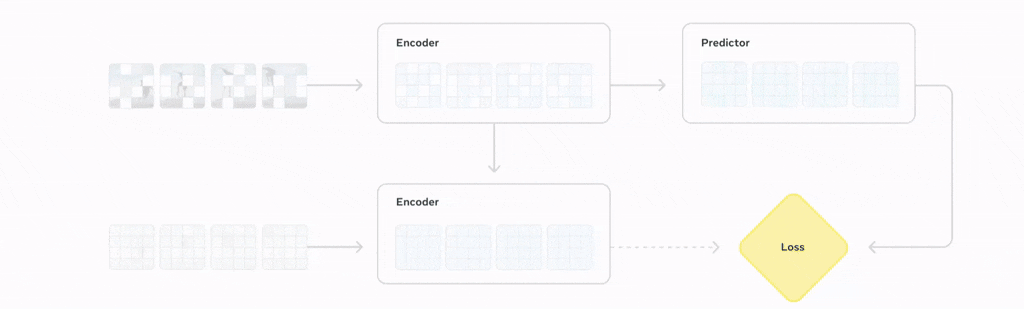
Meta has integrated its V-JEPA 2 video model into the Hugging Face transformers library, enabling developers to perform feature extraction and fine-tuning on frozen encoders. This integration provides a streamlined path for building video understanding and action-conditioned world models with reduced computational requirements.
Key Takeaways
- V-JEPA 2 supports ViT-L, ViT-H, and 1B-scale ViT-g encoders via the Hugging Face Hub.
- Integrated support for torchcodec streamlines video decoding by utilizing FFmpeg for frame sampling.
- The architecture uses a frozen encoder and attentive probing to reduce VRAM requirements during downstream task training.
- New V-JEPA 2.1 family adds a 2B-parameter 'Gigantic' variant and a dense predictive loss for local feature grounding.
Why It Matters
The integration commoditizes Meta's Joint Embedding Predictive Architecture, shifting video AI from pixel-heavy generation to efficient latent-space reasoning. By freezing the backbone and training only lightweight attentive probes, engineers can adapt 1B-parameter models on single mid-range GPUs. This move challenges the dominance of end-to-end fine-tuning, offering a modular template for robotics and high-precision video analytics. Strategically, Meta is reinforcing an open-weights ecosystem to counter closed-source video models, providing the technical infrastructure for others to build physical-world agents and autonomous systems.
Additional Context
V-JEPA 2 represents a shift in how Meta approach physically-grounded AI. Per Meta reports from June 2025, the model was pre-trained on over 1 million hours of internet-scale video to learn scene dynamics without the overhead of pixel-level reconstruction. A specialized variant, V-JEPA 2-AC (Action-Conditioned), was further trained on 62 hours of unlabeled robot trajectories from the DROID dataset. This allowed researchers to demonstrate zero-shot planning for tasks like reaching and grasping on hardware the model had never encountered before, using only monocular RGB input.
In March 2026, Meta updated the family with V-JEPA 2.1, introducing what researchers call 'dense features' to improve spatial and temporal grounding. Per the V-JEPA 2.1 whitepaper, this version incorporates multi-modal tokenizers and a 2B-parameter 'Gigantic' encoder variant. The updated architecture achieves a 20-point improvement in real-robot grasping success rates over the original 2.0 release and sets new benchmarks on egocentric datasets like EPIC-KITCHENS. While version 2.0 is fully integrated into typical library workflows, version 2.1 currently remains accessible primarily through Meta's direct repository and torch.hub entry points.
Read full article at medium.com
Enjoy our coverage?
Add StreamingMeme as a preferred source on Google to see more of our streaming news at the top of your Search results.
Add as preferred source