

M5Stack M.2 kit brings 24 TOPS AI and 8K video to Raspberry Pi 5
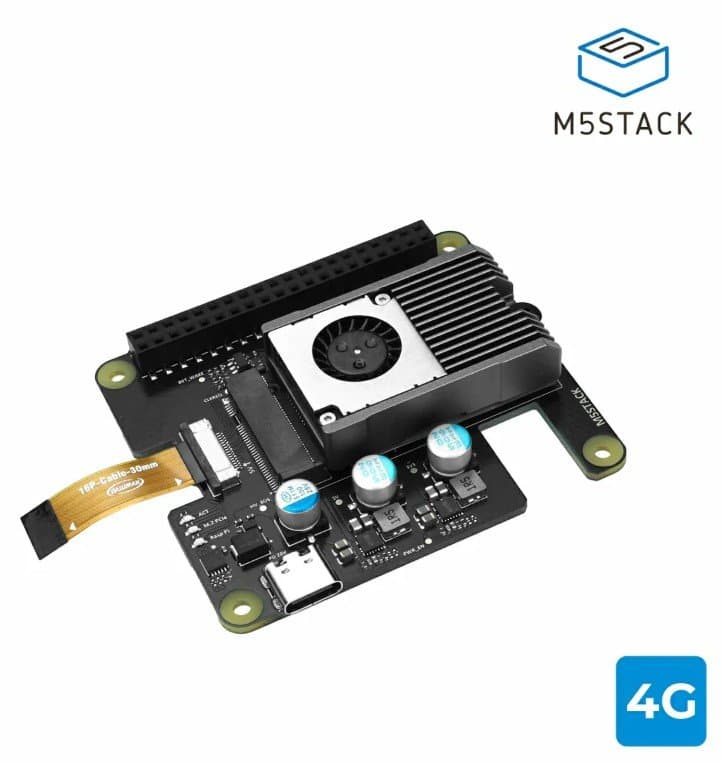
M5Stack has launched the LLM-8850 Kit, an M.2-based AI accelerator featuring the Axera AX8850 SoC, offering 24 TOPS INT8 NPU for edge AI with integrated H.264/H.265 video processing up to 8K/30fps. The kit is designed to integrate with the Raspberry Pi 5, enhancing capabilities for video analytics and multimodal AI workloads. It supports various operating systems and full-stack AI models, priced at $185.00 for the 4GB version.
Key Takeaways
- Delivers 24 TOPS INT8 NPU performance for local inference of CNN, Transformer, and Llama 3.2 models
- Hardware video engine supports 8K/30fps H.264/H.265 encoding and decoding with parallel 16-channel 1080p pipelines
- M.2 M-Key 2242 form factor integrates 4GB of 64-bit LPDDR4x memory and active thermal cooling solution
- Priced at $185.00 for the 4GB version with support for Ubuntu, Debian, and Windows operating systems
Why It Matters
The kit bridges the gap between low-power hobbyist boards and high-end industrial AI gateways by offloading heavy video and multimodal AI workloads to a dedicated NPU. For the video industry, this enables cost-effective, real-time 8K edge analytics and multi-channel 1080p transcoding without cloud latency or subscription fees. By leveraging the Raspberry Pi 5 ecosystem, M5Stack lowers the entry barrier for localized smart surveillance and automated tagging systems. Watch for whether software compatibility expands to ARM-based mini-PCs, which could challenge mid-range NVIDIA Jetson deployments in the computer vision market.
Additional Context
The launch of the LLM-8850 Kit follows Axera Semiconductor’s February 2026 listing on the Hong Kong Stock Exchange. Per 36Kr, the company raised roughly HK$2.96 billion to expand its presence in the edge AI market. Axera’s 8850 series, originally launched in late 2023, remains a cornerstone of its portfolio, with the firm shipping over 100,000 units of the series in 2024 alone. These chips are increasingly utilized in "physical AI" applications, ranging from smart retail kiosks to autonomous vehicle perception systems.
Axera’s dominance in visual AI inference is backed by its proprietary "AX Neutron" NPU and "AX Proton" AI-ISP (Image Signal Processor) architectures. According to HDIN Research, the company’s smart automotive division saw a 618% revenue surge during the 2025 fiscal year, signaling a pivot toward more complex moving-machine intelligence. This proprietary silicon strategy allows Axera to maintain high performance-per-watt ratios, a critical factor for edge devices like those produced by M5Stack.
Competition in the Raspberry Pi-compatible AI space has densified throughout 2026. Per AICerts, Raspberry Pi’s own AI HAT+, which uses Hailo-8L silicon, delivers 40 TOPS but is often constrained by memory costs in high-volume deployments. While M5Stack's 24 TOPS kit offers slightly lower raw throughput, its integrated 8K video encoder and 16-channel decode capabilities prioritize heavy video streaming and analytics workloads that basic NPU-only accelerators may struggle to maintain at sustained thermal loads.
Read full article at linuxgizmos.com
Enjoy our coverage?
Add StreamingMeme as a preferred source on Google to see more of our streaming news at the top of your Search results.
Add as preferred source