
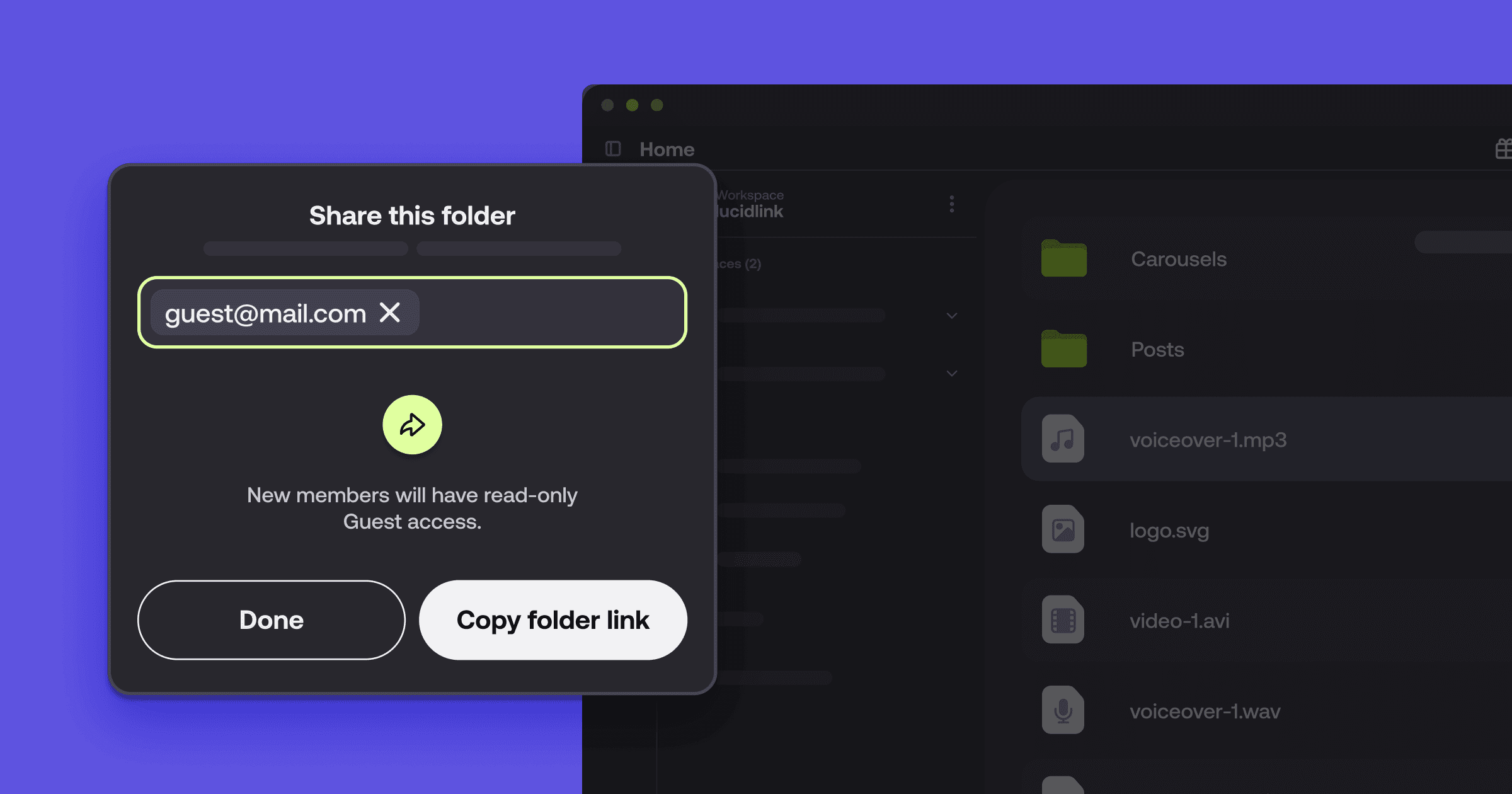
LucidLink announced Guest Access, a browser-based secure file sharing feature for external collaborators, along with a Directory Management API, FQDN-based proxy support, and an iOS app update. The features aim to streamline collaboration and enterprise deployment.
Guest Access directly targets the review-and-approval handoff that has forced production teams to copy large files to external transfer services for outside review. By keeping assets in the filespace under LucidLink's zero-knowledge model rather than duplicating them out, the feature reduces both the security surface and operational overhead of external review cycles. The Directory Management API and FQDN proxy support signal a push deeper into enterprise IT environments where programmatic provisioning and strict network policies are table stakes. Watch whether Guest Access adoption measurably reduces third-party file-transfer tool usage within LucidLink customer pipelines.
LucidLink's January 2026 release arrives amid a period of accelerated product expansion. In March 2026, the company launched LucidLink Connect, which streams data directly from existing S3-compatible object storage without migration or duplication. Per SiliconANGLE (March 5, 2026), Connect uses byte-range streaming to fetch only the file portions applications require, extending LucidLink's filespace model to external data stores. The capability is generally available on Enterprise plans, with AWS Marketplace purchasing forthcoming, and Azure Blob support is planned.
The company's market positioning has strengthened in parallel. Per LucidLink press materials covered by StorageNewsletter (April 16, 2026), LucidLink was named a Leader in G2's Spring 2026 Cloud File Storage Grid report, achieving a satisfaction score of 100 and a 93% user recommendation rate. The platform now manages over 90 PB across 150+ countries for 5,000+ businesses, including Paramount, Shopify, and Adobe.
LucidLink's primary competitors in the media-and-entertainment file delivery space include Signiant Media Shuttle, IBM Aspera, and EditShare. Per a Resilio Connect blog analysis, these alternatives emphasize point-to-point accelerated transfer rather than in-place streaming, positioning them as complementary tools for distribution rather than direct substitutes for real-time editing workflows. The same Resilio analysis flagged logged service outages during 2025 and early 2026 tied to underlying cloud provider disruptions — a structural reliability consideration for mission-critical broadcast workflows that persists alongside LucidLink's feature velocity.
Add StreamingMeme as a preferred source on Google to see more of our streaming news at the top of your Search results.
Add as preferred source