
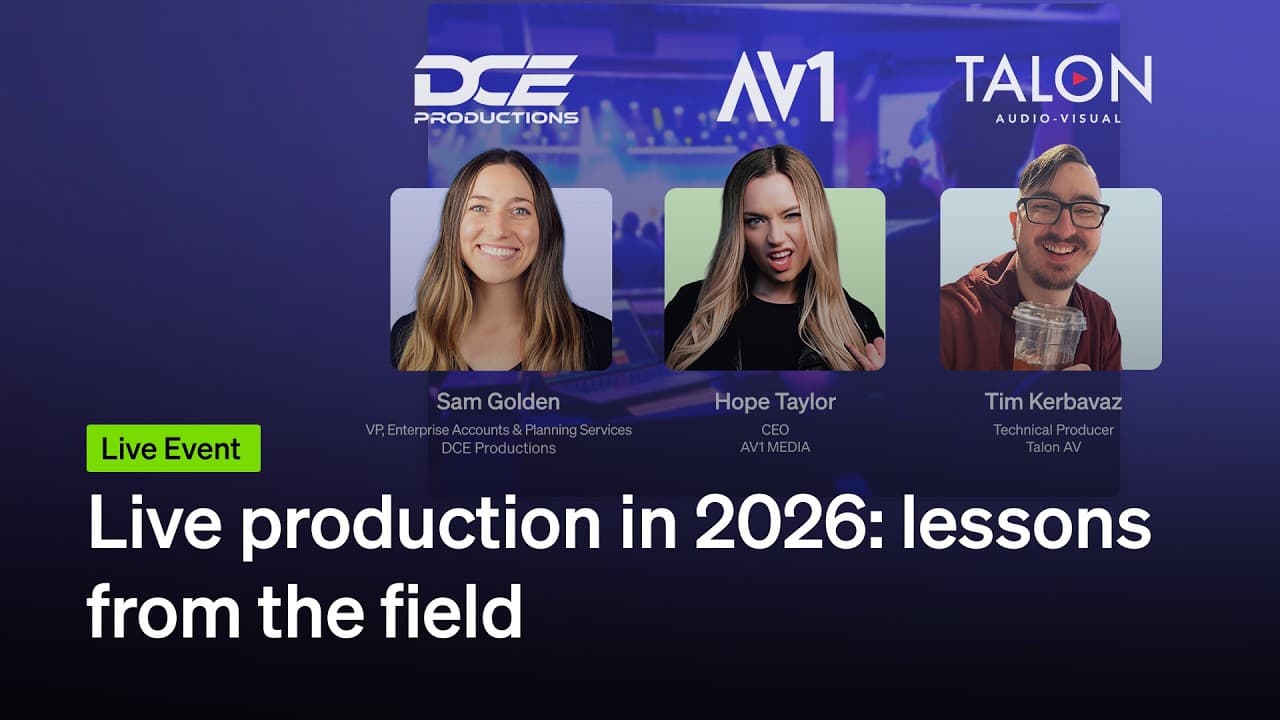
Experts from DCE Productions, AV1 Media, and Talon Audio Visual discussed evolving trends in live event production for 2026. The discussion focused on doing more with less, supporting various formats, and ensuring reliability in live shows, including aspects of connectivity, event accessibility, and streaming technologies.
The shift toward leaner production models indicates a permanent move away from the high-cost, hardware-heavy deployments of the previous decade. For streamers and B2B providers, this means the software-defined production stack must now deliver professional-grade reliability on consumer-grade connectivity. As accessibility requirements and multi-platform distribution become standard rather than optional, vendors who can integrate automated captioning and robust bonded-network solutions will likely capture the mid-tier enterprise market. Watch for a rise in hybrid-ready hardware that prioritizes SRT and NDI protocols to facilitate these high-efficiency workflows.
The 2026 live production landscape is characterized by a transition from experimental IP workflows to standardized operational efficiency. Per NewscastStudio in April 2026, the broadcast industry has moved past the 'proof-of-concept' phase for cloud production and IP distribution, focusing instead on making these tools function reliably at scale with stagnant crew sizes. This aligns with the 'efficiency imperative' noted by Adobe's Meagan Keane, who highlighted that success in 2026 is measured by the ability of smaller teams to manage more content across more platforms simultaneously.
Technological adoption at the 2026 NAB Show further supports these shifting field lessons. Per TV Technology in March 2026, broadcasters are increasingly adopting hybrid production architectures that combine cloud-based workflows with on-premise processing using SMPTE ST 2110 and SRT standards. Companies like Vizrt and Panasonic are responding with AI-powered automation and platforms like KAIROS, designed to reduce operator load and eliminate traditional hardware limitations such as outside-broadcast vans.
Accessibility and connectivity also see significant focus through technological integration. According to reports from The Penn Group in January 2026, over 123 million hybrid events occurred in 2025, driving the development of AI-driven simultaneous translations and intelligent network designs for live environments. Talon Audio Visual and similar technical agencies are using cell-bonded networks to ensure stable connectivity in venues with unreliable local internet, treating event technology as a foundational infrastructure rather than a secondary consideration.
Add StreamingMeme as a preferred source on Google to see more of our streaming news at the top of your Search results.
Add as preferred source