

Liquid AI doubles tokenizer size to boost edge decoding speeds up to 3.7x
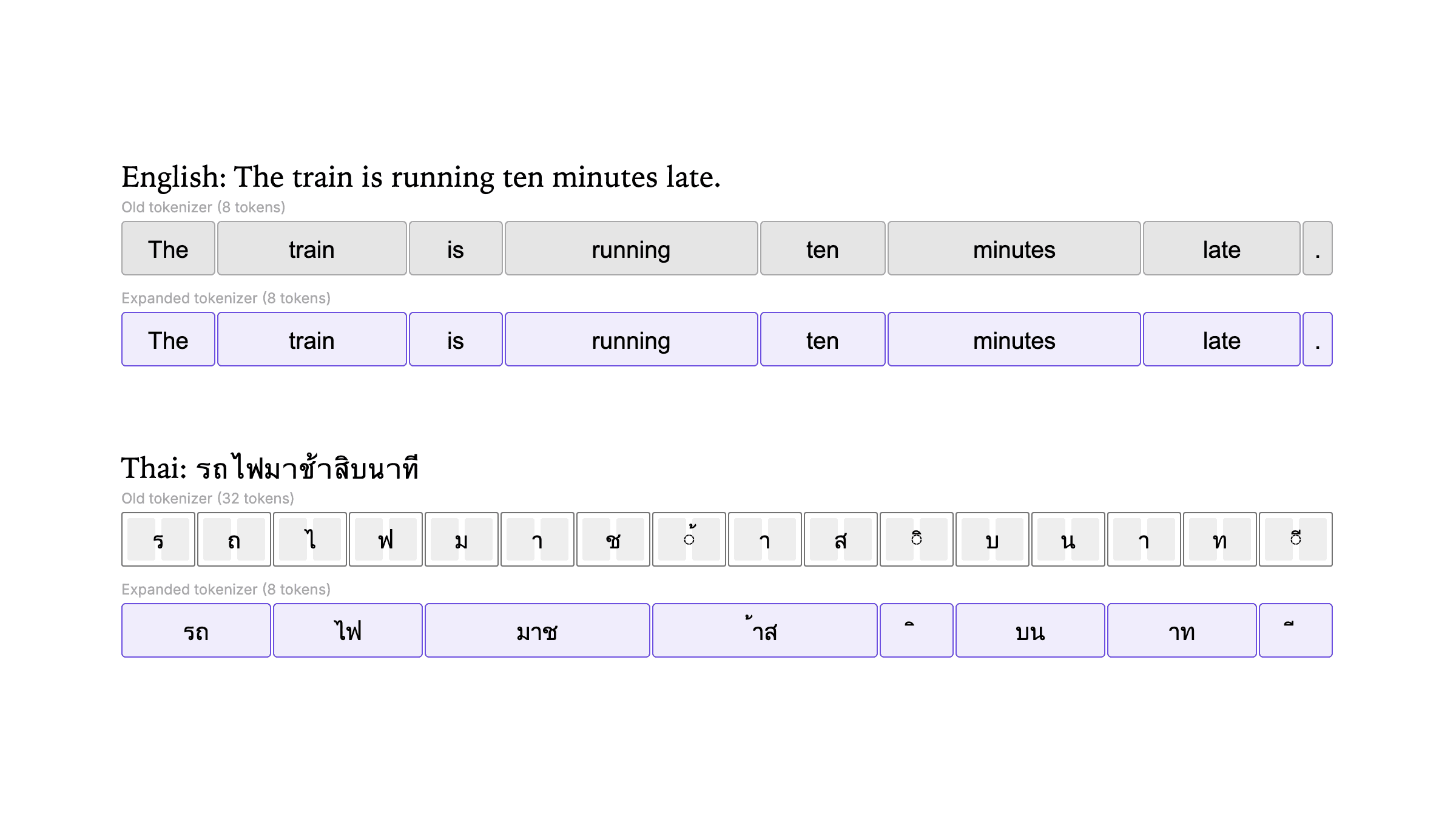
Liquid AI has updated the tokenizer for its LFM2.5-8B-A1B model from 65K to 128K, aiming to improve efficiency for non-English languages including Thai, Hindi, and Vietnamese. The company reports that this in-place vocabulary expansion reduces token counts and accelerates on-device decoding speeds by up to 3.7x on specific mobile silicon.
Key Takeaways
- Vocabulary expansion from 65K to 128K reduced Thai token counts by 4.0x and Hindi by 2.4x.
- The in-place upgrade uses a two-stage adaptation method that preserves model quality while folder-integrating new tokens.
- Net character-level decoding speed improved up to 3.7x on Snapdragon 8 Elite Gen 5 and Apple M4 Max silicon.
- Per-token decoding latency increased by 7-10% due to larger matrix math, though total text generation time decreased.
Why It Matters
Effortless multilingual performance on the edge is the next barrier for mobile-first streaming and agentic workflows. By upgrading the tokenizer in place, Liquid AI addresses the 'token tax' that historically penalized non-Western scripts with higher compute costs and higher latency. For the streaming ecosystem, this indicates a shift toward hyper-localized on-device metadata processing and real-time translation tools that don't depend on cloud infrastructure. Watch for competitors to adopt similar 'continue-pre-train' tokenizer recipes to extend the lifecycle of existing frontier models without incurring the massive costs of full model retraining.
Additional Context
The demand for multilingual edge AI is accelerating as global platforms prioritize linguistic sovereignty and localized workflows. Per AI Data Insider in November 2025, regional initiatives like Switzerland’s Apertus and India’s Bhashini platform have introduced models supporting hundreds of languages to move beyond English-centric AI. Similarly, Alibaba’s Qwen 2.5 has been cited by industry reports as a benchmark for Asian language performance, utilizing sophisticated tokenization to maintain balanced representation across scripts. These developments underscore a clear market shift where native-language efficiency is treated as a strategic B2B requirement rather than an elective feature.
On the hardware front, Liquid AI’s benchmarks coincide with the launch of high-performance mobile silicon capable of handling larger local vocabularies. According to RedMagic and TechNews in September 2025, the Snapdragon 8 Elite Gen 5 (SM8850) features a third-generation Oryon CPU and Hexagon NPU specifically designed to boost on-device AI efficiency by 37%. Devices such as the Samsung Galaxy S26 and OnePlus 15 are expected to leverage these advancements to support complex local tasks like tool calling and real-time audio translation.
Furthermore, Liquid AI's LFM2.5 family represents a departure from standard transformer architectures, using hybrid gated convolutions to manage sequential data more efficiently on constrained hardware. As reported by VentureBeat in June 2026, the company’s focus on the 'agentic' edge—where models must follow structured instructions without wandering off-script—has led to benchmarks where sub-1B models compete with much larger systems like Google’s Gemma 3 1B. This specialization in compact, high-speed architectures positions Liquid AI to challenge cloud-dependent giants in the rapidly growing field of private, always-on edge intelligence.
Read full article at liquid.ai
Enjoy our coverage?
Add StreamingMeme as a preferred source on Google to see more of our streaming news at the top of your Search results.
Add as preferred source