

Leader emphasizes hybrid T&M tools to bridge SDI and IP transition
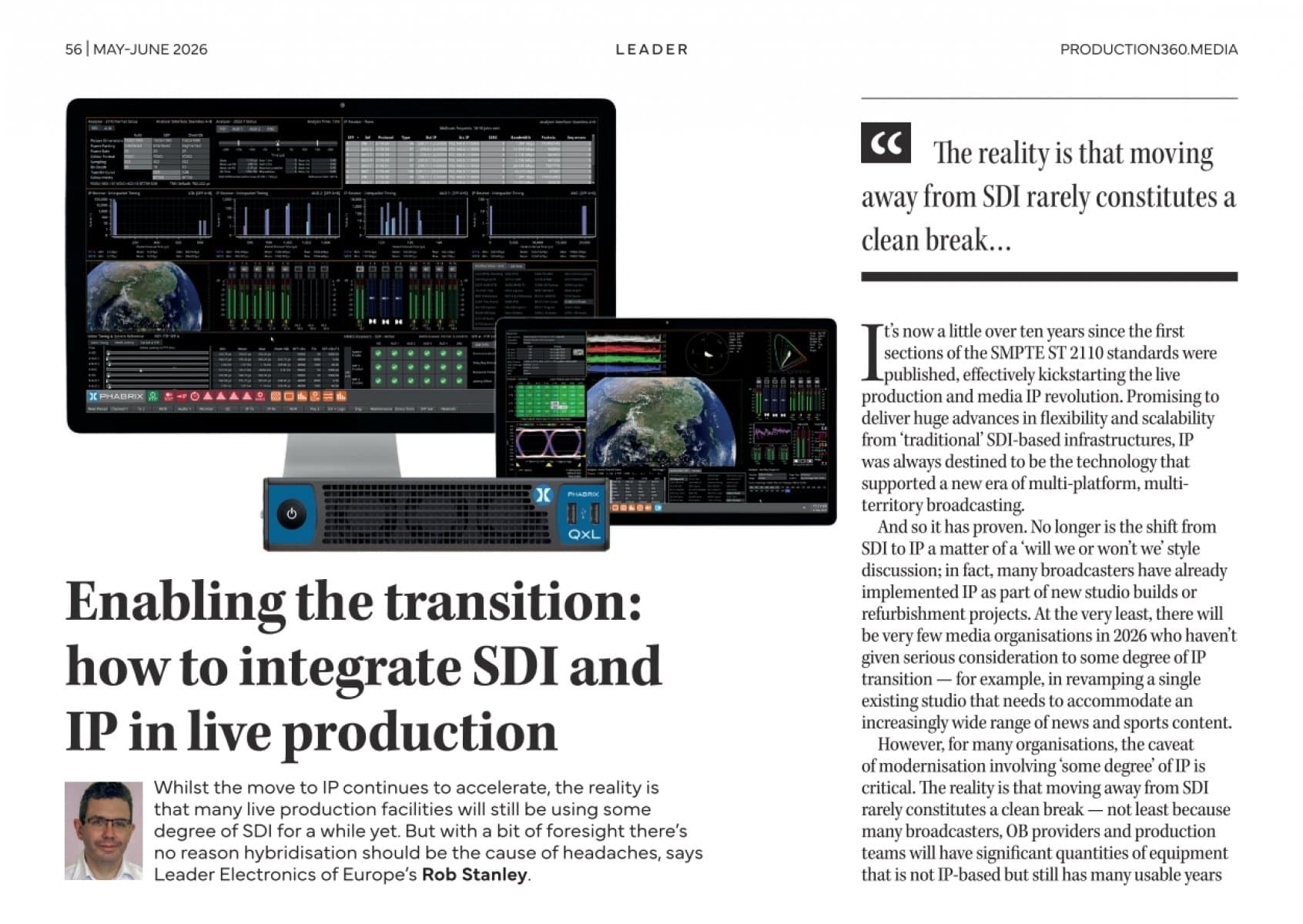
Leader Electronics' Rob Stanley discusses the ongoing transition in live production environments, emphasizing the need for hybrid SDI and IP solutions. The article highlights the role of test and measurement tools, like Leader's ZEN-W and PHABRIX Qx Series, in facilitating this integration for broadcasters. These tools span both 12G-SDI and various ST 2110 IP standards to ensure a smooth transition.
Key Takeaways
- Leader’s ZEN-W and PHABRIX Qx Series integrate legacy 12G-SDI support with modern ST 2110, ST 2022-6, and ST 2022-7 standards.
- Engineers are prioritizing familiar waveform monitoring and picture analysis tools to reduce the learning curve of IP diagnostics.
- Integrated monitoring solutions now combine network-level analysis of packet timing and jitter with traditional A/V quality metrics.
- Hybrid workflows are expected to remain common for several years due to historical renewal cycles and current economic uncertainty.
Why It Matters
The persistence of SDI alongside IP creates a technical bottleneck for broadcasters attempting to scale for 4K and remote production. By providing unified monitoring tools, vendors like Leader enable a phased migration that avoids the cost of dual-monitoring stacks. Successfully navigating this transition is critical for maintaining operational stability in high-stakes live sports and news environments, which cannot afford the packet loss or timing errors inherent in unoptimized IP networks. Stakeholders should monitor for the release of 100GbE-capable testing solutions as Tier 1 broadcasters push beyond initial 25GbE infrastructure limits.
Additional Context
The transition from SDI to IP is increasingly viewed not just as a hardware swap, but as an operational shift that requires deep network expertise. Per SmartTV Mag (March 2024), standard IT networking gear often struggles with the deterministic demands of uncompressed broadcast video, leading facilities to invest in specialized switches with robust Precision Time Protocol (PTP) support. This shift has also moved cost structures from traditional one-time capital expenditures to ongoing operational software licenses and continuous network monitoring.
While IP adoption is accelerating, the logic of keeping SDI remains strong for specific use cases. According to ISE Europe (May 2026), live production teams trust the plug-and-play reliability of SDI, leading to a long-term coexistence strategy. By 2026, roughly 65% of studios have planned for some level of cloud-native workflow integration, per PacketStorm (2025), but the local 'ground' infrastructure often remains a hybrid mix to manage total cost of ownership. This dual-format reality has driven demand for gateways and hybrid monitors that can bridge the visual interface gap.
Technological maturity in the SMPTE ST 2110 suite has stabilized deployment timelines. In May 2026, John Mailhot of Imagine Communications noted that the standard has moved from an emerging risk to a proven architecture for major events, including 16K sports coverage. However, as noted by TVB Europe (January 2025), the 'standardization of IP' is still a work in progress for Tier 2 and Tier 3 broadcasters who lack the technical scale of organizations like Disney or Warner Bros. Discovery, further extending the lifespan of SDI-based hardware.
Read full article at leaderphabrix.com
Enjoy our coverage?
Add StreamingMeme as a preferred source on Google to see more of our streaming news at the top of your Search results.
Add as preferred source