
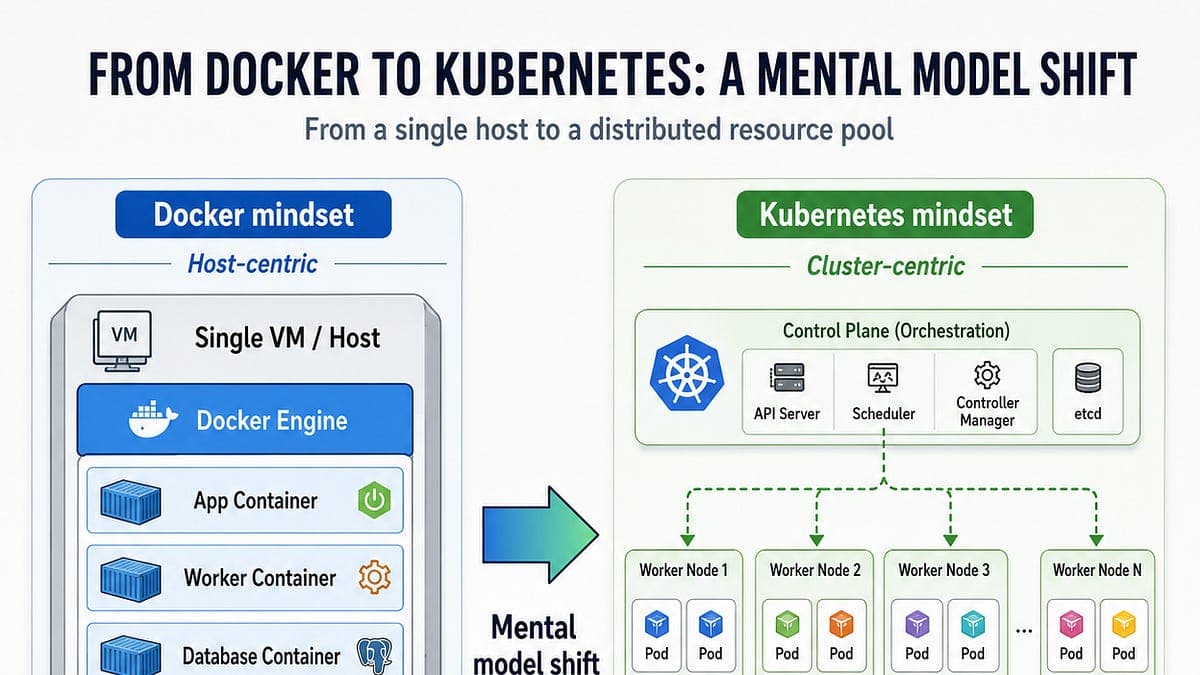
This technical guide details infrastructure strategies for deploying production AI workloads, specifically vLLM inference engines and computer vision encoders, on Kubernetes. It covers resource isolation, GPU scheduling, and model lifecycle management to optimize performance and reduce idle cloud infrastructure costs.
As streaming platforms integrate generative AI for metadata enrichment and real-time vision encoding, infrastructure efficiency becomes a primary cost driver. Standard container patterns often lead to 'noisy neighbor' issues or resource waste due to a lack of hardware-aware scheduling. By adopting event-driven scaling and multi-instance GPU (MIG) partitioning, engineers can reduce idle GPU spend by up to 100% during off-peak hours while maintaining low-latency inference. Watch for more specialized Kubernetes Custom Resource Definitions (CRDs) like KEDA to become industry standards for managing high-cost compute pools.
The shift toward Kubernetes-native AI orchestration has accelerated throughout 2026. Per NVIDIA and CNCF in March 2026, the donation of the Dynamic Resource Allocation (DRA) driver signaled a move away from the decade-old device plugin model toward an API-driven system that better understands GPU topology. This allows the Kubernetes scheduler to reason about NVLink connections and high-bandwidth memory (HBM) rather than treating GPUs as generic integer units. Further optimization arrived in May 2026 with NVIDIA's Dynamo Snapshot, a tool designed to reduce cold-start latency for single-GPU inference to near-zero by restoring loaded model states from checkpoints.
Simultaneously, major cloud providers have refined their managed offerings to support these high-performance patterns. According to Microsoft, by mid-2026, Azure Kubernetes Service (AKS) had transitioned from legacy NGINX Ingress to the Gateway API for AI Automatic clusters, providing the more granular traffic control required for multimodal LLM endpoints. Competitive analysis from Cast AI in April 2026 found that while GPU adoption is surging, average utilization in unoptimized clusters remains as low as 5%, underscoring the necessity of the cloud native AI operations and event-driven triggers suggested by recent research.
Add StreamingMeme as a preferred source on Google to see more of our streaming news at the top of your Search results.
Add as preferred source