

Ideogram 4 open-weight model adds native JSON layout and 2K resolution
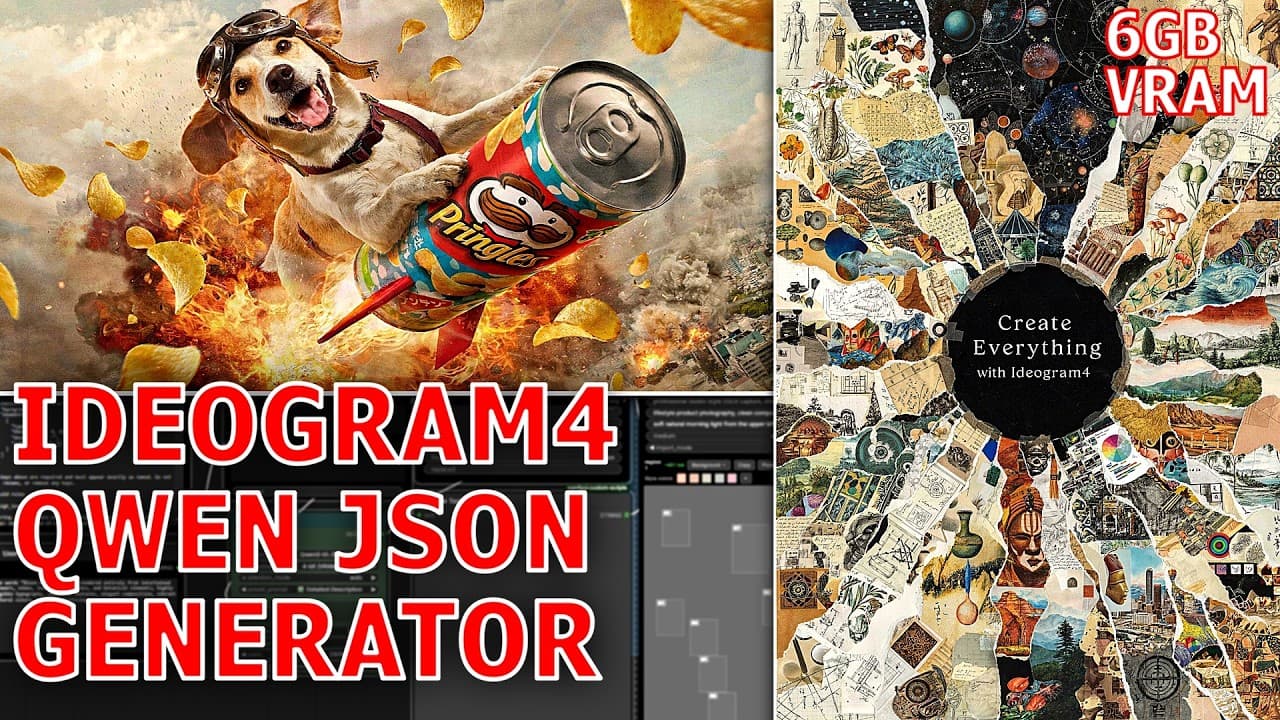
This YouTube tutorial introduces Ideogram 4, an open-weight text generation model with enhanced typography and flexible resolution up to 2K, leveraging a single-stream architecture for image generation. It demonstrates how to run the model with low VRAM using ComfyUI and a custom JSON prompt generator, Qwen VL, for precise control over image elements. The tutorial highlights Ideogram 4's capabilities in realistic human and product images, and exceptional performance in generating posters with integrated text.
Key Takeaways
- 9.3B parameter Diffusion Transformer architecture uses Qwen3-VL-8B-Instruct as its vision-language text encoder.
- Native 2K resolution support allows direct generation of square thumbnails, wide banners, and large-format posters.
- Structured JSON prompting enables precision control over bounding-box coordinates (0–1000 scale) and 16-color hex palettes.
- Available in FP8 and NF4 quantizations, with the NF4 version optimized for 24GB VRAM local GPU setups.
- Ranked as the top open-weight model on DesignArena, surpassing competitors like Flux.2 Dev in typography benchmarks.
Why It Matters
Ideogram 4 shifts the text-to-image workflow from probabilistic sampling to deterministic design. By integrating JSON-driven layout and hex color controls, it provides engineers and designers with a blueprint-like interface for branding and advertising assets. This move positions open-weight models as viable contenders against closed-source systems like GPT Image 2, particularly in professional contexts where spatial accuracy and brand fidelity are non-negotiable. For the streaming and advertising ecosystem, this enables programmatic generation of localized marketing materials at 2K resolution without the artifacts often introduced by post-processing upscalers. Watch for the forthcoming software update to provide a native GGUF loader to further optimize inference times on consumer hardware.
Additional Context
The release of Ideogram 4 on June 3, 2026, marks the first time the company has provided public weights for a foundation model, as reported by open-source sources on GitHub and Hugging Face. While the architecture is released under Apache 2.0, the model weights themselves carry a non-commercial license, which restricts use in direct revenue-generating streams without specific enterprise agreements. This reflects a broader 2026 industry trend where labs release weights to drive community innovation while guarding commercial monetization.
Architecturally, Ideogram 4 utilizes a 34-layer single-stream Diffusion Transformer (DiT). Per technical documentation from the June 2026 launch, text and image tokens share the same projections, facilitating deeper cross-modal interaction than traditional separate-branch models. Competitively, it targets the gap left by proprietary leaders. According to a ContraLabs blind evaluation of ten professional designers in early June 2026, Ideogram 4 was voted the top choice 47.9% of the time for typography tasks, significantly outperforming Google's Nano Banana 2 (30.0%) and Black Forest Labs' Flux.2 [max] (15.5%).
Beyond current capabilities, the Ideogram 4 roadmap includes editable text layers and transparent alpha channels at inference. Per an announcement on the company’s official blog (June 2026), these features aim to eliminate the need for third-party background removal or external OCR-to-vector tools. This vision of a "layered generation stack" aligns with market shifts toward modular asset creation, where AI outputs serve as production-ready components rather than flat, uneditable frames.
Read full article at youtube.com
Enjoy our coverage?
Add StreamingMeme as a preferred source on Google to see more of our streaming news at the top of your Search results.
Add as preferred source