
StreamingMemeStreamingMemeBuyers Guide
AboutLeaderboardsEventsSubmit News
Subscribe

Daily Brief

The streaming industry in your inbox every morning.

Daily Brief

The streaming industry in your inbox every morning.

StreamingMemeStreamingMeme

The independent buyers guide and news aggregator for the streaming technology industry.

Explore

Buyers GuideLeaderboardsEventsSubmit News

Stay updated

Weekly digest of new companies and streaming news.

Categories

Encoding & SoftwareVideo Delivery & CDNStreaming PlatformsAI for VideoProduction HardwareBusiness NewsMonetization & Ad TechRegulatory & Policy

© 2026 StreamingMeme. All rights reserved.

AboutPrivacy PolicyTermsContact
EncodingCDNPlatformsAI & VideoHardwareBusinessAd TechPolicy
← Video Delivery & CDN
CDNTechnical Development

HTTP/2 Bomb Vulnerability: Apache, Envoy, Nginx Face DoS Risk

HTTP/2 Bomb Vulnerability: Apache, Envoy, Nginx Face DoS Risk
Penligent Security Blog – AI-Driven Hacking Tutorials, Exploit PoCs & Cybersecurity Research

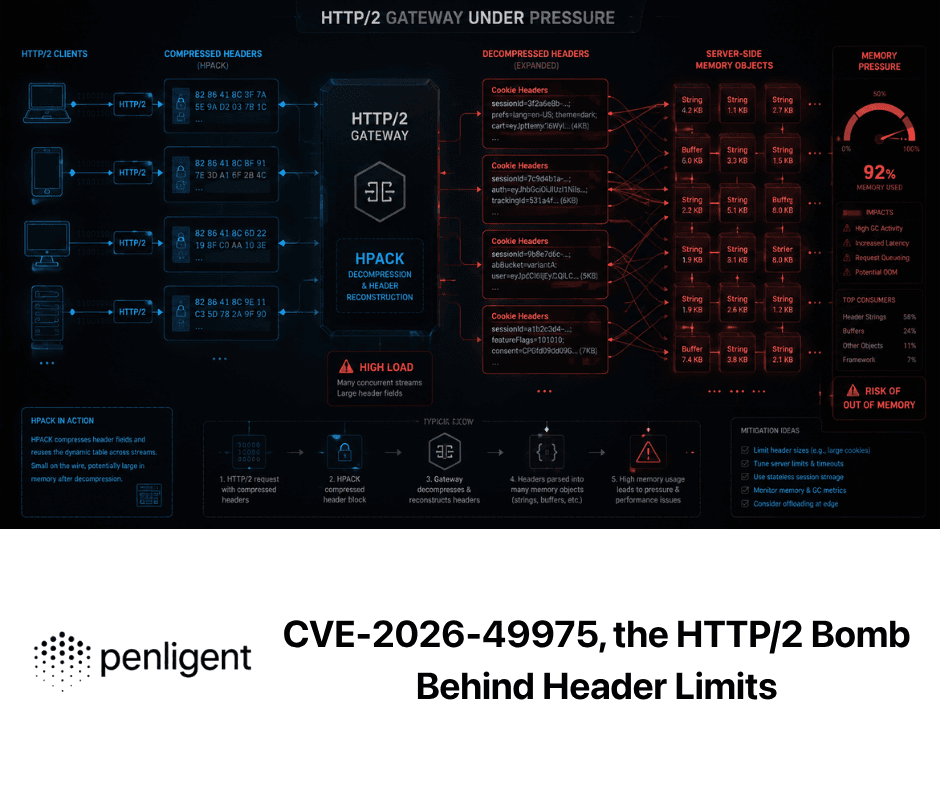
Penligent has published details on CVE-2026-49975, an HTTP/2 Bomb vulnerability affecting Apache httpd (and related issues in Envoy, nginx, IIS, Cloudflare Pingora) due to cookie header accounting flaws. This vulnerability allows small compressed header patterns to expand into costly internal objects, creating remote memory pressure and potential denial-of-service attacks. The article advises streaming industry professionals to inventory HTTP/2 termination points, apply patches, and implement mitigations to prevent these attacks.

Key Takeaways

  • CVE-2026-49975 specifically addresses an Apache httpd cookie header accounting flaw, fixed in `mod_http2` version 2.0.41.
  • The broader 'HTTP/2 Bomb' class impacts servers including Envoy (CVE-2026-47774), nginx (v1.29.8+ with `max_headers`), IIS, and Cloudflare Pingora.
  • The attack uses HPACK decompression and HTTP/2 flow control to expand small requests into large server-side memory allocations, which are then held by stalled streams.
  • Existing header limits often fail to prevent this due to differing interpretations of encoded size, decoded size, object count, and header field accounting, especially for split `Cookie` fields.
  • Mitigation requires patching, disabling HTTP/2 where not critical, implementing strict header-count limits, and applying container memory limits to contain impact.

Why It Matters

This vulnerability class underscores critical, often overlooked, exposure points in streaming infrastructure, potentially disrupting content delivery and platform stability. It highlights how underlying protocol inefficiencies can be weaponized into availability bugs across major web servers and CDNs. Streaming providers must conduct thorough audits of all HTTP/2 termination points—from edge CDNs to internal service mesh components—and implement multi-layered defenses. The focus is now on comprehensive configuration and version management, particularly for ingress and gateway services, to prevent memory exhaustion and ensure continuous service for demanding live and on-demand video workloads.

Additional Context

The "HTTP/2 Bomb" exploit, publicly detailed by Penligent and Calif in June 2026, chains two long-standing HTTP/2 vulnerabilities: HPACK compression bombs and Slowloris-style connection holds (per SecurityWeek, June 2026). While individual components of the exploit have been known for a decade, an AI assistant, Codex, identified how to combine them for maximum effect (Calif blog, June 2026). The attack can knock web servers offline in seconds, with a single client capable of consuming 32GB of server memory from Apache httpd or Envoy in under 20 seconds, even from a 100Mbps connection (Calif blog, June 2026). Researchers note that existing header limits often fail to prevent this due to the nature of compression amplification and how servers count headers, particularly split cookie fields (CSO Online, June 2026). Nginx addressed the vulnerability with the `max_headers` directive in version 1.29.8, while Apache's fix for CVE-2026-49975 is in `mod_http2` v2.0.41. Envoy released patches for several versions including 1.35.11, 1.36.7, 1.37.3, and 1.38.1 (Calif blog, June 2026). Microsoft IIS and Cloudflare Pingora were also identified as vulnerable, but specific patches were not immediately available at the time of the initial disclosure. The incident underscores the need for robust memory management and configuration practices in HTTP/2 deployments, particularly as AI-powered tools become more adept at discovering complex exploit chains (SecurityWeek, June 2026).


Read full article at penligent.ai

Get this in your inbox → Subscribe

Enjoy our coverage?

Add StreamingMeme as a preferred source on Google to see more of our streaming news at the top of your Search results.

Add as preferred source

Related Articles

CDNsun: Akamai and Azure Front Door diverge on media and security features
Lib.rs: Moq-relay 0.3.1 adds mTLS and admission policies for production-grade QUIC streaming
Sebastian Barros via Substack: Verizon secures $1B+ Google deal for AI data center dark fiber

Newest

1 day ago
Barchart: Cerebras and AMD partner on low-latency AI inference architecture
1 day ago
Light Reading: Charter sidesteps Starlink partnership rumors as Q2 broadband losses widen
1 day ago
GuruFocus: Fastly joins Experian to secure autonomous commerce at the edge
1 day ago
The BIG Newsletter: Nexstar and TEGNA Accused of Violating Judicial Order in $6.2 Billion Merger
1 day ago
AI Rights Brief: Google and Disney integrate AI provenance directly into programmatic ad workflows
1 day ago
Front Office Sports: World Cup afternoon ratings spark shift toward earlier U.S. game windows
1 day ago
Futurism: Meta and TikTok face backlash over deceptive AI-generated health ads
1 day ago
Wccftech: Qualcomm Adreno 850 GPU to debut AI Frame Fusion technology
1 day ago
Beet.TV: Brands must re-describe catalogs for AI agents to maintain discoverability
1 day ago
daily.dev: AVIF achieves universal browser support as Edge and Safari close gaps
1 day ago
Los Angeles Times: Disney, Netflix, and Amazon recruit AI talent to automate production workflows
1 day ago
Callaba: Callaba standardizes remote production workflows via SRT and NDI integration
1 day ago
Lib.rs: New zero-dependency Rust decoder vp9dec achieves bit-exact VP9 conformance
1 day ago
IT Brief UK: Fetch.ai and RedSquid TV launch first agentic AI television platform
1 day ago
Vocal: TeqBlaze challenges Epom with modular full-stack white-label ad tech suite
1 day ago
Euronews: EU Expert Panel Backs Age Restrictions and Addictive Feature Bans
1 day ago
Cord Cutters News: FCC chair signals scrutiny for potential streaming-exclusive 2030 World Cup rights
1 day ago
Audio Chocolate: Merging Technologies debuts Anubis Premium SPS for mission-critical broadcast audio
1 day ago
Cord Cutters News: Linear contraction accelerates as 14 cable networks vanish in five years
1 day ago
IPWatchdog: EC mandates Google share search data and Android features under DMA

Upcoming Events

Jul
29–30
Buffer-Free VideoSeattle
Aug
17–20
SET EXPOSao Paulo
Sep
11–14
IBCAmsterdam
Sep
13
SportsPro Streamtime Sports LiveAmsterdam
Sep
16–18
RTC.ONKrakow
View all events →

Top Sources

  1. 1.Sports Video Group104
  2. 2.SiliconANGLE91
  3. 3.YouTube63
  4. 4.Tech Times60
  5. 5.AdExchanger57
  6. 6.TechCrunch55
  7. 7.arXiv50
  8. 8.PPC Land48
Full leaderboards →

Newest

1 day ago
Barchart: Cerebras and AMD partner on low-latency AI inference architecture
1 day ago
Light Reading: Charter sidesteps Starlink partnership rumors as Q2 broadband losses widen
1 day ago
GuruFocus: Fastly joins Experian to secure autonomous commerce at the edge
1 day ago
The BIG Newsletter: Nexstar and TEGNA Accused of Violating Judicial Order in $6.2 Billion Merger
1 day ago
AI Rights Brief: Google and Disney integrate AI provenance directly into programmatic ad workflows
1 day ago
Front Office Sports: World Cup afternoon ratings spark shift toward earlier U.S. game windows
1 day ago
Futurism: Meta and TikTok face backlash over deceptive AI-generated health ads
1 day ago
Wccftech: Qualcomm Adreno 850 GPU to debut AI Frame Fusion technology
1 day ago
Beet.TV: Brands must re-describe catalogs for AI agents to maintain discoverability
1 day ago
daily.dev: AVIF achieves universal browser support as Edge and Safari close gaps
1 day ago
Los Angeles Times: Disney, Netflix, and Amazon recruit AI talent to automate production workflows
1 day ago
Callaba: Callaba standardizes remote production workflows via SRT and NDI integration
1 day ago
Lib.rs: New zero-dependency Rust decoder vp9dec achieves bit-exact VP9 conformance
1 day ago
IT Brief UK: Fetch.ai and RedSquid TV launch first agentic AI television platform
1 day ago
Vocal: TeqBlaze challenges Epom with modular full-stack white-label ad tech suite
1 day ago
Euronews: EU Expert Panel Backs Age Restrictions and Addictive Feature Bans
1 day ago
Cord Cutters News: FCC chair signals scrutiny for potential streaming-exclusive 2030 World Cup rights
1 day ago
Audio Chocolate: Merging Technologies debuts Anubis Premium SPS for mission-critical broadcast audio
1 day ago
Cord Cutters News: Linear contraction accelerates as 14 cable networks vanish in five years
1 day ago
IPWatchdog: EC mandates Google share search data and Android features under DMA

Upcoming Events

Jul
29–30
Buffer-Free VideoSeattle
Aug
17–20
SET EXPOSao Paulo
Sep
11–14
IBCAmsterdam
Sep
13
SportsPro Streamtime Sports LiveAmsterdam
Sep
16–18
RTC.ONKrakow
View all events →

Top Sources

  1. 1.Sports Video Group104
  2. 2.SiliconANGLE91
  3. 3.YouTube63
  4. 4.Tech Times60
  5. 5.AdExchanger57
  6. 6.TechCrunch55
  7. 7.arXiv50
  8. 8.PPC Land48
Full leaderboards →