
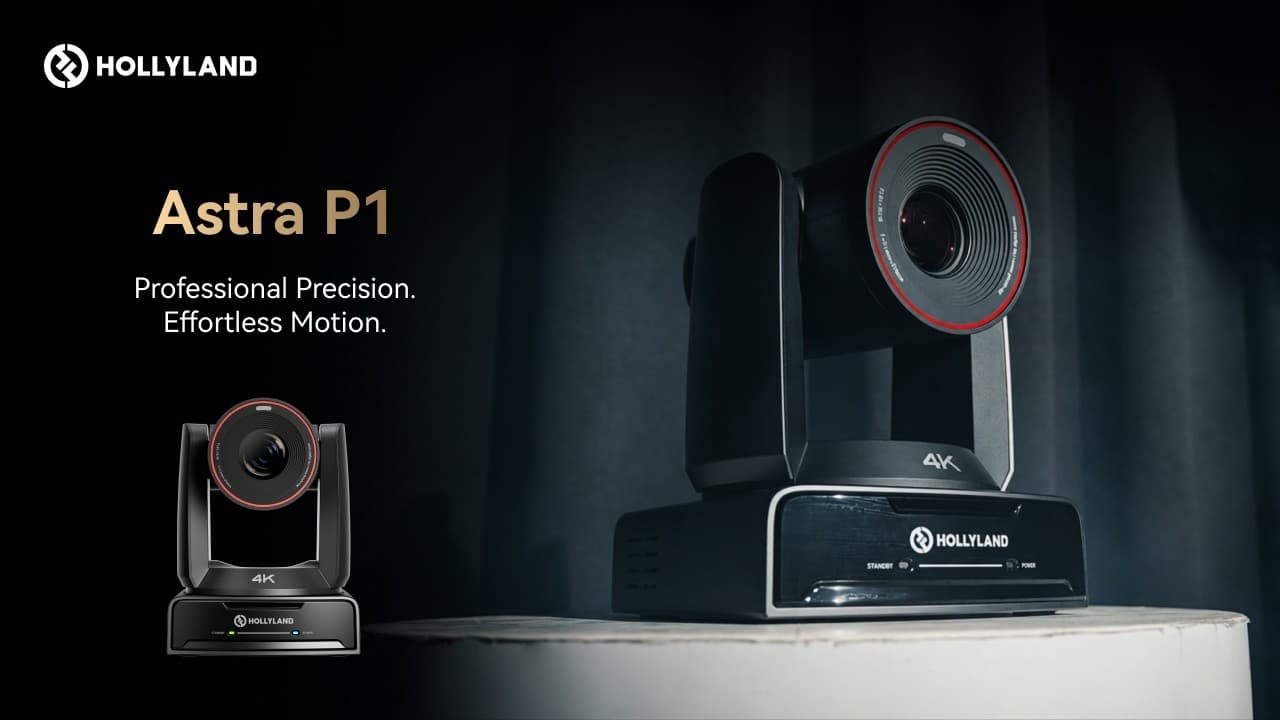
Hollyland has unveiled the Astra P1, a new UHD 4K60 PTZ camera featuring 30x optical zoom, AI auto-tracking, and NDI|HX3 support. Designed for professional live events, the camera offers diverse I/O interfaces including HDMI and 3G-SDI, and supports simultaneous output via multiple channels. It is now available for pre-order at $1,999 USD.
The Astra P1 marks Hollyland's shift toward high-end PTZ automation, addressing the labor shortage in professional live production. By combining deep 30x optical zoom with AI-based 'Face Detection AE,' the camera solves a critical pain point: maintainable exposure for moving subjects in large, unevenly lit venues like houses of worship and auditoriums. Within the broader ecosystem, this launch intensifies competition in the sub-$2,500 4K PTZ market, pressuring established players like Canon and Panasonic to standardize features like NDI|HX3 and onboard AI tracking that were once premium upgrades. Watch for industry adoption of human-posture-based logic to determine if these systems can truly replace manual camera operators in complex, crowded environments.
The launch of the Astra P1 aligns with a broader industry transition toward AI-enhanced PTZ systems. Per statsmarketresearch.com (May 2026), the global AI auto-tracking PTZ camera market was valued at $2.24 billion in 2025 and is projected to reach $5.03 billion by 2034. This growth is largely driven by corporate video conferencing and education sectors, where 4K resolution models currently command a 68% market share. Manufacturers are increasingly prioritizing edge-AI processing to achieve the sub-200ms tracking latency required for professional broadcast standards.
Recent competitive moves underscore the move toward software-defined production. Per joelwsmith.com (January 2026), Canon updated its CR-N lineup in late 2025 with the CR-N350 and CR-N400 models to standardize 4K60 capability and built-in auto-tracking. Meanwhile, specialized IP-first brands like BirdDog have focused on native NDI integration to compete with the 1-inch sensor dominance of Sony’s BRC-X400 series. The Astra P1’s inclusion of an NDI|HX3 license follows this trend of simplifying complex IP workflows for production teams with limited technical staff.
However, the reliance on high-efficiency codecs faces looming regulatory shifts. Per Streaming Media (March 2026), the Via Licensing Alliance restructured H.264/AVC and HEVC fee models, moving from a flat $100,000 cap to a tiered system reaching $4.5 million. This change has prompted hardware manufacturers like Dell and HP to disable HEVC by default in early 2026, creating potential friction for IP-based streaming technologies like NDI|HX3 that rely on these standards for 4K delivery over narrow-bandwidth networks.
Add StreamingMeme as a preferred source on Google to see more of our streaming news at the top of your Search results.
Add as preferred source