

Google Vids integrates Gemini Omni for personal AI-avatar creation
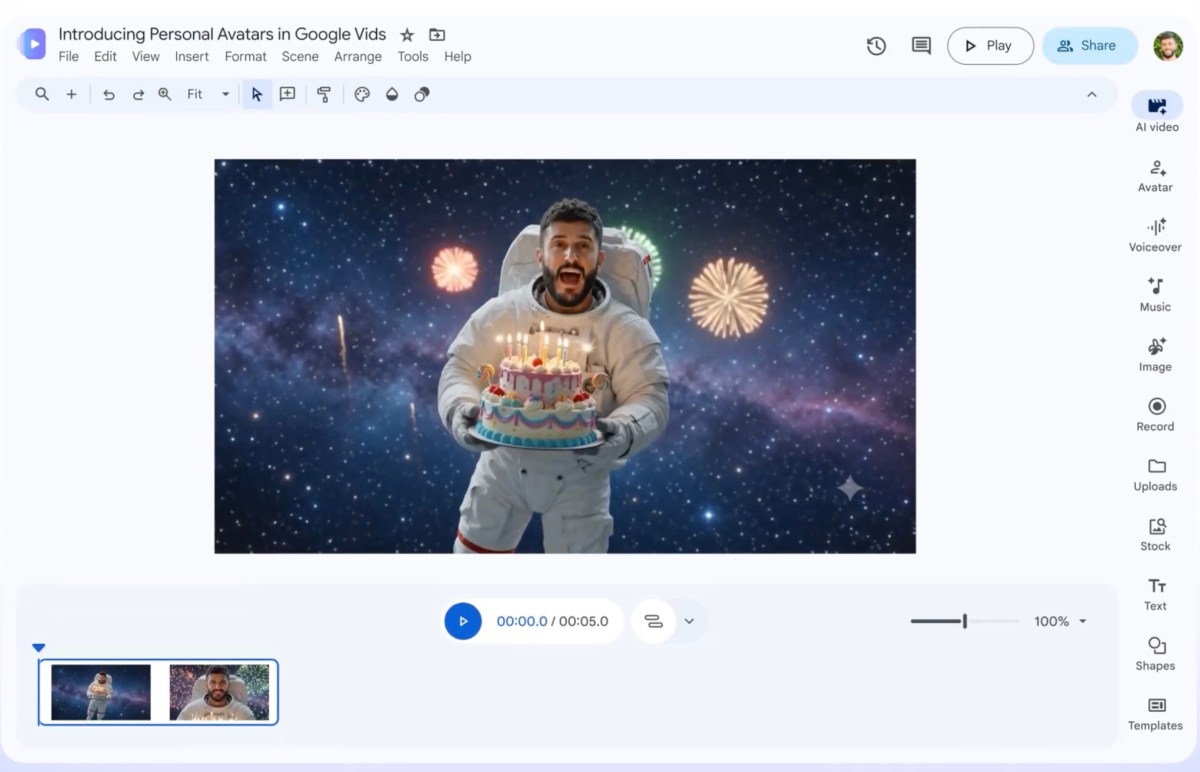
Google has updated its Vids platform, integrating Gemini Omni and personal AI avatars to enable user-generated video creation from text prompts and recordings. The update includes features for conversational editing and invisible watermarking via SynthID, positioning the enterprise tool against specialized AI video competitors.
Key Takeaways
- Gemini Omni integration allows multimodal inputs including text, images, and audio to generate and edit high-quality video clips.
- Personal avatars are restricted to account holders aged 18+ and are linked to their specific Google account likeness for security.
- Conversational editing features permit step-by-step video refinements like background swapping and lighting fixes through natural language prompts.
- Invisible watermarking via SynthID is now standard for all Vids output to prevent unauthorized deepfakes and misuse.
Why It Matters
Google is positioning Vids as a direct competitor to established AI video startups like HeyGen and Synthesia by embedding production-grade features into Google Workspace. This move signals a shift where generative video is treated as a core productivity utility rather than a specialized marketing asset. By anchoring avatar creation to verified Google accounts, the company addresses the deepfake and trust issues that disrupted earlier consumer efforts like OpenAI’s Sora. For the streaming industry, this lowers the barrier for localized training and corporate communication, potentially displacing traditional third-party production workflows. Watch for enterprise adoption rates within the Fortune 100 to see if Workspace integration outweighs specialized feature sets.
Additional Context
The launch of personal avatars in Google Vids follows a volatile period for the AI video sector. Per TechCrunch, OpenAI officially shuttered its Sora app in April 2026 after a sharp 66% drop in user interest and mounting concerns over deepfake moderation. While Sora initially hit #1 on the App Store in late 2025, it struggled with high inference costs—estimated at nearly $1 million per day—and a lack of sustainable enterprise focus. In contrast, Google is embedding these capabilities within its established B2B ecosystem, which recently surpassed 900 million Gemini users per Mashable in May 2026. The broader AI video market remains highly lucrative despite consumer-side setbacks. Per Gartner and HeyGen’s June 2026 reporting, the AI video generator market is projected to grow by 30% annually through 2026, driven by a 70% reduction in production costs compared to traditional live shoots. Specialized competitors are seeing massive momentum; HeyGen recently reached $200 million in annual recurring revenue in June 2026, doubling its size in just eight months. Google’s strategy mirrors this 'identity-first' trend, where 85% of the Fortune 100 now use AI avatars for internal training and sales enablement. Institutional competition is also intensifying. Per Reuters and LA Times reports in early 2026, Microsoft and Bytedance have both accelerated their own video 'world models'—Gemma 4 and Seedance 2.0 respectively—to capture the shift from simple assistants to proactive generative agents. Google’s reliance on its SynthID watermarking technology is a key differentiator in this landscape, providing a standard for content verification that large-scale enterprises require for regulatory compliance.
Read full article at techcrunch.com
Get this in your inbox → Subscribe
Enjoy our coverage?
Add StreamingMeme as a preferred source on Google to see more of our streaming news at the top of your Search results.
Add as preferred source