

Google DeepMind’s Gemma 4 debuts with 37.5% memory reduction in KV cache
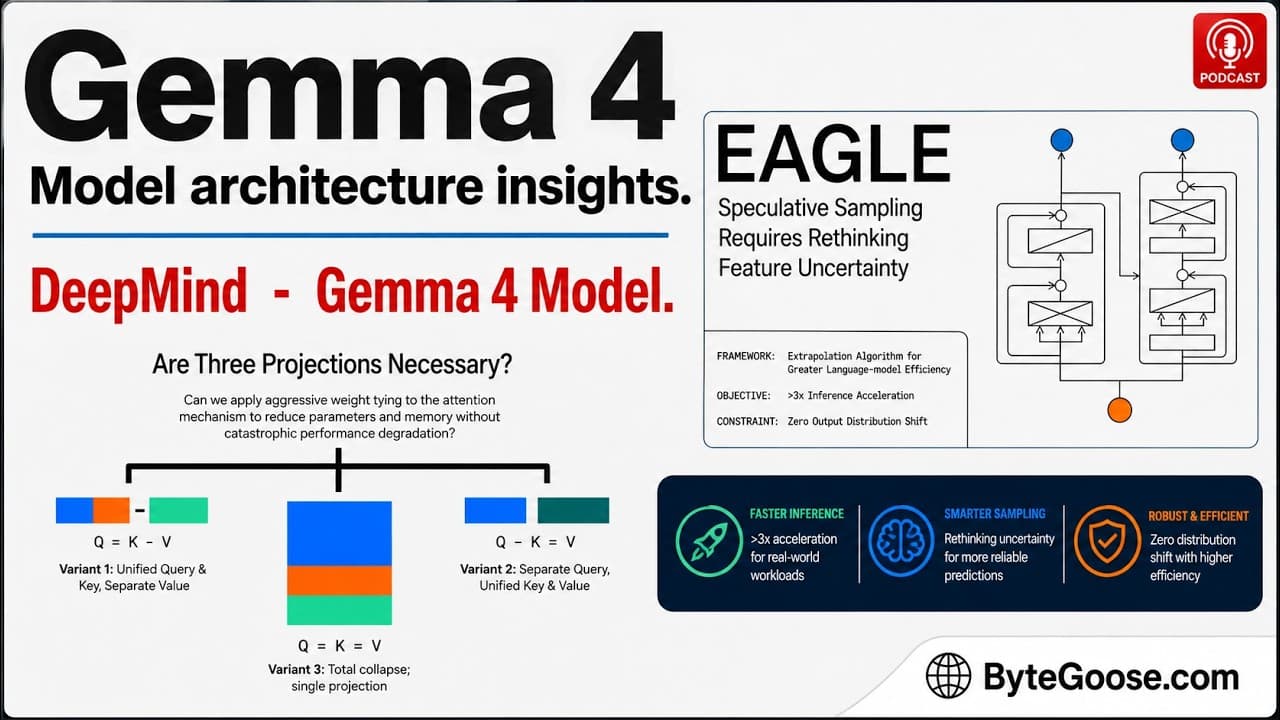
Google DeepMind has released the Gemma 4 model family, introducing architecture optimizations like shared key-value caching and encoder-free designs to improve inference efficiency on consumer hardware. These technical advancements allow for lower memory overhead in multimodal processing, enabling frontier-level reasoning on edge devices.
Key Takeaways
- Shared KV caching reduces global attention memory footprint by up to 37.5% through weight-tying.
- The 12B variant utilizes a unified, encoder-free architecture that projects image and audio data directly into the LLM embedding space.
- Integrated 'Thinking' mode allows models to generate internal logic chains, aiming for significant gains in mathematical and temporal reasoning.
- Scalable deployments range from a 2.3 billion parameter edge model to a 31 billion parameter dense flagship, including a 26 billion parameter Mixture-of-Experts (MoE) version.
Why It Matters
Gemma 4 shifts the B2B streaming and AI landscape by lowering the hardware barrier for real-time multimodal processing, crucial for on-device metadata tagging and intelligent content discovery. By collapsing separate encoders into a unified transformer, DeepMind reduces the 'latency tax' typically associated with video and audio analysis. As enterprises increasingly shift toward local, cost-sensitive agentic workflows, this architecture provides a blueprint for deploying high-reasoning subsystems directly on subscriber-side mobile or desktop hardware. Watch for whether rival open-weights architectures adopt similar weight-tying projections to compete for edge-device dominance.
Additional Context
The Gemma 4 release in April 2026 marked a pivotal strategic transition for Google DeepMind, most notably moving the entire model family to the Apache 2.0 license. Per Medium and Towards AI (April 2026), this shift addressed a primary enterprise friction point, as previous versions utilized a custom license that restricted commercial flexibility. The 31B dense model subsequently reached the #3 position on the Arena AI open-weights leaderboard with a 1452 Elo rating, outperforming several larger competitors on logic-heavy benchmarks. Benchmark data also showed a 4x jump in AIME 2026 math scores compared to Gemma 3, rising from 20.8% to 89.2%.
Competitively, Gemma 4 enters a market increasingly defined by efficient, small language models (SLMs). According to Forbes (July 2026), serving a 7B parameter SLM is now estimated to be 10x to 30x cheaper than running large frontier models, prompting a 75% reduction in GPU and energy costs for active deployments. Simultaneously, Chinese labs including Alibaba and Zhipu AI have launched rival open systems like Qwen 3.5 and GLM-5. While Gemma 4 leads in mathematical logic, analysts at Layer3 Labs (July 2026) noted that Qwen 3.5 maintains an edge in real-time streaming speech and structured JSON output, suggesting the 'intelligence-per-parameter' race remains fragmented across specific functional domains.
Read full article at youtube.com
Enjoy our coverage?
Add StreamingMeme as a preferred source on Google to see more of our streaming news at the top of your Search results.
Add as preferred source