

Global AI patent grants top 100,000 as agentic AI filings surge
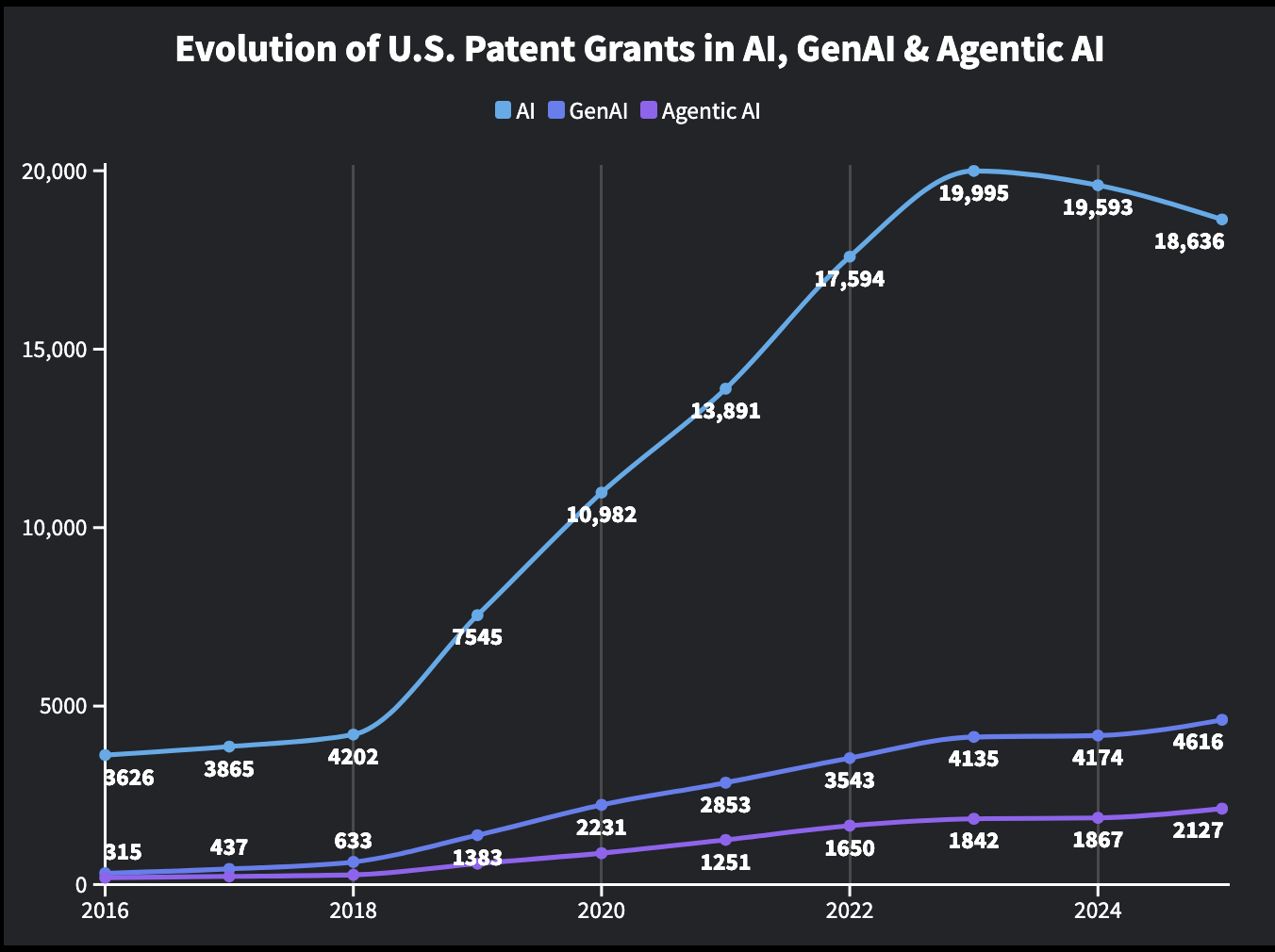
A report from IFI CLAIMS Patent Services details a record 107,279 global AI patent grants in 2025, highlighting a dramatic increase in patent activity for generative and agentic AI. While major technology firms like Samsung, Google, and Nvidia dominate the overall filing landscape, the report notes that some AI developers are increasingly opting for trade secrets to protect their IP.
Key Takeaways
- Worldwide AI patent grants surpassed 100,000 for the first time in 2025, led by Samsung with 2,162 applications.
- Agentic AI patent activity rose to 15% of the total AI domain, with applications growing 59% in the last year.
- Nvidia led the agentic AI subcategory with 225 worldwide applications, followed by Microsoft and Google.
- Pure-play AI developers like OpenAI and Anthropic filed significantly fewer patents than legacy tech giants, while DeepSeek and xAI held zero filings.
- U.S. AI patent grants fell 7% overall, though generative AI and agentic AI categories grew 11% and 14%, respectively.
Why It Matters
The shift toward agentic AI patents signals a transition from passive generative tools to autonomous systems capable of executing complex tasks. For the streaming industry, this suggests an upcoming wave of automated production and personalized content delivery architectures. However, the disparity in filing volume between infrastructure giants like Samsung and model developers like OpenAI highlights a growing strategic divide. Many innovators are prioritizing trade secrets to avoid the public disclosures required by the patent system, especially as legal eligibility for AI inventions remains contested in the U.S. Watch for how this data-security-first approach impacts interoperability and cross-platform licensing in the streaming tech stack.
Additional Context
The surge in AI patent activity is occurring against a backdrop of tightening regulatory and administrative shifts. Following the January 2025 executive order 'Removing Barriers to American Leadership in Artificial Intelligence,' the U.S. Patent and Trademark Office (USPTO) issued revised guidance in late 2025. Per official USPTO filings from November 2025, the office rescinded previous inventorship standards to clarify that AI cannot be named as an inventor, only as a tool used by natural persons. This correction refocused the patentability of AI on traditional human conception, adding pressure on firms to document human contribution in automated workflows. Globally, the landscape is increasingly competitive and bifurcated. A July 2026 report from the World Intellectual Property Organization (WIPO) noted that while U.S. and Japanese filings are accelerating, China currently dominates the generative AI patent space with six times the volume of the United States. This volume gap is particularly pronounced in large language models (LLMs), which have overtaken generative adversarial networks (GANs) as the primary focus of corporate IP portfolios. WIPO research indicates that more than 56,000 generative AI patent families were published during 2024 and 2025 alone, exceeding the total volume produced in the entire previous decade. Strategically, the 'trade secret vs. patent' debate has moved into the courtroom. In July 2026, Apple filed suit against OpenAI in the Northern District of California, alleging misappropriation of trade secrets related to consumer hardware IP. Legal analysts told Managing IP that month that as foundational entities like OpenAI move from software into physical devices—including rumors of 2025 hardware plans—trade secret litigation will likely eclipse traditional patent disputes. This is driven in part by high-profile vulnerabilities; for instance, a March 2026 error at Anthropic exposed 500,000 lines of source code for its coding agent, underscoring the fragility of secrecy-based IP protection.
Read full article at ipwatchdog.com
Get this in your inbox → Subscribe
Enjoy our coverage?
Add StreamingMeme as a preferred source on Google to see more of our streaming news at the top of your Search results.
Add as preferred source