
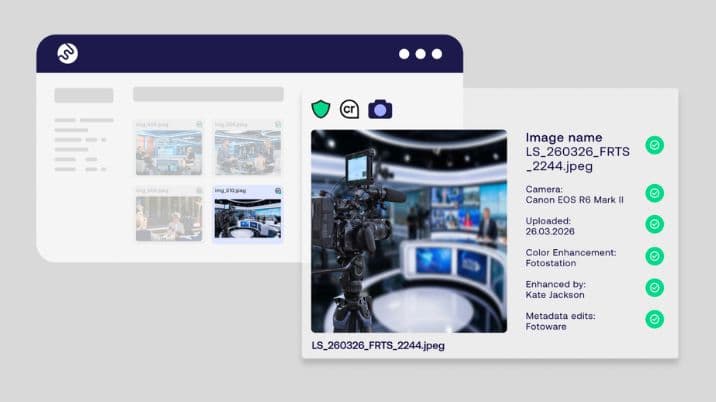
Fotoware has integrated C2PA provenance standards into its Digital Asset Management platform to track content history from capture to publication. The implementation aims to help publishers verify AI involvement and comply with emerging regulations like the EU AI Act.
The integration of C2PA standards directly into DAM workflows shifts provenance from a manual check to a default system requirement. For streaming and digital media organizations, this provides a technical framework to meet transparency mandates under the EU AI Act, which requires clear marking of AI-modified content. By embedding these credentials into the file history, Fotoware reduces the risk of misinformation and simplifies the audit trail for high-volume publishing environments. As manipulated media becomes more sophisticated, this infrastructure establishes a baseline for trust in digital supply chains. Watch for whether other DAM vendors adopt similar native inspection tools or remain dependent on external verification services.
The Coalition for Content Provenance and Authenticity has rapidly expanded its membership and technical specifications since its founding by Adobe, Microsoft, and the BBC in 2021. In early 2025, Reuters announced it would embed C2PA content credentials into all images distributed through its wire service, making it one of the first major news agencies to apply provenance metadata at the point of capture and distribution. That move signaled to downstream publishers and DAM vendors that provenance data would need to survive the full editorial pipeline, not just exist at ingestion. Fotoware's implementation directly responds to that upstream shift by ensuring credentials persist through cropping, resizing, and format conversion within its platform.
On the regulatory front, the EU AI Act's transparency obligations for AI-generated and AI-modified content entered into force in August 2024, with full application of the relevant provisions expected by August 2026. The European Commission published implementing guidelines in March 2025 specifying that machine-readable provenance metadata is a recommended method for meeting Article 50 disclosure requirements. This regulatory timeline creates urgency for media technology vendors to ship compliant tooling before the enforcement window closes. Fotoware's product manager Janniche Moe has framed the integration as a compliance-ready workflow rather than an optional add-on, positioning the company ahead of DAM competitors that still rely on third-party verification plugins.
From a technical standpoint, C2PA Content Credentials 2.3 introduced in late 2024 added support for video containers and streaming manifests, extending provenance beyond still images into motion content. Adobe released an open-source C2PA SDK in January 2025 that enables developers to read and write content credentials in JPEG, PNG, MP4, and WebP formats. That SDK lowers the barrier for DAM and MAM vendors to integrate provenance natively, which is precisely the approach Fotoware has taken. Meanwhile, the Content Authenticity Initiative reported in June 2025 that over 4,000 organizations had adopted its content credentials technology, up from roughly 1,000 a year earlier, indicating that the ecosystem Fotoware is building into is scaling quickly. For streaming platforms and broadcasters managing large video libraries, the convergence of C2PA standards and EU AI Act Article 50 makes native DAM-level provenance a near-term infrastructure requirement rather than a provenance records future consideration.
Fotoware has integrated end-to-end C2PA provenance support into its Digital Asset Management platform. This update tracks asset history from capture to publication, preserving metadata through edits and crops. It helps media organizations verify AI involvement and meet transparency mandates under the EU AI Act by automating the audit trail for digital content.
It tracks asset history from capture to distribution, preserving metadata through edits and crops to verify the origin of digital assets and identify AI-generated components.
The EU AI Act requires clear marking of AI-modified content. Machine-readable provenance metadata is a recommended method for meeting these transparency obligations, which become fully applicable by August 2026.
It shifts provenance from a manual check to a default system requirement, ensuring that content credentials persist through cropping, resizing, and format conversion within the platform.
The development was informed by a Reuters proof of concept that addressed the need for verifiable image origins throughout the editorial pipeline.
Add StreamingMeme as a preferred source on Google to see more of our streaming news at the top of your Search results.
Add as preferred source