

Enterprises prioritize real-time captioning to boost engagement and ROI for global events
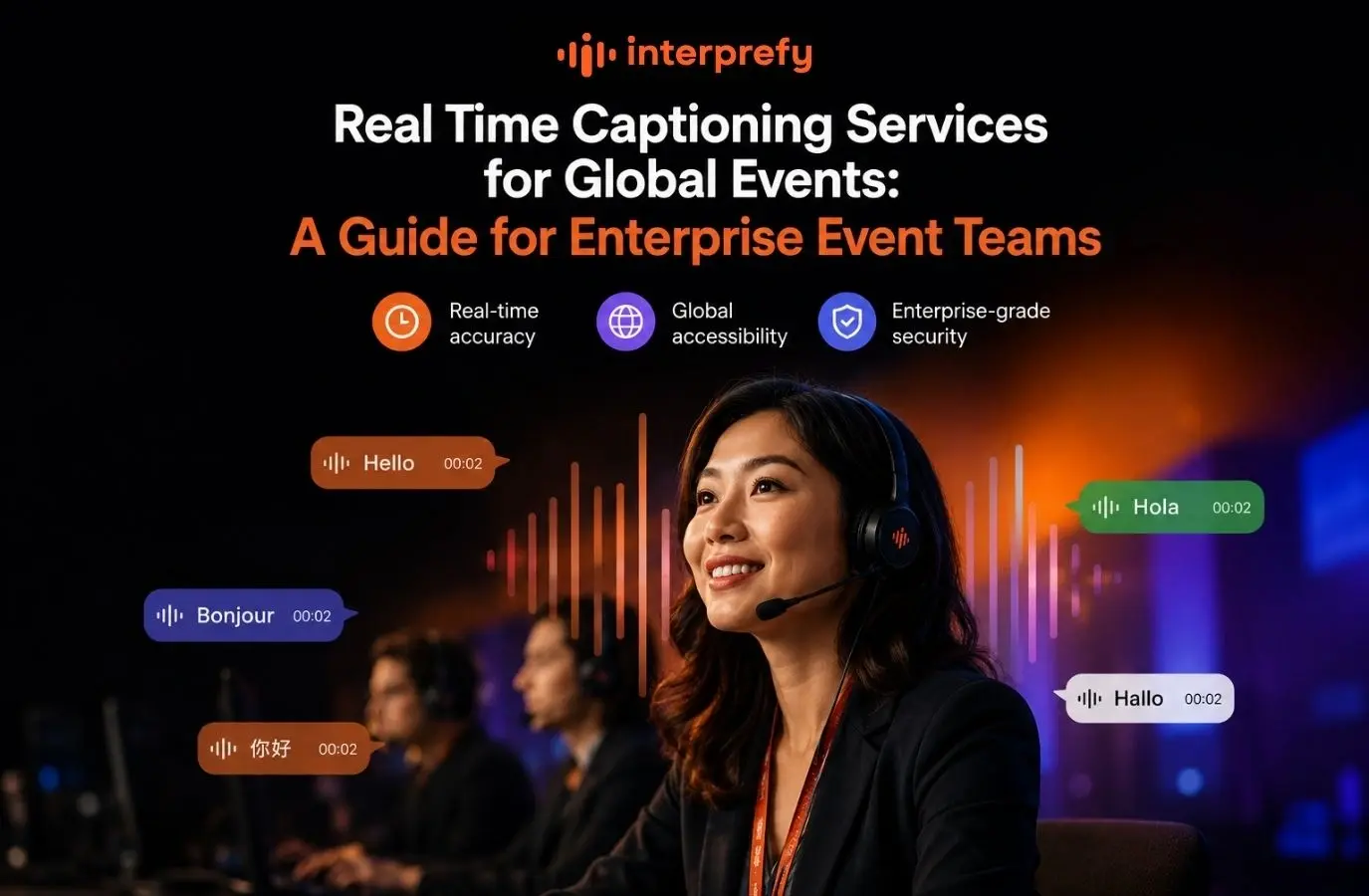
Interprefy published a guide on real-time captioning services for global enterprise events, detailing how AI and human-powered options enhance accessibility and comprehension for diverse audiences. The article explains the technology behind real-time captions, including audio capture, speech recognition, text refinement, and translation, as well as crucial factors for event teams when choosing a captioning partner. It highlights the growing importance of multilingual and hybrid captioning for various event types, from conferences to internal meetings.
Key Takeaways
- 74% of participants believe captions improve their experience, while 42% use them specifically to help maintain concentration.
- Nearly half of event organizers in APAC (46%) and the Middle East (45%) remain unfamiliar with live captioning technology despite rising demand.
- Real-time captioning workflows now use native audio capture and speech recognition engines to deliver text with 90-98% accuracy for clear audio.
- 55% of Middle East organizers cite AI accuracy as a top concern, underscoring the shift toward hybrid models that combine AI speed with human refinement.
Why It Matters
Real-time captioning has matured from an accessibility requirement for deaf and hard-of-hearing audiences into a critical engagement tool for multilingual and remote participants. For the streaming stack, this necessitates tighter integration between live AV feeds and automated speech recognition (ASR) engines to reduce latency. As global internet traffic remains video-dominant, the ability to deliver accurate, searchable, and translated text in real time is becoming a standard competitive requirement for B2B event platforms. Watch for a rise in specialized ASR deployments for technical industries like medical and legal, where 63% of users recently surveyed by Stagetext demand near-perfect accuracy to maintain trust.
Additional Context
The push for high-quality live captions coincides with a significant expansion in the broader video accessibility market. Per SNS Insider (August 2025), the AI-enhanced video accessibility market is projected to grow from $3.81 billion in 2025 to $21.22 billion by 2035. This growth is driven by tightening international regulations, such as the European Accessibility Act (EAA) which took effect in June 2025, forcing enterprises to standardize inclusive digital experiences. In 2026, the focus has shifted from simple automation to human-in-the-loop workflows to ensure compliance and avoid the 'hallucination' risks often associated with generic AI models.
In the U.S., the upcoming ADA Title II deadlines for state and local government entities are driving a surge in procurement for platforms that integrate transcription, captioning, and audio description within a single workflow. Market leaders like Verbit have responded by partnering with streaming providers like Wowza as of late 2025 to deliver low-latency live captions for large-scale productions. Meanwhile, 3Play Media's May 2025 State of ASR report indicated that while AI models like Whisper X have shown marked improvement in reducing errors, human review remains essential for specialized content, particularly in sports where noise and unscripted speech cause error rates to triple compared to controlled environments.
Usage patterns verify that captions are no longer a niche feature. Recent data from Sonix (January 2026) shows that 70% of Americans now watch video content with subtitles primarily for better comprehension. This mainstream shift is especially pronounced in the corporate sector; per Interprefy (November 2025), organizers identify webinars and internal business meetings as the highest priority for multilingual delivery, with 85% of Middle East business organizers expressing frustration when live translation services are absent from global events.
Read full article at interprefy.com
Enjoy our coverage?
Add StreamingMeme as a preferred source on Google to see more of our streaming news at the top of your Search results.
Add as preferred source