

Decoding Transformer architectures: Choosing between encoder-only, decoder-only, and hybrid models
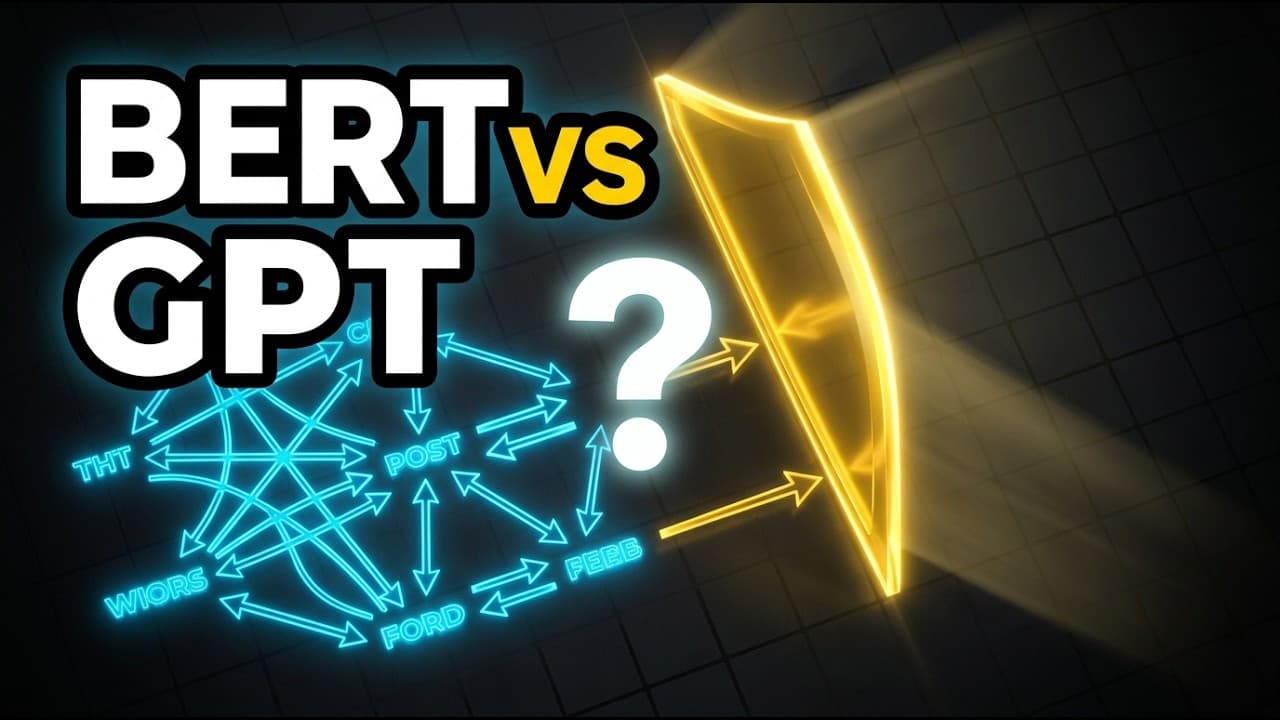
This educational video provides a technical overview of Transformer neural network architectures, distinguishing between encoder-only, decoder-only, and encoder-decoder models. It details the underlying mathematical mechanics, including scaled dot product attention and routing configurations, to help engineers select appropriate designs for natural language processing tasks.
Key Takeaways
- Encoder-only models like BERT utilize unmasked bidirectional visibility, making them optimal for understanding deep context and classification tasks.
- Decoder-only designs such as GPT rely on causal left-to-right attention, prioritizing generative text creation and reasoning over holistic sentence analysis.
- Encoder-decoder architectures (T5, BART) combine bidirectional encoding with causal decoding to excel at sequence-to-sequence tasks like translation and summarization.
- Scaled dot product attention prevents vanishing gradients by scaling query-key products by the square root of the key dimension (D_k) before softmax normalization.
Why It Matters
Understanding these architectural foundations is essential as streaming platforms transition from simple metadata tagging to AI-driven content synthesis. While encoder-only models provide faster, single-pass inference for search and sentiment analysis, generative features require the more computationally expensive autoregressive approach of decoders. As video processing demands increasingly include real-time summarization and translation, selecting the correct routing configuration prevents models from producing nonsensical outputs while optimizing GPU resource allocation. Watch for the industry's shift away from general-purpose decoders toward specialized hybrid models for high-throughput video indexing.
Additional Context
By mid-2026, the streaming and AI sectors have seen a significant convergence in model design. Per LTX.io (July 2026), the Diffusion Transformer (DiT) architecture has largely replaced U-Net backbones for production video generation because it scales more effectively with compute and maintains better temporal consistency. This shift is visible in leading tools like ByteDance’s Seedance 2.0 and Google’s Veo 3.1, which use transformers to process video and audio jointly to eliminate synchronization drift. This architectural maturity is enabling a transition where professional video production pipelines—incorporating text-to-video, native 4K resolution, and synchronized audio—can be executed via a single model call.
Simultaneously, the industry is grappling with the 'quadratic bottleneck' of traditional attention mechanisms. Per Dev.to (April 2026), doubling context windows quadruples compute costs, leading to the rapid adoption of FlashAttention-3 and Rotary Positional Embeddings (RoPE) to support windows exceeding 1 million tokens. While decoder-only models maintain dominance in general-purpose generative AI due to their scaling efficiency, specialized video tasks are moving toward hybrid architectures. For instance, per forasoft.com (August 2025), companies are now integrating multimodal embeddings into search pipelines, allowing one model to index text, image, and video metadata concurrently, which has reduced content operations spend by up to 60%.
Read full article at youtube.com
Enjoy our coverage?
Add StreamingMeme as a preferred source on Google to see more of our streaming news at the top of your Search results.
Add as preferred source