

ContentWise architecture shifts 'brain' from LLMs to recommendation engines
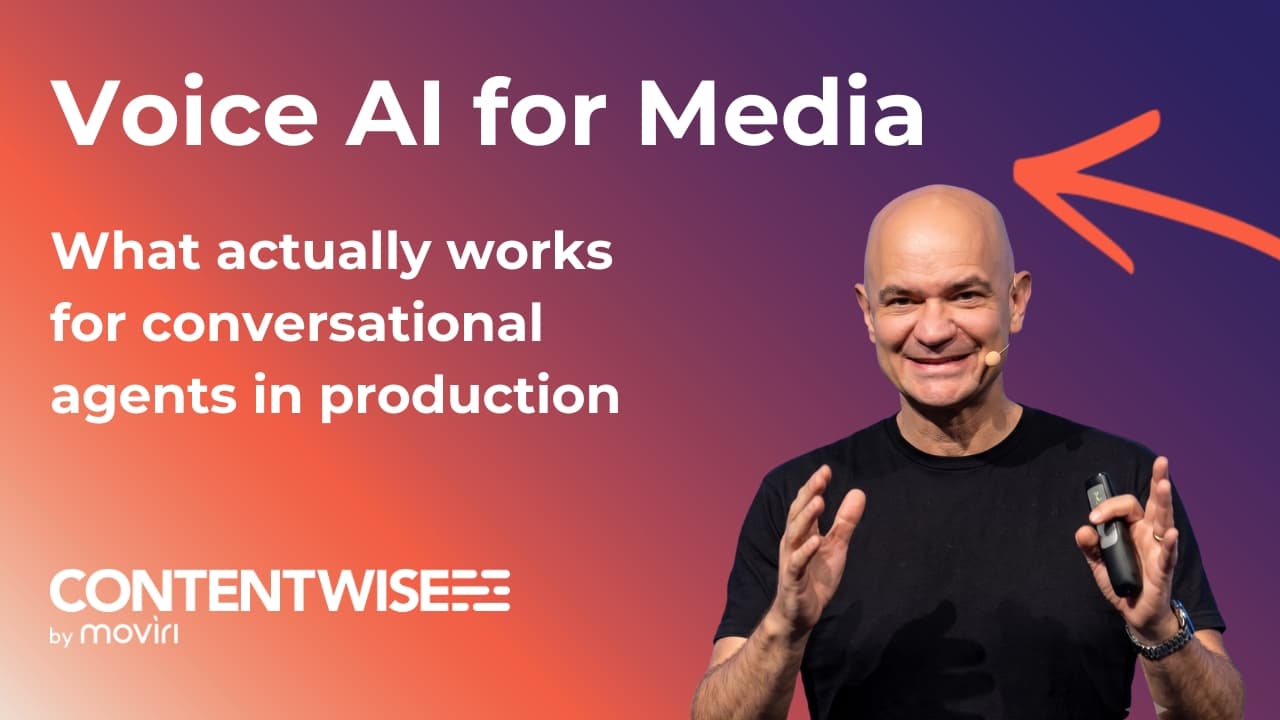
ContentWise demonstrated a voice agent prototype for media and streaming, emphasizing a dedicated recommendation engine (UX Engine) over premium LLMs for personalized, low-latency experiences. The architecture prioritizes speed and cost-efficiency, utilizing smaller, open-weight LLMs for intent translation while relying on the recommendation engine for content ranking and grounding. This approach also keeps business rules separate from the LLM prompt, allowing for flexible editorial changes.
Key Takeaways
- Architecture restricts LLMs to intent translation and narration, leaving content ranking to the recommendation engine
- Open-weight models like Qwen 3.6 deliver 233ms response times, meeting the 250ms natural conversation ceiling
- Small-model implementation costs roughly 500x less than premium reasoning models for 10 million subscriber deployments
- User context blocks of 7,531 characters ground LLM responses in actual viewing history and explicit profile data
- Business rules reside in the UX Engine rather than LLM prompts to allow real-time editorial changes without code deployment
Why It Matters
This shift addresses the critical 'latency-cost trap' in streaming voice interfaces, where premium LLMs provide high reasoning at the expense of natural interaction speeds and sustainable margins. By decoupling intelligence—using LLMs for language and recommendation engines for catalog logic—operators can deploy responsive voice agents that respect licensing windows and editorial priorities without the high inference costs of frontier models. As the industry moves toward agentic discovery, this modular approach prevents vendor lock-in and ensures that discovery remains driven by a platform's first-party data rather than a third-party model's training data. Keep an eye on the adoption of 'small' 7B-class models for intent routing in smart TVs and set-top boxes through late 2026.
Additional Context
The move to optimize voice latency aligns with broader efforts across the streaming stack to integrate 'agentic' capabilities into content discovery. Per ContentWise, the company launched its specialized Agent Engine in July 2025, specifically designed to automate high-value editorial tasks using protocols like Google’s Agent-to-Agent (A2A) and Anthropic’s Model Context Protocol (MCP). This allows marketing teams to set high-level goals—such as promoting trending sports highlights—which the system then decomposes into automated workflows across a multi-agent architecture. This transition from basic 'text-to-speech' search to autonomous discovery agents reflects a massive market shift; Gartner recently projected that 40% of enterprise applications will embed task-specific AI agents by the end of 2026.
Operational costs remain a central hurdle for these deployments. Research from Deloitte in mid-2025 indicated that while human-handled support calls cost between €4 and €8, AI-handled calls fall significantly to approximately €0.15 to €0.40 per minute. However, for streaming operators with tens of millions of users, pure API-based LLM costs for discovery can still aggregate into millions of dollars in monthly overhead. This has led to a surge in the use of specialized, low-latency models. For example, the Cartesia Sonic 3.5 model and Deepgram’s Aura-2 have emerged as key competitors in the 'ultra-low' latency space, with Sonic claiming time-to-first-audio beneath 100ms in clean conditions.
Furthermore, the 250ms threshold highlighted by ContentWise is increasingly cited as the 'gold standard' for breaking the uncanny valley of voice AI. While some consumer-facing platforms like Vapi and Retell AI advertise sub-second latencies, research from Trillet in early 2026 suggests that while 800ms feels 'natural,' the 500ms to 1,200ms window is the realistic target for production-grade systems that must also handle tool-calling and metadata retrieval. As streaming platforms look to support major global events like the 2026 World Cup, the ability to manage thousands of concurrent prompts with profile-grounded accuracy will be the primary differentiator between successful voice deployments and simple 'button-press' voice search.
Read full article at contentwise.com
Enjoy our coverage?
Add StreamingMeme as a preferred source on Google to see more of our streaming news at the top of your Search results.
Add as preferred source