

ByteDance Seed Audio 1.0 launches multimodal audio scene generation for creators
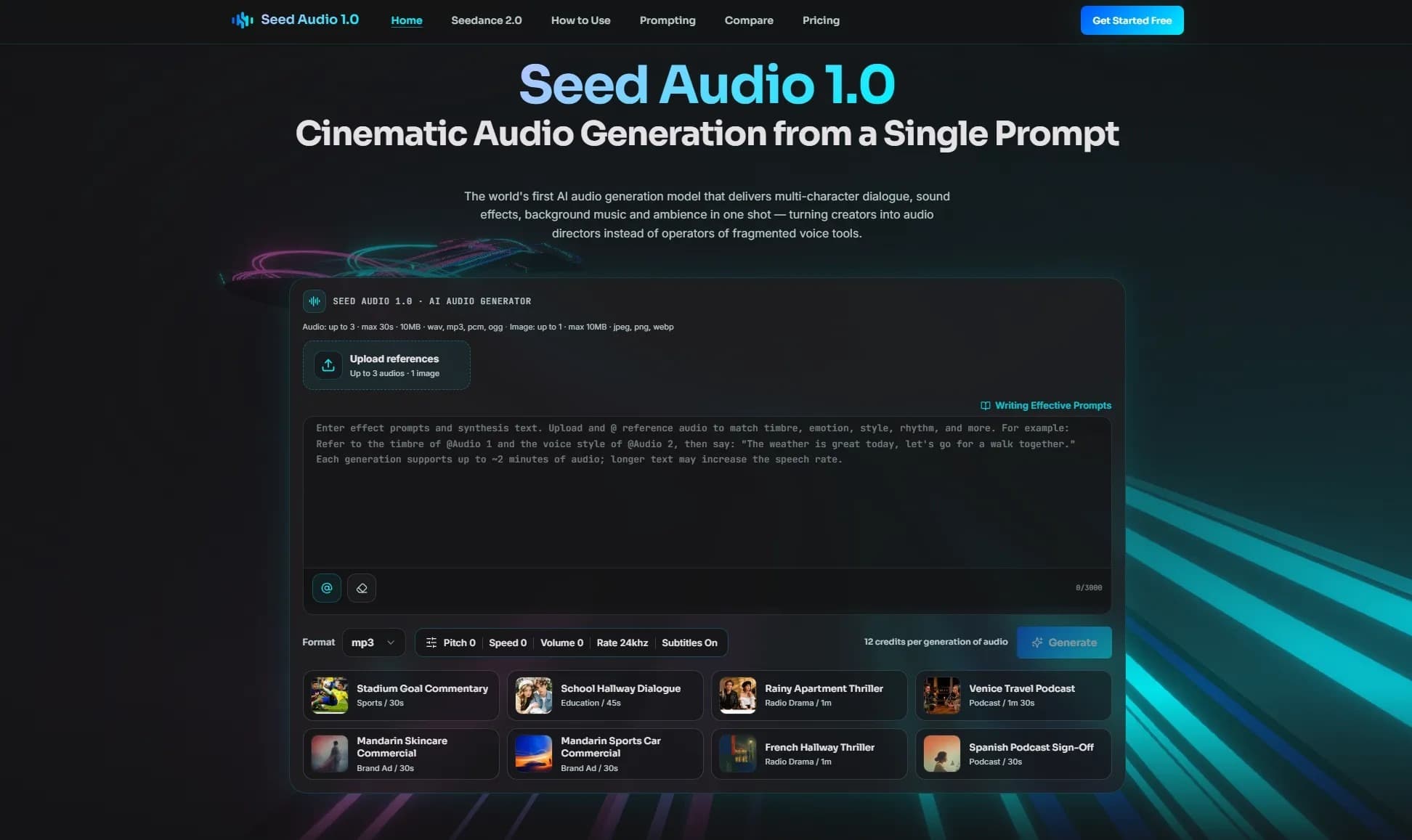
The article discusses the emergence of multimodal AI audio tools like Seed Audio 1.0, which enable creators to generate integrated soundscapes including dialogue, music, and ambient effects from single prompts. This shift aims to streamline production workflows for podcasters, game developers, and localization teams by replacing fragmented audio editing processes with early-stage prototyping.
Key Takeaways
- Seed Audio 1.0 supports generating up to two minutes of continuous audio in a single pass with consistent character timbre.
- The model offers precise dialogue timing control down to 100ms intervals using text or reference audio inputs.
- Multilingual support covers over 20 languages, allowing for natural cross-language voice performance transfer in dubbing workflows.
- Indie game developers can use the tool to create layered environmental sounds, including footsteps and room tone, from text descriptions.
Why It Matters
This release shifts AI audio from isolated text-to-speech tasks to integrated scene orchestration. For streaming platforms and production houses, this reduces the 'audio gap' in AI-generated video and simplifies the localization of global content by maintaining character consistency across languages. As tools like this mature, the industry moves closer to fully automated end-to-end production pipelines where sound design is an early-stage prototype rather than a final, expensive post-production layer. Watch for ByteDance to integrate these capabilities directly into the TikTok or CapCut creation suites to drive broader user adoption.
Additional Context
The launch of Seed Audio 1.0 arrives as major tech players race to expand the scope of generative audio beyond simple voice synthesis. Per Meta, November 2023, the company introduced Audiobox, a research model designed to unify speech and sound effects generation, though its public demo was discontinued in early 2026. Meanwhile, Google DeepMind launched MusicFX DJ in October 2024, utilizing its Lyria model to enable real-time, production-quality 48 kHz stereo music generation. These developments suggest a broader industry pivot toward 'multimodal' audio where music, sound effects, and voice are treated as a singular, cohesive output rather than separate tracks.
In the commercial sector, ElevenLabs has positioned itself as a primary competitor by expanding into AI-driven sound effects. Per ElevenLabs, May 2024, the company released a text-to-sound tool trained on Shutterstock’s licensed audio library, allowing creators to generate royalty-free Foley and ambient sounds. However, the rise of high-fidelity audio generation has triggered significant legal resistance. In June 2024, the RIAA filed lawsuits against AI music startups Suno and Udio on behalf of Universal Music Group, Sony Music, and Warner Records, alleging unauthorized use of copyrighted recordings for model training. Per industry reports from May 2026, while Udio eventually reached a licensing settlement with Universal Music Group for a per-generation royalty of $0.002 to $0.005, Suno continues to contest the claims on fair use grounds.
This landscape of rapid technical expansion and intensifying legal scrutiny defines the current market for tools like Seed Audio. As ByteDance makes the model available through its enterprise-facing Volcano Engine (per ByteDance, July 2026), the focus is shifting toward professional-grade consistency and controllable 'scene-level' generation. This addresses a critical friction point in AI video production, where high-quality visuals from platforms like Luma Dream Machine or Runway Gen-3 often lack native, synchronized audio accompaniment.
Read full article at nerdbot.com
Enjoy our coverage?
Add StreamingMeme as a preferred source on Google to see more of our streaming news at the top of your Search results.
Add as preferred source