

Axelera AI launches Mini PC to eliminate discrete GPUs at edge
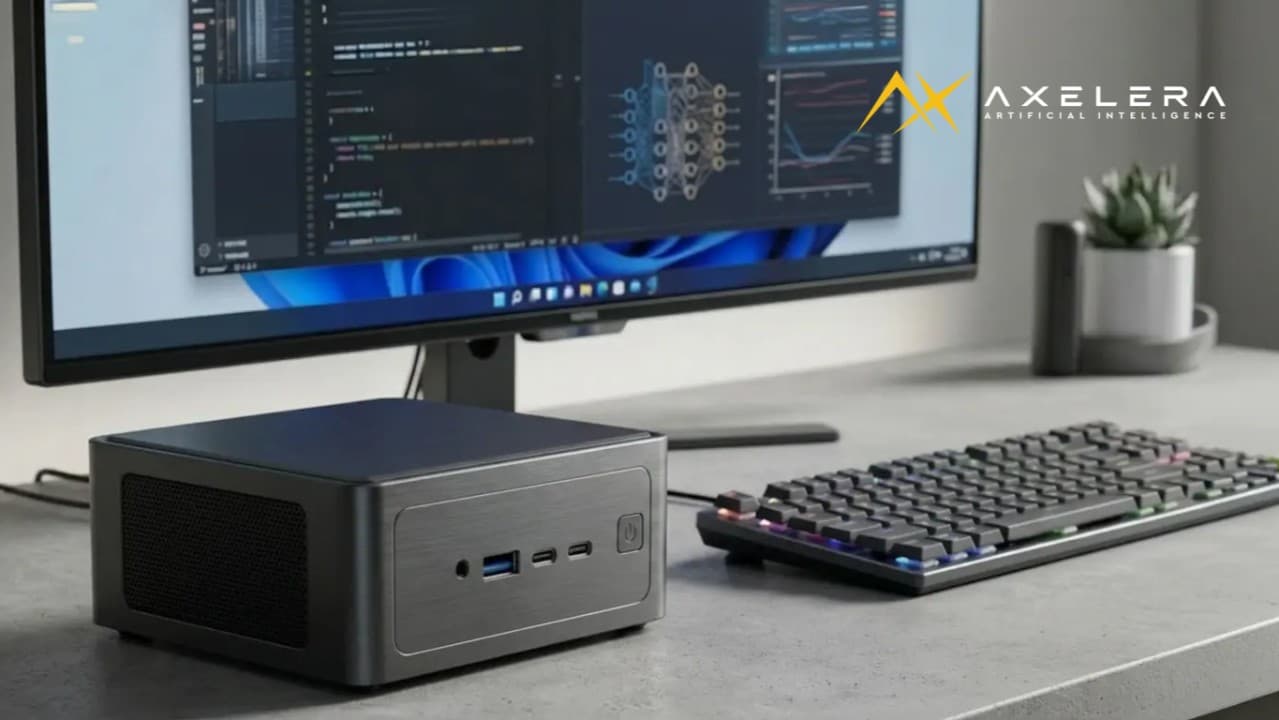
Axelera AI has launched a new Mini PC equipped with its Metis M.2 MAX AI accelerator and an Intel Core Ultra processor. Designed for edge computer vision, the platform supports over 25 simultaneous 1080p video streams for applications like smart city infrastructure and industrial inspection.
Key Takeaways
- Metis M.2 MAX AI accelerator delivers up to 15 TOPS/W with a typical power draw of 3.5W to 11W.
- Hardware configuration features 32GB DDR5 memory and an Intel Core Ultra 125H (Meteor Lake-H) processor.
- Voyager SDK provides a Model Zoo with 100+ pre-trained models for object detection and pose estimation.
- System supports third-party performance verification claiming speeds up to 3x faster than competing edge solutions.
Why It Matters
This launch signals a shift away from expensive, power-heavy GPU architectures for edge video analytics. By offloading sustained AI workloads to the Metis accelerator while the CPU handles system management, operators can scale smart city and industrial inspection deployments within tighter thermal and power budgets. This moves high-density inference from centralized racks to local hardware, reducing cloud latency and bandwidth costs. Watch for increased competition from NVIDIA's Jetson Orin and AMD’s Ryzen AI platforms, which are currently vying for the same production-grade edge footprint.
Additional Context
The release of the Axelera AI Mini PC occurs as the broader edge hardware market is projected to reach $30.74 billion by late 2026, per Mordor Intelligence. This growth is increasingly driven by specialized ASICs and NPUs, which accounted for over 43% of the edge AI hardware market last year, as organizations prioritize energy efficiency over general-purpose GPU flexibility. Per Intento Research in April 2026, on-device AI accelerators like the Metis series are now critical for meeting new data residency regulations in the EU that compel local processing of sensitive surveillance data.
Axelera AI’s expansion is supported by a significant funding tailwind, having secured over $450 million in total equity and grants as of early 2026, per Tracxn reporting. A recent Series C round in February 2026, led by Innovation Industries and featuring BlackRock, has targeted the manufacturing scale of the company’s Europa and Metis platforms. This capital injection is intended to address the fragmentation in the edge AI semiconductor space, where established players like Qualcomm and NXP are also launching on-prem inference engines.
Technically, the shift toward integrated mini PCs reflects a larger industry trend of "physical AI," where vision becomes the primary sensor for autonomous decision-making in retail and logistics. Major competitors are responding with increased density; for example, NVIDIA launched Jetson Thor in late 2025 to target 800 TOPS for humanoid robotics, while AMD’s Ryzen AI 9 HX 370 has become a staple in premium mini PCs for local inference, per reports from Layer3Labs in June 2026. Axelera’s strategy relies on the Voyager SDK to maintain compatibility across its hardware ecosystem, aiming to attract developers moving from cloud-first training environments to power-constrained edge sites.
Read full article at astutegroup.com
Enjoy our coverage?
Add StreamingMeme as a preferred source on Google to see more of our streaming news at the top of your Search results.
Add as preferred source