
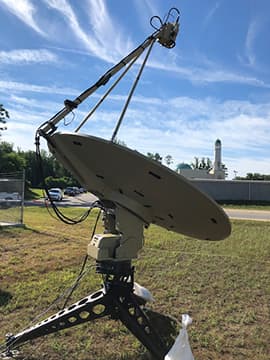
AvL Technologies has announced new 2.4m motorized flyaway antennas, including models 2418, 2460, and 2020PIB. These antennas support C-, X-, Ku-, and Ka-band operations and feature robust environmental tolerances with an embedded, OpenAMIP-compliant antenna control system designed for field deployment.
The release of these 2.4m terminals addresses the professional streaming market's shift toward high-capacity, multi-band resilience for remote live production. By integrating OpenAMIP-compliant controllers and supporting multiple frequency bands on a single platform, AvL lowers the barrier for field technicians to establish high-throughput backhaul without specialized engineering support. In a fragmented market where MEO and GEO orbits are increasingly hybridized, these portable high-gain systems ensure signal stability during critical event coverage where terrestrial fiber or 5G is absent. For the ecosystem, this signals a consolidation of hardware footprints, as one terminal can now service diverse orbital networks. Professionals should watch for subsequent firmware updates enabling LEO tracking on these specific positioners.
The launch of AvL’s 2.4m motorized flyaway family coincides with a broader industry transition toward multi-orbit interoperability as a standard requirement for satellite ground segments. In March 2025, AvL executives indicated at a Washington satellite trade event that customer demand had shifted significantly toward terminals capable of switching effectively between GEO and MEO orbits to maintain connectivity. This trend is mirrored by recent market data from Fortune Business Insights in June 2026, which values the global satellite ground station market at $69.06 billion, with a projected compound annual growth rate (CAGR) of 11.91% through 2034. This growth is largely underpinned by the proliferation of high-throughput satellite (HTS) payloads that necessitate more robust field hardware.
Simultaneously, traditional parabolic architectures are facing competition from electronically steered antennas (ESAs) and flat-panel designs, which Mordor Intelligence reported held 44.1% and 34.2% of the market respectively in early 2026. While ESAs offer low-profile advantages for mobile platforms, manufacturers like AvL continue to refine parabolic systems for the broadcast and defense sectors due to their superior rain-fade resilience and high-gain efficiency in congested frequency bands. Per research from everythingRF in May 2026, C-band and Ku-band remain the workhorse frequencies for satellite newsgathering (SNG) and primary backhaul because of their established performance in harsh atmospheric conditions.
Technological focus has also expanded toward ground segment virtualization and cloud-native control. According to recent reporting from Novaspace in mid-2025, the rise of Ground Station as a Service (GSaaS) models is forcing hardware manufacturers to adopt modem-agnostic, software-defined control systems like the OpenAMIP protocol used in AvL’s new terminals. This shift allows broadcasters to integrate field antennas more directly into cloud-based production workflows, reducing latency and simplifying the logistics of global signal distribution.
Add StreamingMeme as a preferred source on Google to see more of our streaming news at the top of your Search results.
Add as preferred source