
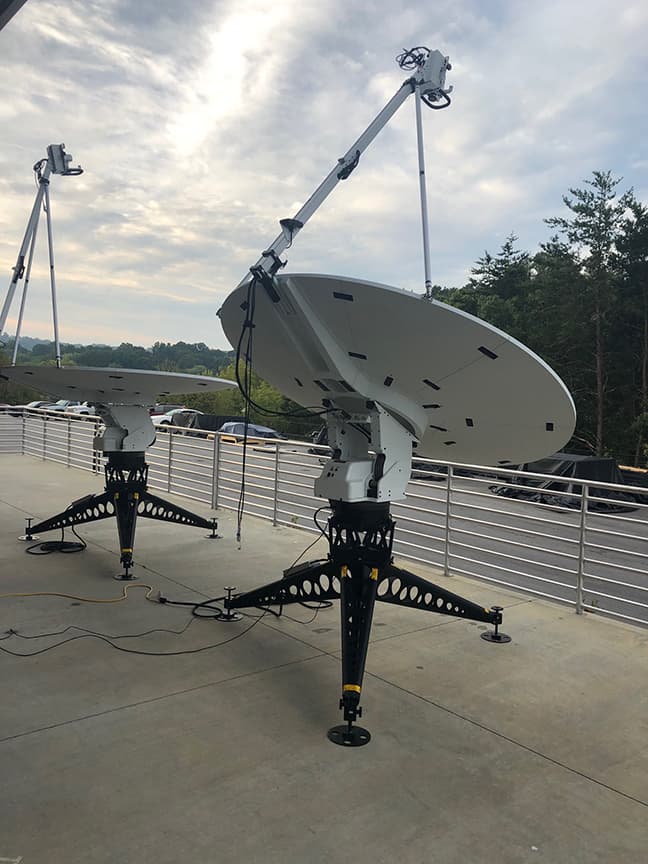
AvL Technologies has launched a new 2.0m motorized flyaway antenna designed for multi-band satellite operations, including Ku-, C-, X-, and Ka-band frequencies. The antenna features a segmented carbon fiber reflector, a two-man lift design, and an embedded control system with auto-acquisition and OpenAMIP compatibility, meeting FCC and Intelsat standards.
The release addresses the industry's need for high-gain, portable ground infrastructure capable of navigating the increasingly complex multi-orbit environment. By integrating multi-band support and OpenAMIP compatibility, the antenna allows broadcasters and service providers to switch between GEO and newer MEO/LEO constellations without swapping entire hardware stacks. As spectral congestion in Ku-band increases, the optional Ka- and X-band feeds provide critical flexibility for high-resolution 4K/UHD contribution from the field. This launch reinforces the trend toward automated, "two-man lift" terminals that reduce operational overhead while maintaining the millimetric pointing accuracy required for high-throughput satellite links. Watch for adoption rates among Tier 1 news broadcasters looking to standardize remote uplink hardware.
The launch of AvL’s 2.0m terminal follows a broader industry shift toward multi-orbit ground hardware as satellite operators consolidate. Per Satellite Today (April 2026), massive industry consolidation—including the SES-Intelsat and Viasat-Inmarsat mergers—has created a market demand for terminals that can seamlessly transition between different orbital planes. This hardware evolution is critical as global satellite capacity is projected to exceed 50Tbps by the end of 2026, with 97% of new capacity coming from Non-Geostationary Satellites (NGSO), according to Euroconsult reporting. In March 2026, competitor Intellian Technologies debuted a rival 2.4m flyaway system specifically targeting tactical and high-growth markets, signaling an intensifying race to provide the smallest, highest-gain apertures for mobile data. Furthermore, the push for "intelligent" ground segments is accelerating; per Informa (March 2026), providers are increasingly embedding AI-driven site-digitalization tools to allow for remote beam steering and automated interference mitigation. AvL’s move to include an embedded, web-based controller reflects this push toward autonomous operations, aimed at reducing the need for specialized satellite engineers on-site during remote broadcasts.
Add StreamingMeme as a preferred source on Google to see more of our streaming news at the top of your Search results.
Add as preferred source