

Autodesk and Wonder Dynamics tackle the $150M filmmaking budget barrier
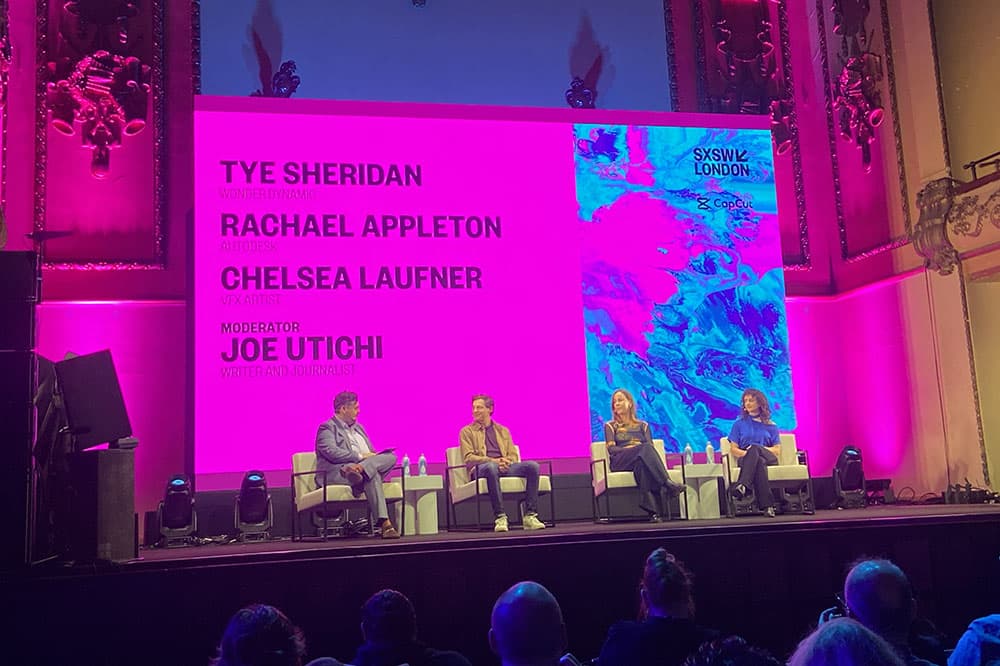
At SXSW London, a panel discussed how AI is transforming visual effects workflows, making advanced tools more accessible to creators and enabling indie filmmakers to produce visually ambitious content on smaller budgets. Panelists highlighted tools like Wonder Dynamics and Autodesk Flow Studio, which use AI to replace actors with CG characters while preserving performance, and discussed AI's role in democratizing filmmaking and streamlining production costs across preproduction, production, and postproduction.
Key Takeaways
- Autodesk Flow Studio, formerly Wonder Dynamics, uses AI to replace live-action actors with CG characters while maintaining performance and camera movement.
- The technology provides artists with automated 3D assets that can be exported to traditional VFX pipelines like Maya or Blender for manual refinement.
- Creators are utilizing image-to-3D generation to build background environments and secondary characters, reducing the need for specialized modeling skills.
- Integrated clean-plate functionality allows for the removal of subjects from footage even with complex, moving camera shots.
Why It Matters
The immediate implication is a sharp reduction in the technical and financial overhead required for high-fidelity VFX, moving character-driven sci-fi from the $100M+ studio bracket into the indie domain. For the broader ecosystem, this shifts competitive pressure onto traditional VFX houses to adopt iterative AI tools or risk being undercut by leaner, 'permissionless' creator-led productions. Watch for the integration of these tools into unified production clouds, which will link on-set performance capture directly to post-production environments by late 2026.
Additional Context
The strategic push to democratize VFX through AI follows Autodesk's May 2024 acquisition of Wonder Dynamics, a move designed to integrate automated 3D character workflows into its broader 'Flow' industry cloud. Per Autodesk and MotionMedia reporting in May 2025, Flow Studio officially launched as part of the Media & Entertainment Collection, featuring a Pro tier for subscribers and a standalone standalone 'Preview' plan. This was followed by a major pricing restructure at SIGGRAPH 2025 in August, where Autodesk introduced a dedicated free tier and slashed the price of its 'Lite' plan by 50% to $10 per month. These moves are aimed squarely at lowering the entry barrier for solo creators and small studios who previously could not afford Hollywood-grade performance capture systems.
Simultaneously, the industry is navigating a cultural secondary effect often termed 'AI slop' by critics and viewers. Per MarTech reporting in April 2026, brands like Coca-Cola have faced public backlash for over-indexing on AI-generated visuals that audiences perceived as lacking human craftsmanship. This sentiment is forcing a market distinction between fully 'generative' AI—which creates content from scratch—and the 'iterative' AI tools discussed at SXSW. The latter focus on automating the 'objective' labor of rotoscoping and rigging, while leaving the 'subjective' creative direction to human artists. According to Technavio and Grand View Research, the AI-in-VFX market is projected to grow specifically in the production segment, reaching nearly $10 billion by 2033 as studios prioritize these efficiency-focused tools to manage shrinking independent film margins.
Read full article at postperspective.com
Enjoy our coverage?
Add StreamingMeme as a preferred source on Google to see more of our streaming news at the top of your Search results.
Add as preferred source